Reviews, news and how-to guides
AI articles and reviews — page 33
Find a review, catch up on the news or learn how to complete a task. Browse by topic or filter the library below.
Not sure where to begin?
Answer three questions and get a focused tool shortlist for your budget and priority.
Use the AI Tool Finder →Choose a pathway
Explore by topic
Owners and lean teams
Work & Operations
Save time on research, meetings, planning, finance, administration, and repeatable operations.
Marketing and fundraising teams
Marketing & Growth
Plan campaigns, improve social publishing, email, analytics, fundraising, and measurable growth.
Writers and publishers
Content & Search
Research, write, optimize, refresh, and distribute useful content with responsible AI workflows.
Creators and communications teams
Video, Audio & Creative
Create, edit, repurpose, and distribute video, voice, podcasts, images, and presentations.
Service and community leaders
Customers & Community
Improve customer support, donor stewardship, volunteer coordination, outreach, and client communication.
Builders and decision makers
Build, Design & Govern
Choose and deploy AI safely across websites, apps, design systems, privacy, security, and governance.
Editor recommended
Start with these essential guides
Selected by the editors to help you get started.

How Small Business Owners Can Save 10+ Hours a Week With AI Automation in 2026
A practical, no-hype guide to automating the repetitive tasks that consume small business owners' most limited resource: time.
A practical, no-hype guide to automating the repetitive tasks that consume small business owners' most limited resource: time. Written for small business owners working 50+ hours a week on operations, marketing, and admin, with a decision framework, step-by-step workflow, measurable outcomes, and clear limitations.
Read guide
How Understaffed Nonprofits Can Build Capacity With AI Tools in 2026
A strategic framework for using AI to multiply a small team's output without burning out the people you have.
A strategic framework for using AI to multiply a small team's output without burning out the people you have. Written for nonprofit executive directors leading teams of fewer than five people, with a decision framework, step-by-step workflow, measurable outcomes, and clear limitations.
Read guide
How to Choose the Right AI Tool for Your Business
Stop chasing every new AI launch. A practical decision framework for evaluating AI tools based on your actual needs, budget, and risk tolerance.
A practical decision framework for evaluating AI tools: define the problem, score contenders, decide build vs. buy, and know when to cancel. No hype, just a repeatable process.
Read guide
Recently published
Latest articles
Vid2Notes Review: Turn Training Videos Into Usable Notes
Review Vid2Notes for illustrated training notes: free upload limits, annual billing, export options and a practical accuracy check before sharing.
Review Vid2Notes for illustrated training notes: free upload limits, annual billing, export options and a practical accuracy check before sharing.
Read guide
Voice AI for Canva Review: Narration Costs and Practical Limits
Review Voice AI for Canva: character allowances, in-app generation and a narration test for presentations, training videos and client campaigns.
Review Voice AI for Canva: character allowances, in-app generation and a narration test for presentations, training videos and client campaigns.
Read guide
LayerBack Review: Turn Diagram Images Into Editable Files
Review LayerBack for editable Visio, PowerPoint and draw.io diagrams, including download credits, privacy limits and a connector-checking trial.
Review LayerBack for editable Visio, PowerPoint and draw.io diagrams, including download credits, privacy limits and a connector-checking trial.
Read guide
The weekly briefing
Make better AI decisions each week.
Get tool recommendations, product and pricing news, and a practical task to try each week.
Browse reviews, news and guides

Meta Launched Muse: What Its Personal AI Agent Can Do—and What It Can Access
Muse can work in the background across connected services, but the consequential story is its permission architecture: a dedicated cloud computer, hidden credentials, a separate Sentinel, and explicit approvals.
Meta's Muse personal agent can browse, use connected apps, and complete approved transactions. Here is how access, credentials, privacy, pricing, and safeguards work.
Read guide
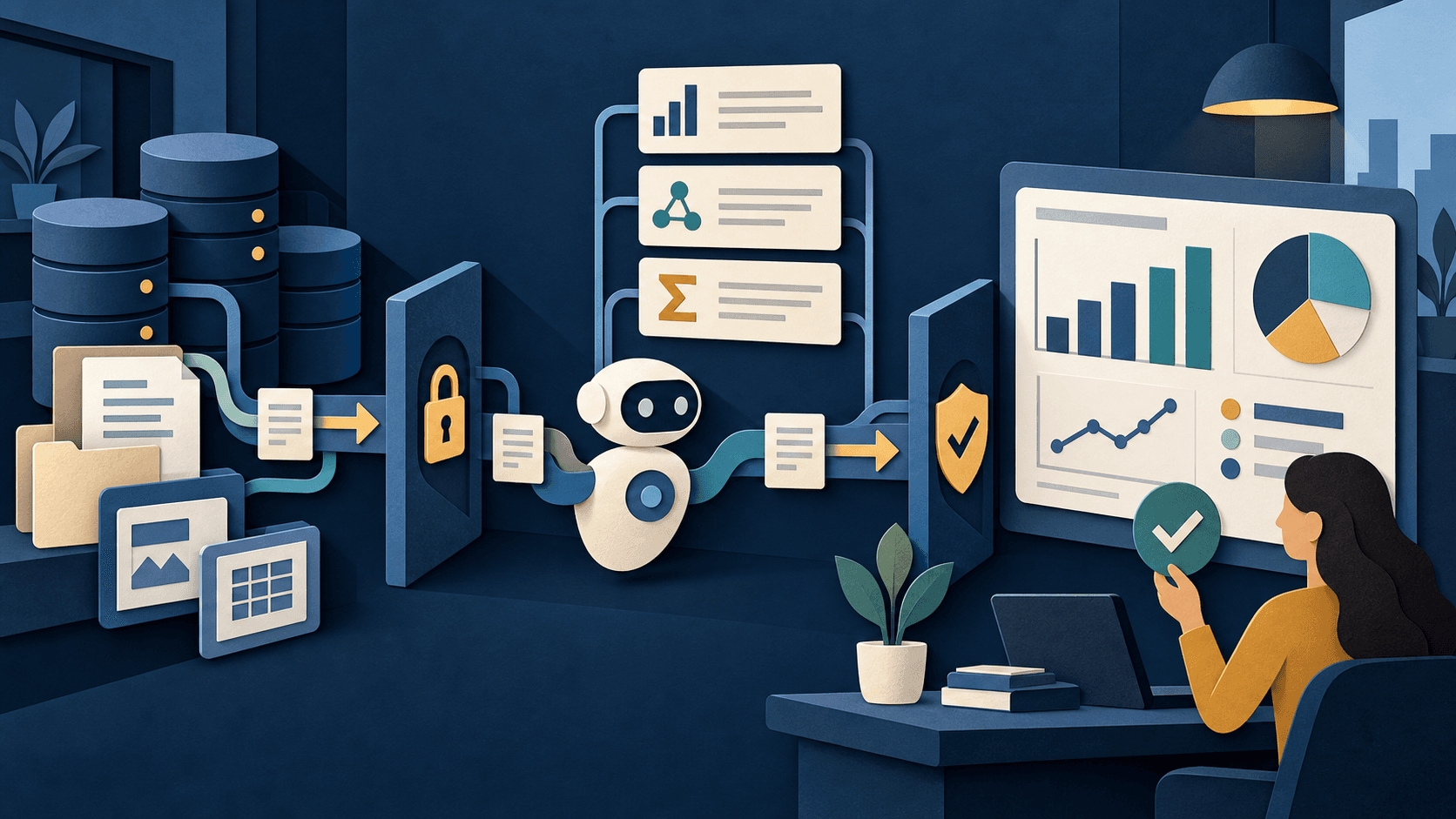
ChatGPT Data Agent Connects Company Data to Dashboards and Actions: What Teams Should Know
The new ChatGPT Work plugin can query governed data sources, use business definitions, build interactive dashboards, and propose actions—but access control does not validate the analysis.
OpenAI's Data agent connects ChatGPT Work to warehouses, documents, semantic layers, and BI tools. Here is what it can do and what administrators must test.
Read guide

OpenAI Launched the Agents API: What Builders Need to Know
The public beta packages the Codex agent harness, durable sessions, subagents, tools, and selectable execution environments—but production ownership still sits with the builder.
OpenAI's new Agents API manages long-running sessions and multi-agent orchestration while letting builders choose where code executes. Here is what the beta changes.
Read guide

ChatGPT for Financial Services: What OpenAI's New Workspace Includes
The tailored workspace combines GPT-6 Astra with hosted premium datasets and finance workflows; eligible institutions must contact sales, and every output still needs expert review.
OpenAI's finance workspace bundles premium datasets, granular citations, templates, and enterprise governance. Here is what institutions can verify before a pilot.
Read guide

GPT-Live-1 Comes to the API: What It Means for Voice Agents
The model can listen and speak simultaneously, delegate deeper work, and support telephony—but the advertised voice-layer rate is not the complete cost of an agent.
GPT-Live-1 is now available to developers at $0.05 per minute for the front-end voice layer. Here is what full-duplex changes and what teams still need to test.
Read guide

GPT-6 Astra vs Claude for Business: Which Should Your Team Choose?
Astra is the higher-control agent bet; Claude remains the more flexible model family for many cost-sensitive knowledge and coding workflows.
GPT-6 Astra is best tested for difficult end-to-end agent work, while Claude offers more model and price choices for everyday business workloads.
Read guide

GPT-6 Astra API Pricing and Migration Guide
Astra costs $10 per million input tokens and $50 per million output tokens before long-context and tool charges.
A practical guide to GPT-6 Astra token pricing, long-context multipliers, required API changes, and a measured production migration.
Read guide

Is GPT-6 Astra Safe for Enterprise Data?
Astra can fit approved enterprise workloads, but only when the product, contract, data class, tools, and permissions are governed together.
GPT-6 Astra supports enterprise data controls, yet its critical cyber capability and agent permissions demand stricter deployment safeguards.
Read guide

EU AI Act Compliance Checklist for Small Businesses
Small businesses need an AI inventory, role classification, staff literacy, and risk-based controls before they need a giant compliance program.
A practical EU AI Act checklist for small businesses using chatbots, hiring tools, content generators, customer automation, and other AI systems.
Read guide

Which AI Tools Fall Under the EU AI Act's High-Risk Rules?
High-risk status usually follows intended use and decision impact—not whether a product is marketed as generative AI.
The EU AI Act treats certain regulated-product safety components and sensitive decision systems as high-risk; ordinary productivity use is usually not enough.
Read guide

Msty vs AnythingLLM for Local AI: Which Is Better?
Msty is the friendlier individual desktop workspace; AnythingLLM is the stronger self-hosted and multi-user foundation.
Choose Msty for a polished personal local-model workspace and AnythingLLM for open-source self-hosting, team access, and extensible agents.
Read guide

Superwhisper vs Wispr Flow: Which Voice Dictation App Is Better?
Superwhisper is stronger for local control; Flow is stronger for a polished cloud-first dictation experience across more platforms.
Superwhisper offers configurable local and cloud processing, while Wispr Flow emphasizes adaptive, internet-connected dictation and team administration.
Read guide

Granola vs Fathom for Meeting Notes: Which Is Better?
Granola is the better AI notepad for attentive synthesis; Fathom is the better recorder for searchable calls, clips, and follow-up automation.
Granola captures device audio without a meeting bot and discards audio; Fathom visibly joins, records, stores, and makes calls searchable.
Read guide

How to Verify AI Research and Citations
A citation is evidence only when the source exists, says what the answer claims, and is strong enough for that claim.
A practical seven-step method for checking AI-generated research, from claim extraction and source identity to quote context and reproducibility.
Read guide

How to Evaluate an AI Tool's Privacy Claims
Translate “private” into a documented data flow, enforceable terms, technical controls, and a deletion test.
A practical privacy due-diligence method for separating AI marketing language from the product, plan, contract, and controls your organization will actually use.
Read guide

OpenAI Launched GPT-6 Astra: What Changed, What It Costs, and Who Should Upgrade
Astra targets long, tool-using assignments—but its premium API price, staged rollout, and critical cyber capability make controlled evaluation more important than a default migration.
GPT-6 Astra is OpenAI's new model for complex, end-to-end work. Here is what changed, what the API costs, where access is rolling out, and how to test it safely.
Read guide

OpenAI’s Navier–Stokes Proof Claim: What Is Verified?
Separate the published claim, formal checking and independent mathematical acceptance.
OpenAI released a Navier–Stokes proof claim and Lean formalization. Here is how to distinguish the artifacts from independent acceptance.
Read guide

Arcade Review 2026: Agent Authorization, Tools, and Pricing
A research-based Arcade review covering features, pricing, privacy, limitations, alternatives, and a practical buyer test.
Arcade is an actions runtime for AI agents that manages OAuth, user tokens, tool execution, and policy enforcement across thousands of agent-oriented tools.
Read guide