The decision
Should you choose ScrapeAtlas?
Test a narrow endpoint with the starter credits and measure usable records before purchasing.
Best for
Developers building public-data workflows; Analysts able to validate source coverage.
Choose something else if
Private-account data access; Buyers expecting a complete social-listening dashboard
Evidence
Verified research · rating withheld
Pricing checked
From $19 · Nov 10, 2026
Free access is available, with limits.
100 starter credits once per account; no credit card required.
DiscoverAI may earn a commission if you sign up or buy through our ScrapeAtlas affiliate link, at no additional cost to you. This relationship does not determine our verdict.
In this guide
Short answer
ScrapeAtlas is worth a small pilot for developers who need public social data inside their own applications. Its attraction is reducing the work of maintaining separate retrieval integrations. Its value depends on whether the exact fields your workflow needs arrive reliably enough to justify the integration and review time.
Affiliate disclosure: DiscoverAI may earn a commission if you sign up or buy through our ScrapeAtlas affiliate link, at no additional cost to you. This relationship does not determine our verdict.
Free buyer comparison checklist
Compare this tool before committing.
Use the buyer checklist to compare two tools on the same tasks, including quality, review time and total cost. Get the weekly top 5 AI tools, one practical workflow and one way to reduce AI spending.
Evidence and review scope
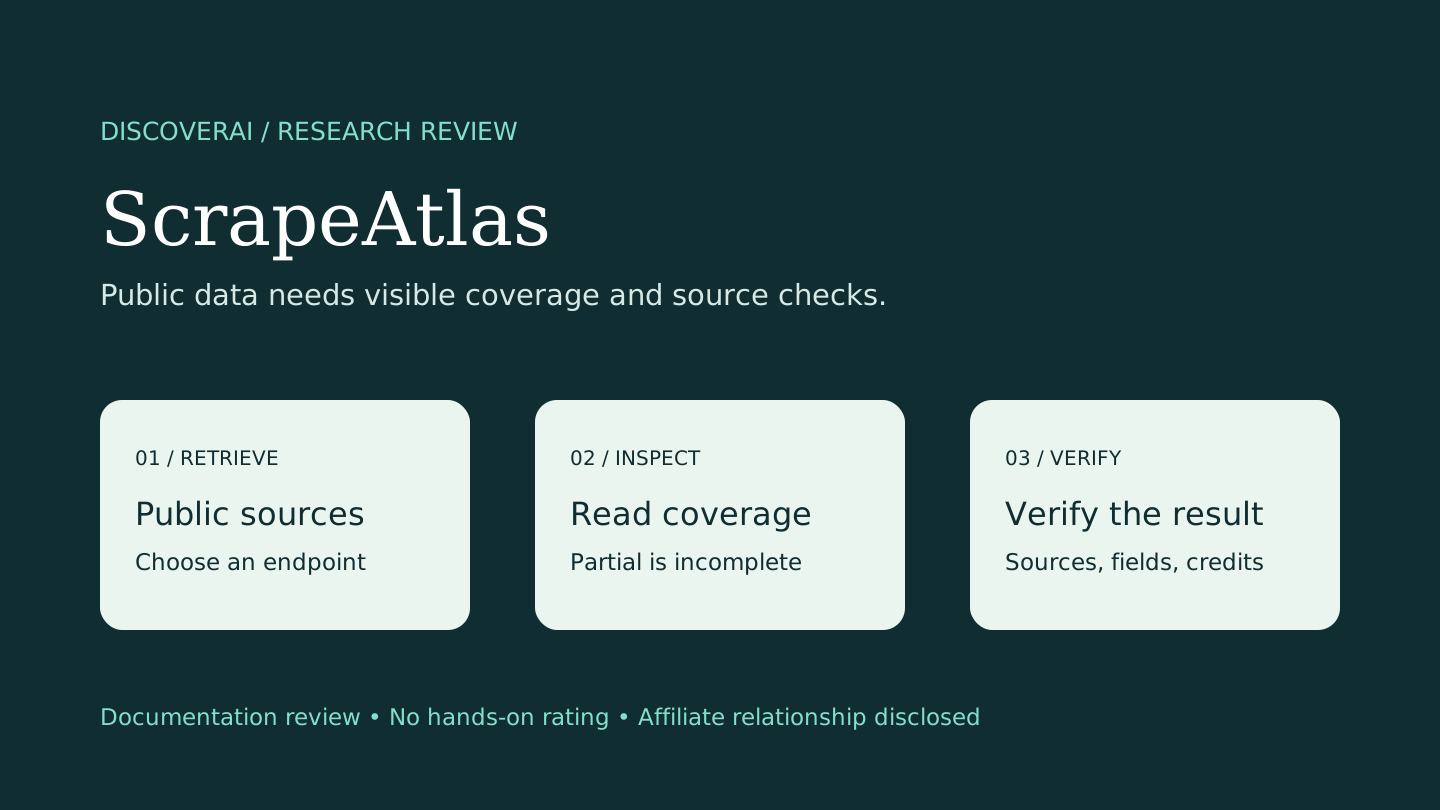
This is an official-documentation review checked November 10, 2026. We did not create an account, call the API, buy credits, contact support or audit data deletion. Ratings are withheld. The evaluation below is a proposed test, not a benchmark we ran. Public examples and customer testimonials are provider material, not our results.
What ScrapeAtlas does
The API documentation describes public profiles, posts, comments, videos, commerce listings and advertising data returned as JSON. Inputs depend on the endpoint: a URL, handle, identifier or search query. Your application remains responsible for storage, scheduling and analysis.
This makes it a potential data layer for creator research or a source-backed assistant. It does not establish that a generated summary is correct. Keep the source URL and retrieval time beside every conclusion so an editor can inspect the evidence. Select the endpoint around the actual research question rather than collecting every available field.
Pricing: credits are not completed research tasks
The official pricing section lists these one-time USD packs:
| Pack | Price | Credits |
|---|---|---|
| Free starter grant | $0 | 100 once per account |
| Starter | $19 | 10,000 |
| Growth | $89 | 50,000 |
| Scale | $249 | 200,000 |
No card is required for the starter grant. Purchased credits do not expire. Successful retrievals generally cost one credit, including partial results and valid empty collections; LinkedIn post search, Quora search and Threads user search are listed at two. Each extra page is another request. Failed requests and internal retries carry no extra credit charge according to the provider.
The practical budgeting question is cost per accepted record. Before buying, record requests, pagination, manual cleanup and downstream model costs for one complete job. A cheap request that cannot support the intended conclusion has little value. Keep a small spending ceiling until that job succeeds repeatedly.
Partial responses need explicit handling
The response guide distinguishes success, partial, failed and challenged outcomes. A partial result can return HTTP 200 with known omissions. Check status and coverage warnings rather than accepting every successful HTTP response as complete. Preserve unknown values as unknown; an absent metric should not silently become zero.
For a research application, show incomplete coverage next to the result. Stop a summary from saying there were no relevant comments when retrieval was incomplete. Rate limits and unavailable sources should produce visible gaps, with bounded retries and a route for manual checking. These are our implementation recommendations, not controls we verified in a deployed integration.
AI agents and MCP: confirm compatibility
The MCP page labels the integration a preview and describes Streamable HTTP with a bearer API key in a custom header. It also contains language saying hosted access is on its way. Meanwhile, the privacy policy describes OAuth assistant connections. Those public descriptions do not establish support for every client today. Ask which authentication path is live for your specific assistant before relying on it.
For an agent pilot, limit the question and approved endpoints. Review the proposed calls before allowing repeated retrieval. Treat returned posts as source material: instructions inside a retrieved post should never control the agent's next action. Keep credentials in the client's secure connection settings rather than prompts.
Privacy and retained searches
The privacy policy says retrieval workers do not maintain a response cache or archive. Application usage records omit target URLs, handles, search text and response content. Dashboard Search social behaves differently: account-linked search text and related metadata can be retained for up to 90 days, and AI providers receive relevant material for suggestions and summaries. These are provider statements, not audited findings.
Decide which interface your team will actually use before assessing data handling. API-only research and an interactive dashboard search have different records. Avoid confidential terms in test queries and inspect the current policy for your workload.
The public data notice limits retrieval to supported public information; it does not provide private inboxes or account-only content. It also explains that public visibility grants no blanket permission to reuse material. Plan how your application handles source changes and deletion requests before retaining results.
Billing and operational boundaries
The terms describe non-refundable delivered digital credits and consumed usage, subject to stated exceptions and applicable rights. They require secure handling of credentials and respect for published limits. Confirm the checkout total and refund terms before a large top-up.
Keep the first purchase small while evaluating fit. A larger balance does not make incomplete data complete or guarantee that a source remains reachable. Agree the endpoint and service expectations with the provider if your product cannot tolerate an outage.
Proposed buyer test
Use a narrow, permitted research task and a small set of public source pages that you can inspect manually. Write down required fields and failure conditions before opening the trial.
- Pick ten representative records, including a sparse page and one recently updated page. Record a manual reference with retrieval time.
- Call only the necessary endpoints. Save request identifiers, status, coverage warnings and credit deductions without recording secrets.
- Compare every required field with the source. Count missing, stale and mismatched values separately from accepted records.
- Test pagination boundaries. Check whether repeated pages create duplicates and whether a partial result is clearly labelled in your application.
- Exercise authentication and unavailable-source handling in a controlled test. Confirm retries stop and the user sees an actionable message.
- If using an assistant, require source links and uncertainty in its summary. Check whether it invents a conclusion when a response is incomplete.
- Measure total spend and review minutes for the completed task. Compare that with a manual baseline before buying a larger pack.
Proceed only when the pilot meets your own coverage and cost requirements. Save the failed cases as regression examples when the upstream platform changes.
Alternatives and verdict
A source platform's own API is a sensible first comparison when it provides your required access. A configurable scraping platform may fit custom extraction requirements better. Manual research can remain economical for a small, infrequent sample. These are workflow alternatives, not comparative performance rankings.
Our recommendation is to evaluate ScrapeAtlas as a retrieval component, with human review and visible coverage limits. Start with the starter grant, confirm MCP compatibility if needed and purchase against a measured workload. Use our AI tool buyer checklist to record the decision; the ScrapeAtlas profile summarizes the features and caveats.
Transparency
How this guide was checked
Editorial accountability
Who checked this guide
- Evaluation type
- Hands-on evaluation
- Last materially checked
- Evidence
- 7 listed sources
Hands-on testing is identified explicitly. Research-based coverage uses cited product documentation and other named sources; it does not imply every paid plan was used. Read the full methodology.
Editorial freshness
Pricing and material product claims were checked November 10, 2026.
Review evidence
What this guidance is based on
- Evaluation type
- Official documentation review; no hands-on benchmark
- Research date
- November 10, 2026
- Commercial relationship
- Supplied affiliate link; disclosed
Important limits
- • No account, API, purchase, support or deletion tests performed.
- • Data completeness, latency and reliability not independently verified.
- • MCP pages differ on authentication and availability; confirm client compatibility.
Standardized benchmark coverage
How this review maps to the research benchmark
Citation accuracy
Eligible · not yet runThis review describes source-grounded research, retrieval, or document work. A controlled product run is required before scoring.
Read protocol v2026.10-v1 →Thematic analysis
Not applicableThe reviewed workflow is not qualitative evidence analysis, so a thematic-analysis score would be misleading.
Read protocol v2026.10-v1 →Eligibility is not a product score. DiscoverAI publishes results only after output collection, blinded adjudication, reproducibility checks, and severe-error review.
Open the optional evaluation worksheet
Reusable trial worksheet
Test ScrapeAtlas before you commit
Turn this review’s buyer test into evidence. Your entries autosave only in this browser and are never added to shared shortlist links.
Confirm the tool meets every must-have workflow and stakeholder requirement.
Review starting point: Developers building public-data workflows; Analysts able to validate source coverage
Run the same representative work you would use in production; do not score a polished demo.
Review starting point: Run a bounded set of representative tasks with known acceptable outcomes, then compare the result with your current workflow.
Calculate the effective cost per accepted result, including usage, review, corrections, and required add-ons.
Review starting point: Checked November 10, 2026: one-time USD packs: Starter $19/10,000 credits, Growth $89/50,000, Scale $249/200,000. 100 starter credits, once per account, no card. Credits do not expire. Successful partial and valid empty responses can be charged; some endpoints cost two credits.
Define an acceptance threshold, test known answers and edge cases, and record every correction.
Review starting point: Editorial quality signals: features 0.0/5. Validate these signals in your own work.
Verify what data enters the product, who can access it, how long it is retained, and whether it trains models.
Review starting point: Use approved low-risk data first. Check roles, consent, deletion, subprocessors, model-training settings, and the contract—not only the marketing page.
Test the real handoffs, permissions, failure states, and export path your team depends on.
Review starting point: ScrapeAtlas integration requirements are not fully structured in this review; list every required system and test each connection.
Record training, governance, reliability, accessibility, ownership, and change-management risks before rollout.
Review starting point: Partial and empty results can consume credits; Coverage depends on source and endpoint; MCP compatibility needs confirmation
Loading saved worksheet… · private to this device or your optional account
Community evidence
How verified users put ScrapeAtlas to work
Structured, editor-moderated experience—not star ratings. This complements our independent review and never changes its score.
No approved community evidence yet. Be the first verified user to contribute.
Community choice
Recommend ScrapeAtlas
Loading weekly votes…
One vote per verified account per tool, counted for seven days. Return after your vote expires to support again. Community votes influence homepage trends, never editorial ratings. Voting does not subscribe you to emails.
Sources and references
References cited by this article. Check the original source for scope, dates and current terms.
Frequently asked questions
What is ScrapeAtlas?
A public-data retrieval API returning structured JSON for applications, research workflows and AI agents. It is not itself a guarantee of complete data or accurate AI analysis.
Is ScrapeAtlas free?
The official offer lists 100 starter credits once per account, with no credit card. This is an initial grant, not a recurring monthly allowance.
How much does ScrapeAtlas cost?
One-time packs are $19 for 10,000 credits, $89 for 50,000 and $249 for 200,000, checked November 10, 2026. There is no monthly commitment; verify checkout before purchase.
Do partial results use credits?
Yes. The provider charges successful partial responses and valid empty collections. Pagination adds requests; check the endpoint rate and response accounting.
Does it work with every MCP client?
Do not assume so. The public MCP page describes a preview requiring Streamable HTTP and custom authorization headers, while the privacy policy also describes OAuth assistant connections. Confirm your exact client with the provider.
Did DiscoverAI test ScrapeAtlas?
No. This is official-documentation research dated November 10, 2026. No account, API, purchase, support or deletion tests were performed; ratings are withheld.
Does DiscoverAI earn commission?
DiscoverAI may earn a commission if you sign up or buy through our ScrapeAtlas affiliate link, at no additional cost to you. This relationship does not determine our verdict.
Recommended tool
Use ScrapeAtlas if this workflow fits your team
Test a narrow endpoint with the starter credits and measure usable records before purchasing.
DiscoverAI may earn a commission if you sign up or buy through our ScrapeAtlas affiliate link, at no additional cost to you. This relationship does not determine our verdict.
Tools mentioned in this article
ScrapeAtlas
Bring public social data into applications with coverage checks
ScrapeAtlas retrieves public social and commerce data as structured JSON for developer workflows and AI agents, using one-time credit packs.
Read next