In this guide
What happened
Google’s November 3 developer post argues for measuring cost per successful task when evaluating model routing. Its experiment uses a lightweight classifier and Gemini configurations. This is a published engineering experiment, not an announcement of a universal routing service or a guaranteed saving for your application.
Free token-saving worksheet
Choose a model with a measured cost per useful result.
Compare task quality, context size, retries and accepted results with our editable worksheet. Get the weekly top 5 AI tools, one practical workflow and one way to reduce AI spending.
The finding and its limits
In the official post, Google describes a 50-question, automatically graded coding test. Low-thinking Flash solved all 50; a classifier-routed setup also solved all 50, with reported cost and latency benefits on short tasks. Google explicitly discloses no partnership with or endorsement of TypeSafe, whose Jev classifier it used.
The post reports that lowering the output-token ceiling did not reduce reasoning cost as intended and caused failures on harder tasks. It cautions that results came from single runs, hand-assigned difficulty and simple grading. Switching models can also complicate caching for repeated long context. DiscoverAI has not reproduced the benchmark.
Why the baseline matters
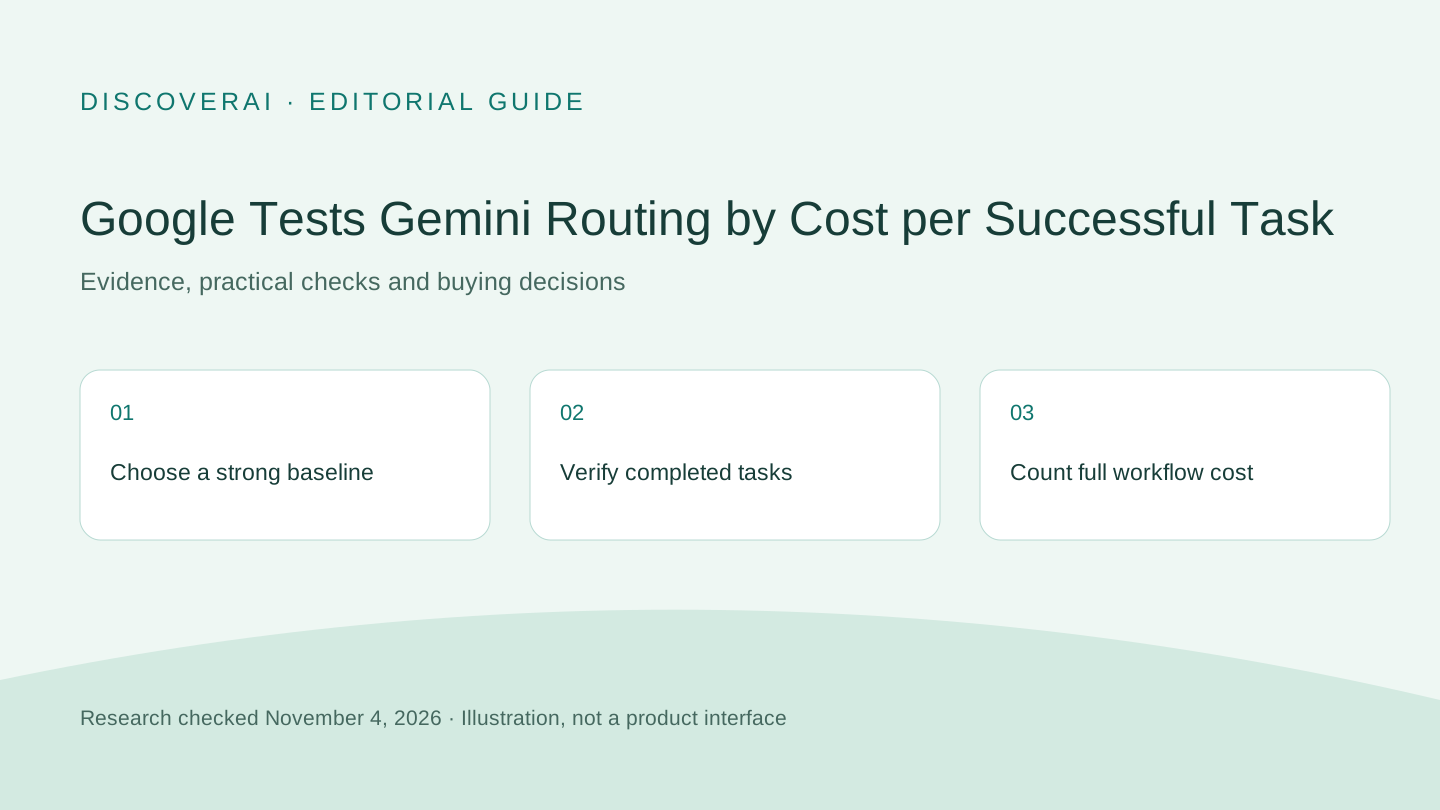
Our interpretation is that a router should earn its operational complexity. Compare it with a well-configured single model before comparing it with your most expensive default. A routing layer that looks economical against an unnecessarily heavy baseline may be an expensive way to arrive at the simpler configuration.
A short support classification, a repository-wide code change and a document extraction have different acceptance conditions. The same router may be useful for one and unhelpful for another. Decide what counts as a completed, correct task before looking at a bill.
What an engineering team could test
Build a small evaluation set from permitted work. Include routine cases, difficult cases and plausible mistakes that a superficial answer would hide. Keep some inputs out of router tuning. Run the current baseline and candidate configuration against the same acceptance checks.
Record model usage, retries, tool costs, review time and final pass or fail. Also record response time and any failed escalation. A cheaper individual call can create a more expensive completed task if it needs repair. This is our proposed pilot, not an experiment performed for this article.
Avoid a production switch based only on a successful demonstration. Establish a fallback when routing fails and decide who reviews unexplained changes. Keep the baseline available until the candidate has evidence on the workload that actually matters.
Reader takeaway
The useful news is a concrete comparison method: test routing against a strong simple baseline and count verified outcomes. The reported results do not establish a saving for long-context agents or your own task distribution.
Use our router-switch checklist to structure a pilot, then record costs and evidence in the buyer matrix.
Sources and timing
This analysis was published November 4, 2026 and covers Google’s November 3 post. No API calls, purchases or production routing changes were made for this report.
Transparency
How this guide was checked
Editorial accountability
Who checked this guide
- Evaluation type
- Research-based verification
- Last materially checked
- Evidence
- 1 listed sources
Hands-on testing is identified explicitly. Research-based coverage uses cited product documentation and other named sources; it does not imply every paid plan was used. Read the full methodology.
Editorial basis
What this guidance is based on
- Editorial basis
- Source-led analysis
- Primary references
- 1
- Products covered
- 0
- Last checked
- 2026-11-04
Important limits
- • Features, availability, and pricing can change after publication; confirm consequential details with the provider.
Sources and references
References cited by this article. Check the original source for scope, dates and current terms.
Frequently asked questions
Is Google announcing a managed routing product here?
The source is an engineering experiment and implementation discussion, not evidence of universal managed-service availability.
Do the results guarantee savings for long-context agents?
No. Google describes a small single-run test and notes caching tradeoffs for repeated context.
Did DiscoverAI reproduce the benchmark?
No. Reported findings are attributed to Google; the suggested pilot is editorial guidance.
Read next