In this guide
Make the router earn the switch
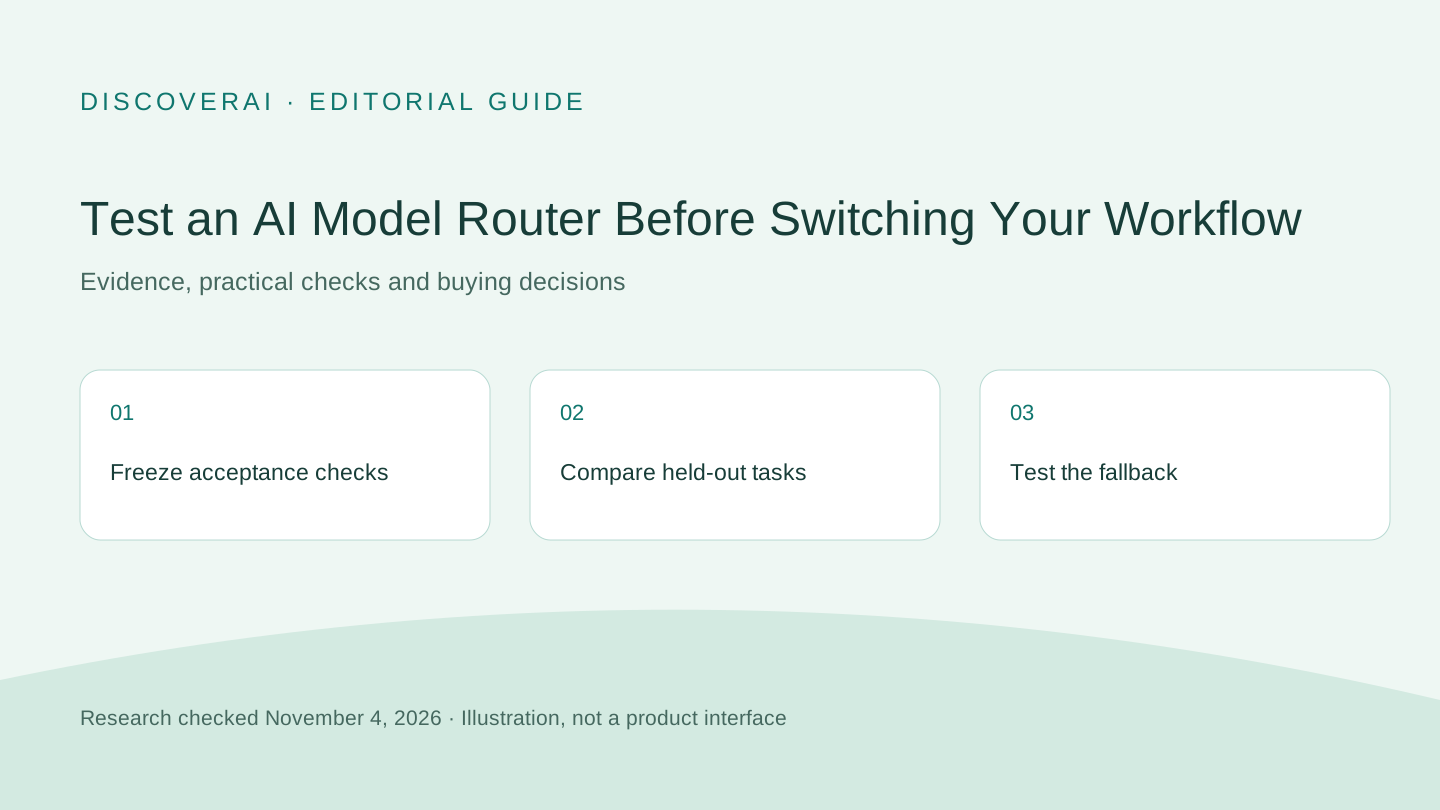
Test a candidate model router against a well-configured single-model baseline using the same tasks and acceptance checks. Count the full cost of verified work. This process is useful when a team is tempted to route requests based only on prompt length, model price or a successful demonstration.
This is a proposed evaluation workflow. DiscoverAI has not run the experiment described here. Start with the router pilot CSV; no account is required.
Free workflow pilot checklist
Test the workflow before you buy the tool.
Get the buyer checklist, including task, owner, approval, fallback, and time-saved fields—plus one useful briefing a week.
1. Define an accepted task before a cheap call
For extraction, acceptance might mean every required field matches the permitted source. For code work, it might mean passing relevant checks and human review of the changed behavior. Write down a concrete failure that matters, such as a missing field or an incorrect state transition.
Include review time in the comparison. An answer that looks complete but needs manual repair is unfinished work. Keep failed tasks in the record rather than dropping them from an average.
2. Keep development and held-out cases separate
Collect permitted examples of routine work, difficult work and short prompts with hidden complexity. Remove sensitive information while preserving what makes each case difficult. Mark which tasks may be used to tune routing and reserve others for evaluation.
Freeze the routing rules before running the reserved set. If you change a rule after seeing a failure, evaluate it on a fresh reserved set before calling the change an improvement. Otherwise you may only be measuring familiarity with your examples.
3. Compare the simplest credible baseline
Run the same inputs through the current configuration and candidate. Where feasible, include a lighter single-model setup too. Keep tool access, source material and acceptance criteria comparable. Record the date and configuration so later results have context.
Google’s November 3 experiment found that reducing an output ceiling did not produce the intended reasoning savings. Its small test also showed that caching and model switching complicate comparisons. Those findings motivate testing your own configuration; they do not establish your results.
4. Use a cost table that includes failures
| Record | Why it matters |
|---|---|
| Baseline and selected route | Shows what changed |
| Provider, classifier and tool spend | Captures more than answer tokens |
| Retry and repair time | Reveals hidden work |
| Verification pass or failure | Defines completed value |
| End-to-end latency | Reflects the actual wait |
| Cache assumptions | Explains a possible cost difference |
Calculate total recorded workflow cost divided by accepted tasks, while also reporting failures and sample size. If there are zero accepted tasks, mark the ratio undefined rather than hiding the failure behind a low bill. Repeat borderline cases before interpreting a small difference.
5. Check fallback before enabling the candidate
Decide what happens when the classifier is unavailable or the selected model returns an unusable answer. Test that fallback with disposable inputs. Keep the original configuration available and define a stop condition before moving real work.
A candidate is ready for a wider pilot only when quality is acceptable, the cost difference survives complete accounting and someone owns the failure review. Avoid relying on one unusually favorable run.
Keep the decision reviewable
Save inputs, outputs and acceptance notes where authorized. The worksheet is a log, not a benchmark certification. Read the news analysis for the reported experiment’s boundaries, and use the buyer matrix to compare review effort alongside price.
Transparency
How this guide was checked
Editorial accountability
Who checked this guide
- Evaluation type
- Research-based verification
- Last materially checked
- Evidence
- 1 listed sources
Hands-on testing is identified explicitly. Research-based coverage uses cited product documentation and other named sources; it does not imply every paid plan was used. Read the full methodology.
Editorial basis
What this guidance is based on
- Editorial basis
- Source-led analysis
- Primary references
- 1
- Products covered
- 0
- Last checked
- 2026-11-04
Important limits
- • Features, availability, and pricing can change after publication; confirm consequential details with the provider.
Sources and references
References cited by this article. Check the original source for scope, dates and current terms.
Frequently asked questions
Is the cheapest call always the cheapest completed task?
No. Count classification, tool usage, retries and repair alongside accepted output.
Can I tune routing on the evaluation tasks?
Keep tuning and reserved tasks separate; a rule changed after seeing a failure needs fresh evaluation.
What if no tasks pass verification?
Report the failures and mark cost per accepted task undefined because there is no successful denominator.
Read next