In this guide
What changed
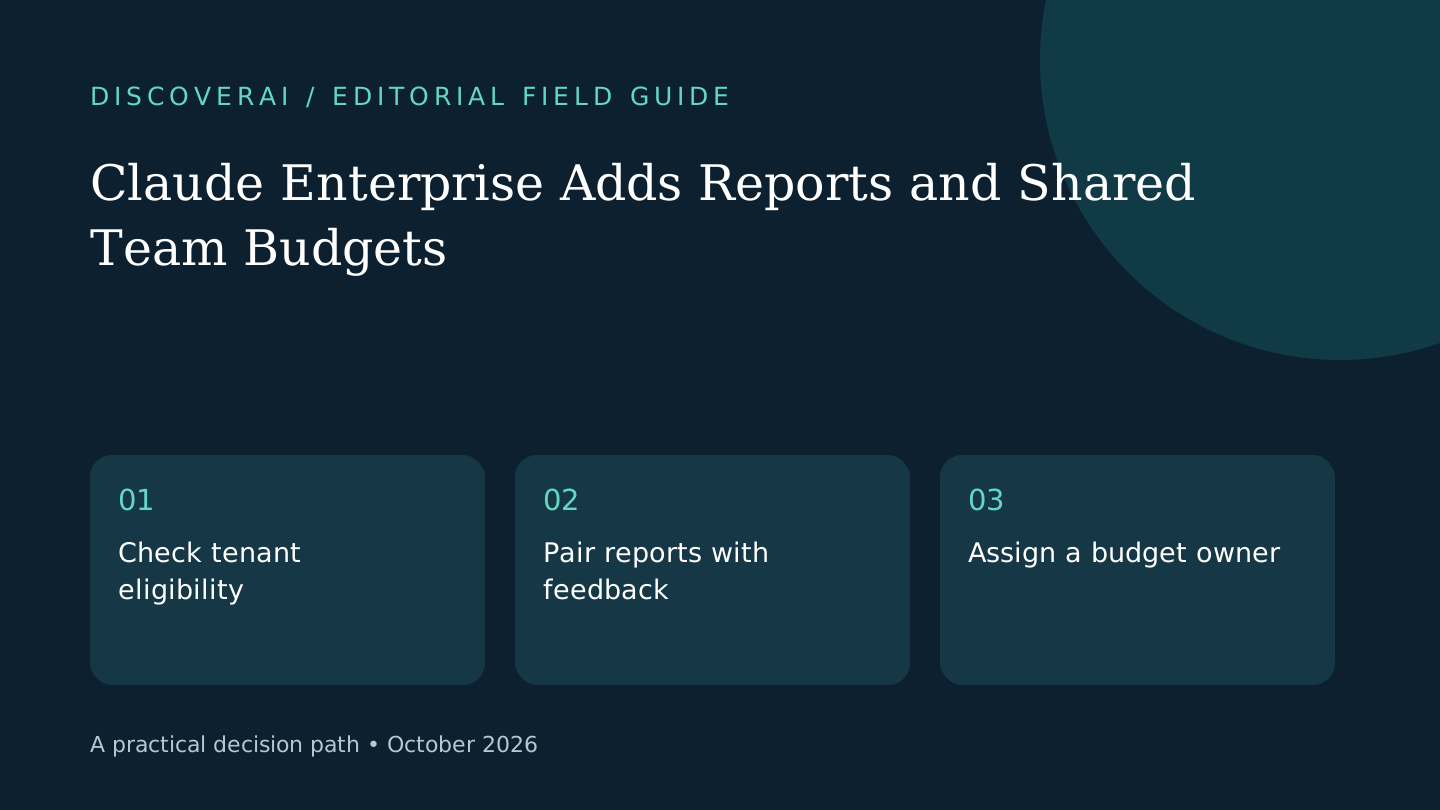
Anthropic’s October 28 announcement makes smart reports, in-app surveys and pooled group budgets generally available for Claude Enterprise, with configuration-dependent eligibility. This article is announcement analysis published the same day, not a hands-on evaluation.
Smart reports analyze sampled team transcripts to group work and identify costs and friction. Surveys collect member feedback. Pooled budgets provide a shared monthly allowance while retaining individual limits; a request counts against both and stops at whichever is exhausted first. Anthropic says reports are for adoption and planning, not individual performance or employment decisions. Check configuration eligibility before assuming access.
Free AI governance buyer checklist
Know what the tool can read, write, retain, and trigger.
Get a checklist for access, evidence, security, ownership, and rollback—plus one decision-ready briefing a week.
Why this matters for team adoption
Our assessment is that the useful change is a closer connection between observed work, employee feedback and a spending decision. An administrator can investigate whether a recurring obstacle deserves training, a workflow change or additional budget. None of those choices follows automatically from a high usage count.
A frequently used task might be valuable, or it might be a frustrating task that requires repeated attempts. A low-use team might be underserved, or it might have work that the current deployment does not help. Treat the report as the beginning of an inquiry and give people a way to explain the context.
A proposed rollout review
Choose one team and one ordinary reporting period. Before looking at the report, list the outcomes that team actually needs: a checked draft, a resolved customer request or a usable analysis. Keep this list short enough that reviewers can examine actual examples.
Compare the themes in the report with a small set of completed deliverables and voluntary feedback. Ask whether the same obstacle appears in both. If the apparent problem is missing access to an approved source, increasing the model budget may not address it. If the work is useful but repeatedly blocked by an allowance, a budget change may deserve a bounded trial.
These are editorial evaluation suggestions. We have not inspected an Enterprise tenant or confirmed the reports’ completeness, classification quality or recommendations.
Budget pooling still needs an owner
Before changing allowances, name a person who can approve exceptions and explain how staff request them. Keep a small record of why each change was made and when it will be reviewed. A shared budget works best when a team can understand the priorities behind it.
Use a hypothetical busy week to rehearse the process. What happens when one project consumes most of the available amount? Who decides whether another task waits? Do not wait for an important deadline to discover that the team has no agreed answer.
Privacy and interpretation
Explain the reporting purpose to affected staff before enabling a new review process. Separate workflow improvement from judgments about an individual. A transcript sample cannot show everything that happened before or after the model interaction, including the human work required to correct a result.
Keep any exported findings limited to the people who need them. Resolve internal access and retention expectations before sharing a report more widely. Our analysis does not establish whether a particular organization’s configuration meets its requirements.
What to do next
Confirm access and configuration with the official announcement and support documentation, then evaluate one reporting cycle before changing company-wide policy. Measure whether the chosen intervention improves accepted work and reduces friction, rather than whether people send more prompts.
Use the selection matrix to record the decision criteria and browse AI workflows for a bounded task to evaluate.
Transparency
How this guide was checked
Editorial accountability
Who checked this guide
- Evaluation type
- Research-based verification
- Last materially checked
- Evidence
- 1 listed sources
Hands-on testing is identified explicitly. Research-based coverage uses cited product documentation and other named sources; it does not imply every paid plan was used. Read the full methodology.
Editorial basis
What this guidance is based on
- Editorial basis
- Source-led analysis
- Primary references
- 1
- Products covered
- 0
- Last checked
- 2026-10-28
Important limits
- • Features, availability, and pricing can change after publication; confirm consequential details with the provider.
Sources and references
References cited by this article. Check the original source for scope, dates and current terms.
Frequently asked questions
Is this available on every Claude plan?
The announcement concerns Claude Enterprise, with configuration-dependent eligibility.
Does pooling remove individual limits?
No. Requests count against both the shared budget and the member limit.
Has DiscoverAI tested these reports?
No. This is an analysis of the October 28 announcement.
Read next