In this guide
What changed
Google's October 19 announcement says interactive apps created in Gemini can be exported into a private Google Sites draft. Users can customize the draft and publish it through Sites. This analysis was written October 27; it is not a same-day launch report.
Free AI governance buyer checklist
Know what the tool can read, write, retain, and trigger.
Get a checklist for access, evidence, security, ownership, and rollback—plus one decision-ready briefing a week.
Availability and policy boundaries
Google lists web, Android and iOS availability for eligible Workspace, Workspace Individual and personal accounts with Gemini access. Organization users need Sites enabled and permission to create and edit sites. Existing Sites and Drive policies apply; the announcement describes no new administrator control.
Why the draft stage matters
Our editorial assessment: exporting into a draft creates a useful review point between an experiment and a shared resource. Teams can agree on the audience, check wording and test behavior before anyone relies on the app. Export convenience does not demonstrate production readiness.
A hypothetical training team might build a practice calculator. The first question is whether the calculation handles the actual training examples, not whether the app looks convincing inside a branded page. Give the owner a small set of known answers and require a recorded comparison.
What a team should test
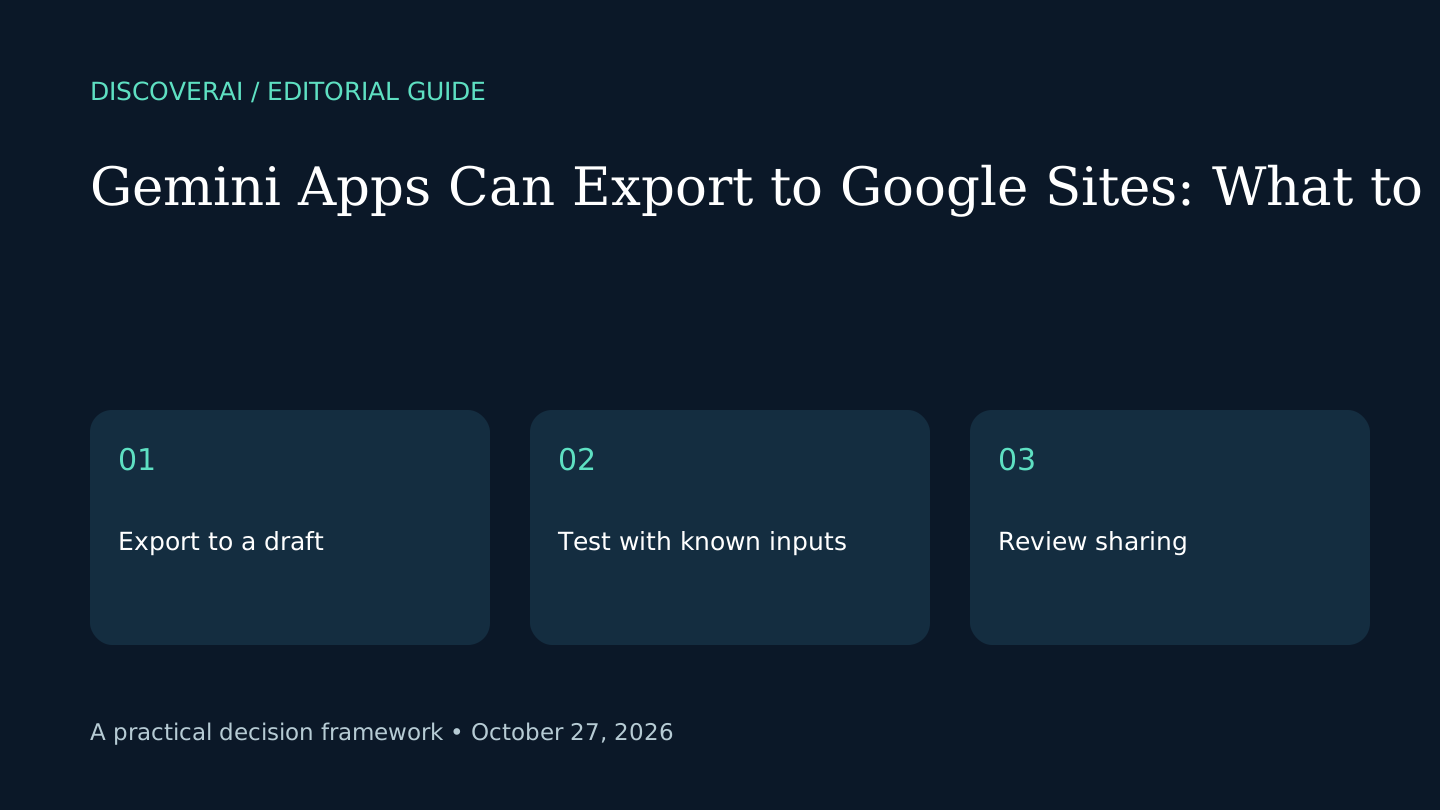
First define one job and its boundaries. State which inputs are supported and what should happen when a field is blank or invalid. Include an extreme value and a decimal if those are relevant. A successful happy-path demonstration leaves those ordinary failure cases unresolved.
Next, review sharing with a second test account that represents the intended audience. Check both what can be viewed and what can be changed. Keep real customer information out of the pilot until its handling has been reviewed under your organization's rules. These are proposed checks, not claims about a vulnerability in the new integration.
Keep an owner after publication
Appoint someone to answer questions, correct mistakes and retire the page when the underlying process changes. Record the date and assumptions of any calculation. A generated app can be easy to distribute while still needing routine maintenance.
For a simple internal activity, this may reduce the manual work of moving a prototype into a shareable page. For a customer-facing service, requirements such as permissions, reliable storage and support need their own assessment. The announcement alone does not establish those properties.
A practical next step
Choose one low-risk example and keep its original specification beside the draft. Ask a colleague to complete the task without coaching. Record wrong answers, unclear labels and inaccessible controls before expanding scope. Our website-form test guide provides another focused acceptance check, and the Tool Finder can help compare approaches.
This is source-based news analysis, not a hands-on test of the export. We have not verified individual account availability.
Transparency
How this guide was checked
Editorial accountability
Who checked this guide
- Evaluation type
- Research-based verification
- Last materially checked
- Evidence
- 1 listed sources
Hands-on testing is identified explicitly. Research-based coverage uses cited product documentation and other named sources; it does not imply every paid plan was used. Read the full methodology.
Editorial basis
What this guidance is based on
- Editorial basis
- Source-led analysis
- Primary references
- 1
- Products covered
- 0
- Last checked
- 2026-10-27
Important limits
- • Features, availability, and pricing can change after publication; confirm consequential details with the provider.
Sources and references
References cited by this article. Check the original source for scope, dates and current terms.
Frequently asked questions
Does export publish the app immediately?
Google describes export into a private Sites draft, followed by normal customization and publication.
Can organizations still control access?
The announcement says existing Sites and Drive policies apply and Sites creation permissions are required.
Has DiscoverAI tested the export?
No. This article reports the announcement and proposes a review process.
Read next