The decision
Should you choose MemoTune?
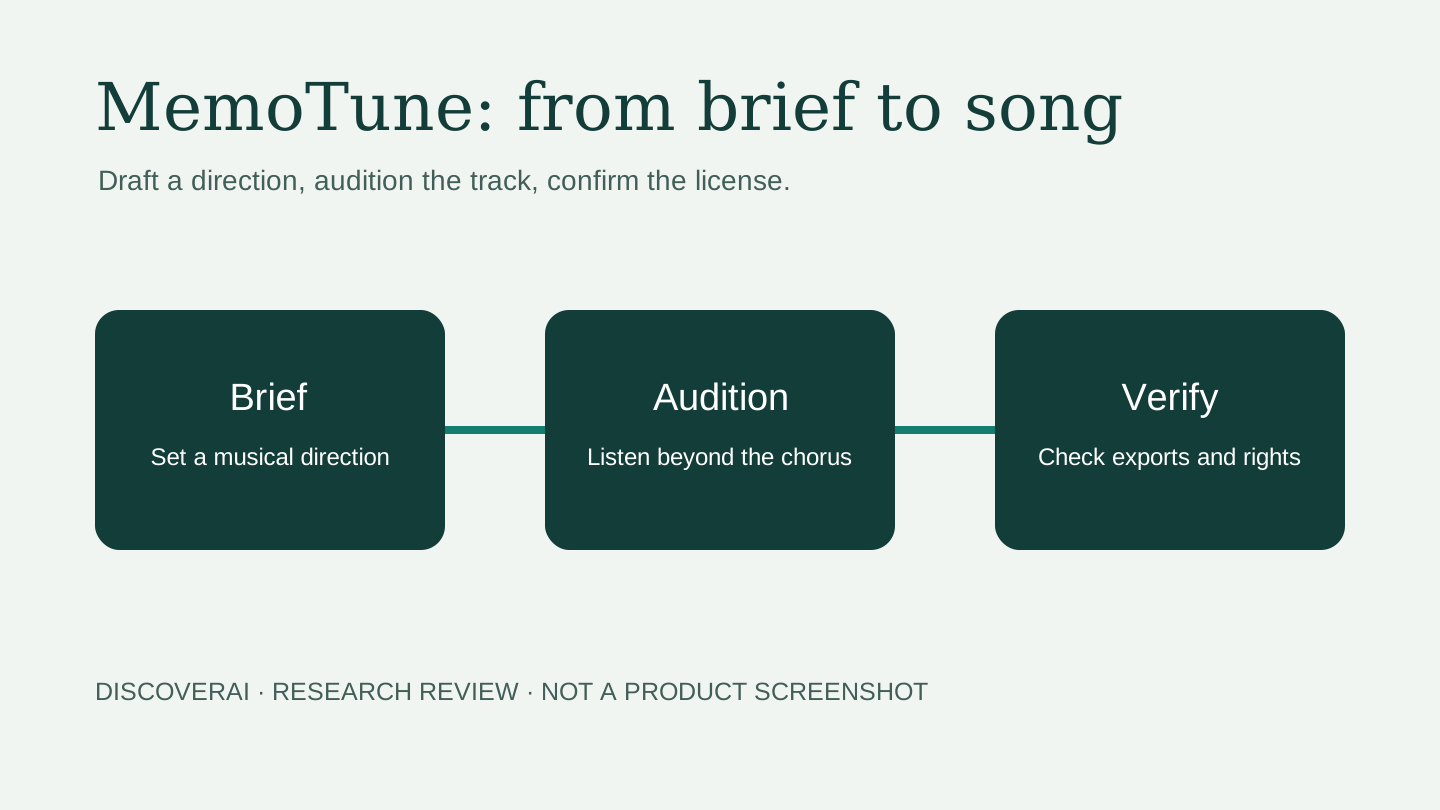
Test one short brief, inspect the downloaded audio and confirm the license before committing.
Best for
Creators evaluating music concepts; Personal song projects.
Choose something else if
Buyers requiring guaranteed exclusive rights; Commercial users relying on Basic or Creator plan cards without clarification
Evidence
Verified research · rating withheld
Pricing checked
From $9.9 · Nov 10, 2026
Free access is available, with limits.
Free credits for personal evaluation; check current allowance and expiry in your account.
DiscoverAI may earn a commission if you sign up or buy through our MemoTune affiliate link, at no additional cost to you. This relationship does not determine our verdict.
In this guide
Short answer
MemoTune is worth evaluating for turning a song idea into a draft you can listen to and refine. Its appeal is reducing the effort between writing a brief and hearing a musical direction. A good purchase decision still depends on whether a usable take saves you time after revisions, exports and rights checks.
Affiliate disclosure: DiscoverAI may earn a commission if you sign up or buy through our MemoTune affiliate link, at no additional cost to you. This relationship does not determine our verdict.
Free buyer comparison checklist
Compare this tool before committing.
Use the buyer checklist to compare two tools on the same tasks, including quality, review time and total cost. Get the weekly top 5 AI tools, one practical workflow and one way to reduce AI spending.
Evidence and review scope
We reviewed official public documentation on November 10, 2026. We did not create an account, generate music, train a voice, purchase a plan or test support. Ratings are withheld. The evaluation below is a proposed buyer test, not a report of measured results. We have not independently established audio quality, reliability or originality.
What MemoTune does
The product overview describes a browser workflow that starts with prompts or lyrics and produces two song versions. It also documents section replacement, extension and vocal separation. That combination may help when an otherwise promising draft needs a specific passage revised.
The practical question is whether you can preserve what works while fixing what fails. A generated chorus that sounds convincing in isolation may still sit awkwardly beside the verse. Judge continuity, phrasing and arrangement across the whole track. Treat polished demonstrations as examples selected by the provider, rather than evidence that every brief will produce comparable results.
Pricing and billing
The pricing page displayed these rates:
| Plan | Monthly billing | Annual upfront total | Monthly credits |
|---|---|---|---|
| Basic | $9.90 | $94.80 | 300 |
| Creator | $19.90 | $178.80 | 900 |
| Premium | $39.90 | $358.80 | 3,000 |
| Ultra | $119.90 | $1,078.80 | 12,000 |
Annual equivalents are $7.90, $14.90, $29.90 and $89.90 monthly, respectively; these require yearly payment. Free credits support personal evaluation, but check the current allowance in your account. We did not verify checkout or per-action credit consumption.
Compare the cost per approved track rather than the advertised generation allowance. A high quota is less useful if most attempts need replacement. Budget revision time alongside the subscription, and record credit consumption before and after each action.
Important plan conflicts
The pricing cards show commercial-license benefits for Basic and Creator, but the same page’s FAQ and the terms limit commercial use to Premium and Ultra. Basic’s card also shows music video access, while its FAQ excludes it. Obtain written confirmation of the exact entitlement before paying. We flag pricing for re-verification rather than publishing an unqualified offer.
The terms attach commercial rights to content generated during an active Premium or Ultra subscription and say those rights continue after it ends. Do not assume upgrading licenses earlier tracks retroactively. Save your generation dates, plan records and the applicable terms with each approved export.
Royalty-free describes permitted usage without recurring per-use royalties; it does not establish exclusive rights or guarantee acceptance by a distributor. Verify destination requirements before planning a release. This review evaluates the provider’s documentation and does not determine copyright status for any particular output.
Credits, cancellation and refunds
The terms say unused credits generally do not roll over unless the plan specifies otherwise. Their refund conditions require a request within 72 hours, no more than five generated songs and no voice-model training. Qualifying non-technical refunds carry a 5% processing deduction; verified unresolved platform failures have different treatment. Cancellation alone does not guarantee a refund. Check the current policy before purchasing and keep trial spending small.
Privacy and voice uploads
The privacy policy says creative inputs and outputs are excluded from general or shared model training. Explicit custom voice training instead processes audio for a private voice model. Generated work is private by default, but service delivery involves storage and third-party processing.
Account data can remain for a reasonable period after deletion; the policy does not give that phrase a fixed duration. Songs follow account and plan settings, and analytics may persist for up to 24 months. Deletion can be requested through support. These are provider statements rather than an independent security assessment.
Use a fictional brief for initial evaluation. Obtain permission before uploading someone else’s voice, lyrics or recording, and confirm any client-specific data requirements before using confidential material.
A practical buyer test
Use this proposed evaluation with a small, original brief:
- Define an audience, mood, approximate duration, language and intended placement. Write down what makes a result acceptable before generating.
- Use the same brief across a few attempts. Record settings, credits consumed, completion time and the number of discarded takes.
- Listen on headphones and ordinary speakers. Inspect lyric intelligibility, pronunciation, abrupt transitions, vocal artifacts and distracting background sounds.
- Try changing one section while keeping the surrounding song intact. Check whether the edit preserves musical flow and the brief’s meaning.
- Download the format your editing workflow needs. Import it into your actual project, inspect the start and ending, and test the intended cut points.
- Keep a local copy of approved audio and its generation metadata. Record correction time and total spending per usable track.
- For commercial work, verify the generation-time plan and written licensing clarification before publishing. Separately check the receiving platform’s rules.
A useful result should improve the complete workflow, including editing. Set a stopping rule: if repeated attempts miss the same pronunciation or structure requirement, compare another approach rather than consuming the entire allowance.
Alternatives and who should consider it
MemoTune makes most sense as an experiment for creators who want a quick musical direction or a personalized song. It needs a closer trial when precise performance, repeatable revisions or client delivery matter. A stock-music library may suit a fixed production deadline; a musician or conventional production workflow may offer more deliberate control. Those are workflow alternatives, not measured winners from this review.
Use the AI tool buyer checklist to weight cost, privacy and control. For work involving separated audio, our stem-checking guide offers an additional listening checklist.
Our recommendation
Start with a modest personal test and evaluate the exported result in its intended context. Resolve the plan contradictions before paying for commercial work. The MemoTune buttons use the disclosed affiliate link; the MemoTune tool profile provides the structured summary.
Transparency
How this guide was checked
Editorial accountability
Who checked this guide
- Evaluation type
- Hands-on evaluation
- Last materially checked
- Evidence
- 4 listed sources
Hands-on testing is identified explicitly. Research-based coverage uses cited product documentation and other named sources; it does not imply every paid plan was used. Read the full methodology.
Editorial freshness
Pricing cards conflict with FAQs and terms on commercial licensing and Basic video access; checkout not tested.
Review evidence
What this guidance is based on
- Evaluation type
- First-party documentation review; no hands-on benchmark
- Research date
- November 10, 2026
- Commercial relationship
- Supplied affiliate link; disclosed
Important limits
- • No account, generation, voice training, purchase, export or support tests performed.
- • Pricing cards conflict with licensing terms and Basic video entitlements.
- • No independent audio quality, originality or speed benchmark.
Standardized benchmark coverage
How this review maps to the research benchmark
Citation accuracy
Not applicableThe reviewed workflow does not produce source-grounded research answers, so a citation score would be misleading.
Read protocol v2026.10-v1 →Thematic analysis
Not applicableThe reviewed workflow is not qualitative evidence analysis, so a thematic-analysis score would be misleading.
Read protocol v2026.10-v1 →Eligibility is not a product score. DiscoverAI publishes results only after output collection, blinded adjudication, reproducibility checks, and severe-error review.
Open the optional evaluation worksheet
Reusable trial worksheet
Test MemoTune before you commit
Turn this review’s buyer test into evidence. Your entries autosave only in this browser and are never added to shared shortlist links.
Confirm the tool meets every must-have workflow and stakeholder requirement.
Review starting point: Creators evaluating music concepts; Personal song projects
Run the same representative work you would use in production; do not score a polished demo.
Review starting point: Run a bounded set of representative tasks with known acceptable outcomes, then compare the result with your current workflow.
Calculate the effective cost per accepted result, including usage, review, corrections, and required add-ons.
Review starting point: Displayed November 10, 2026: Basic $9.90 monthly or $94.80/year; Creator $19.90 monthly or $178.80/year; Premium $39.90 monthly or $358.80/year; Ultra $119.90 monthly or $1,078.80/year. Confirm checkout and licensing conflicts before paying.
Define an acceptance threshold, test known answers and edge cases, and record every correction.
Review starting point: Editorial quality signals: features 0.0/5. Validate these signals in your own work.
Verify what data enters the product, who can access it, how long it is retained, and whether it trains models.
Review starting point: Use approved low-risk data first. Check roles, consent, deletion, subprocessors, model-training settings, and the contract—not only the marketing page.
Test the real handoffs, permissions, failure states, and export path your team depends on.
Review starting point: MemoTune integration requirements are not fully structured in this review; list every required system and test each connection.
Record training, governance, reliability, accessibility, ownership, and change-management risks before rollout.
Review starting point: Conflicting plan-benefit descriptions; Commercial rights restricted by generation-time plan; Credit costs and usable output quality untested
Loading saved worksheet… · private to this device or your optional account
Community evidence
How verified users put MemoTune to work
Structured, editor-moderated experience—not star ratings. This complements our independent review and never changes its score.
No approved community evidence yet. Be the first verified user to contribute.
Community choice
Recommend MemoTune
Loading weekly votes…
One vote per verified account per tool, counted for seven days. Return after your vote expires to support again. Community votes influence homepage trends, never editorial ratings. Voting does not subscribe you to emails.
Sources and references
References cited by this article. Check the original source for scope, dates and current terms.
Frequently asked questions
What is MemoTune?
A browser-based AI music creation service for generating and refining songs from prompts or lyrics.
Is MemoTune free?
It offers free credits for personal evaluation. The allowance and expiry should be checked in your account.
Can I use MemoTune songs commercially?
The terms restrict commercial use to work generated during an active Premium or Ultra subscription. Basic and Creator pricing cards conflict with that restriction; obtain written clarification before relying on those cards.
Does an upgrade license earlier songs?
The terms attach commercial rights to the plan active when content is generated. Do not assume an upgrade retroactively licenses earlier work.
Does DiscoverAI have an affiliate relationship?
DiscoverAI may earn a commission if you sign up or buy through our MemoTune affiliate link, at no additional cost to you. This relationship does not determine our verdict.
Did DiscoverAI test MemoTune?
No. This review assesses official public documentation checked November 10, 2026. We did not generate songs, buy a plan or test support; ratings are withheld.
Recommended tool
Use MemoTune if this workflow fits your team
Test one short brief, inspect the downloaded audio and confirm the license before committing.
DiscoverAI may earn a commission if you sign up or buy through our MemoTune affiliate link, at no additional cost to you. This relationship does not determine our verdict.
Tools mentioned in this article
MemoTune
Generate song ideas, then check the take and its license
MemoTune generates and refines AI songs from prompts or lyrics, with plan-specific export and commercial-use limits.
Read next