In this guide
What was announced
Anthropic is expanding its AI for Science program through foundations, institutions and research groups. Its October 28 announcement highlights 20 partners, with Claude credits distributed through organizations as well as specific research initiatives. This analysis was published November 2, 2026; the announcement was not made today.
The list includes the Sloan and Simons foundations, the Wellcome Sanger Institute and EMBL. Anthropic describes many collaborations as early-stage. It also identifies the Model Hardware Standard for lab instruments as a research preview. Those statements describe access and ongoing work, not independent proof of improved research outcomes.
Free workflow pilot checklist
Test the workflow before you buy the tool.
Get the buyer checklist, including task, owner, approval, fallback, and time-saved fields—plus one useful briefing a week.
How this differs from the original program
The May 2025 program offered API credits to selected researchers attached to research institutions, with applications reviewed for scientific contribution, project impact and potential AI benefit. The new announcement broadens the distribution route through organizations. It does not establish a universal free allowance for every scientist or a general free Claude plan.
Researchers should ask their institution which route is available, what costs the credits cover and whether there is a project-specific deadline. Neither a partner listing nor this article confirms an individual lab's approval.
Why access and evidence are separate questions
Our analysis: credits can make it easier to attempt a scoped project, but they do not settle whether the resulting work is correct or reproducible. A literature-screening assistant and an instrument-operating agent need different evaluation and permission boundaries. Treating both as a generic chatbot pilot would hide the most consequential differences.
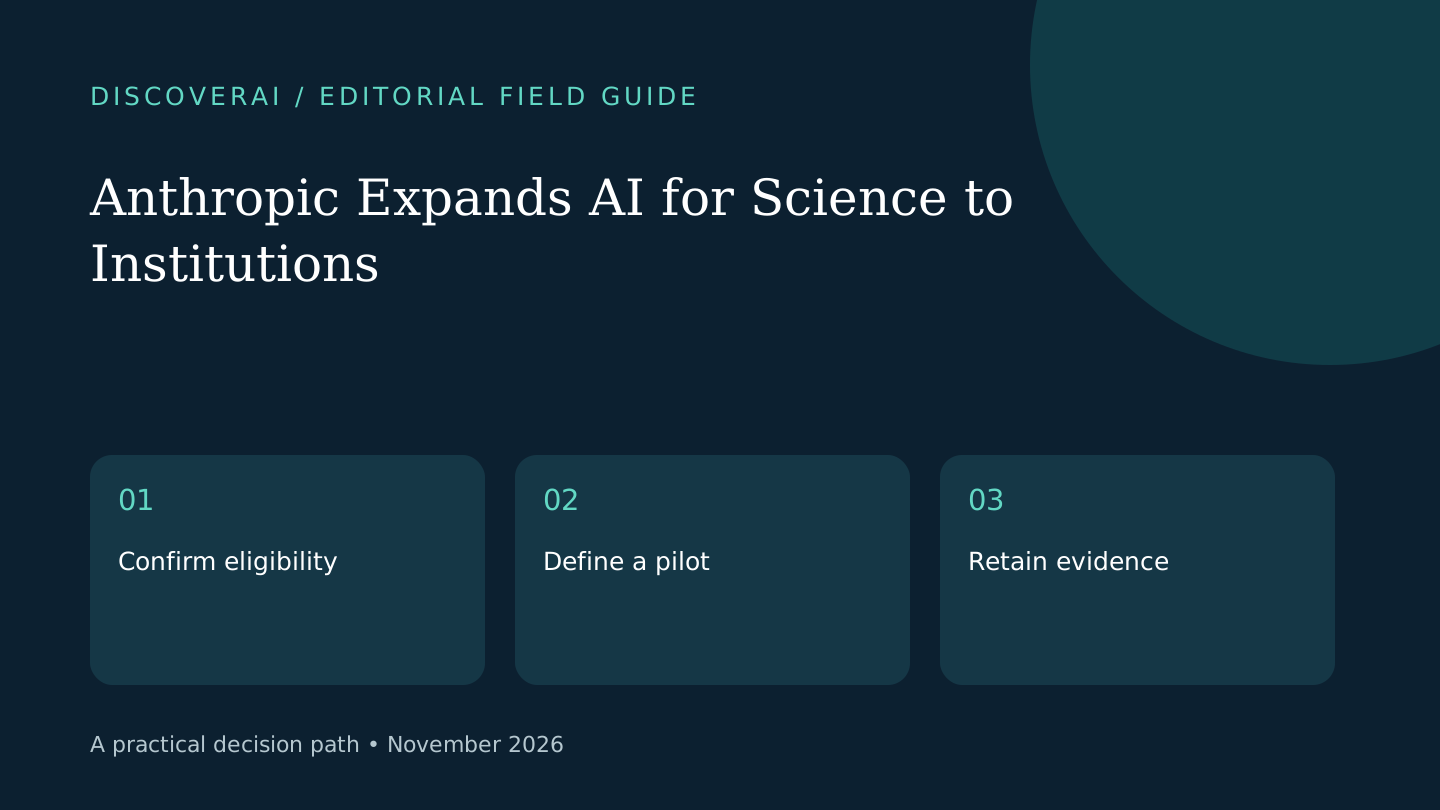
Before using funded access, define a deliverable you can independently inspect. For an analysis workflow, keep the source dataset, code, model configuration and expected checks together. Assign a person to approve changes to the research process. These are proposed project controls, not requirements we have verified across partner institutions.
A useful first pilot
Start with a small, already permitted dataset and a question with an established checking method. Save the baseline result before introducing AI assistance. Record corrections, failed attempts and researcher review time alongside credit consumption.
For example, a team could evaluate whether a proposed data-cleaning script preserves known row counts and value ranges. Passing those checks would support that narrow task, not a claim that the model can independently design an experiment or operate equipment. Physical actions require their own approval process.
What remains unknown
The announcement does not provide a single entitlement table covering all partners, and it does not establish outcomes for every collaboration. We have not independently assessed the described projects. Watch for accessible methods, retained outputs and results that another group can reproduce rather than extrapolating from the size of the partner list.
Use our buyer evaluation matrix to define the evidence a pilot must produce. Funding access is a starting point; the decision to expand should follow the task's own results.
Transparency
How this guide was checked
Editorial accountability
Who checked this guide
- Evaluation type
- Research-based verification
- Last materially checked
- Evidence
- 2 listed sources
Hands-on testing is identified explicitly. Research-based coverage uses cited product documentation and other named sources; it does not imply every paid plan was used. Read the full methodology.
Editorial basis
What this guidance is based on
- Editorial basis
- Source-led analysis
- Primary references
- 2
- Products covered
- 1
- Last checked
- 2026-11-02
Important limits
- • Features, availability, and pricing can change after publication; confirm consequential details with the provider.
Sources and references
References cited by this article. Check the original source for scope, dates and current terms.
Frequently asked questions
Was this program announced on November 2?
No. This November 2 analysis covers the October 28 expansion and distinguishes it from the original May 2025 program.
Does the expansion guarantee free credits for every researcher?
No. The announcement describes organizational partnerships; eligibility and access need confirmation.
Does a research preview establish production readiness?
No. Evaluate the specific workflow and approval requirements before relying on it.
Tools mentioned in this article
Claude
Anthropic's thoughtful, safety-focused AI with exceptional long-form reasoning
Claude excels at deep analysis, long-form writing, and nuanced reasoning. Built by Anthropic with a focus on safety and helpfulness.
Read next