How to Analyze Customer Interviews With AI Without Losing the Evidence
Use AI to accelerate transcription and comparison while keeping participant consent, exact quotations, contradictory cases, and researcher judgment visible.
Bottom line
A practical seven-step workflow for turning customer interviews into source-linked findings without letting a generated summary become the evidence.
Editorial accountability
Who checked this guide
- Evaluation type
- Research-based verification
- Last materially checked
- Evidence
- 4 listed sources
Hands-on testing is identified explicitly. Research-based coverage uses cited product documentation and other named sources; it does not imply every paid plan was used. Read the full methodology.
Editorial basis
What this guidance is based on
- Editorial basis
- Source-led analysis
- Primary references
- 4
- Products covered
- 3
- Last checked
- 2026-10-02
Important limits
- • This workflow is not legal, ethics-board, or institutional-review advice.
- • Teams must adapt consent, retention, privacy, accessibility, and security controls to their participants and jurisdiction.
In this guide
Short answer
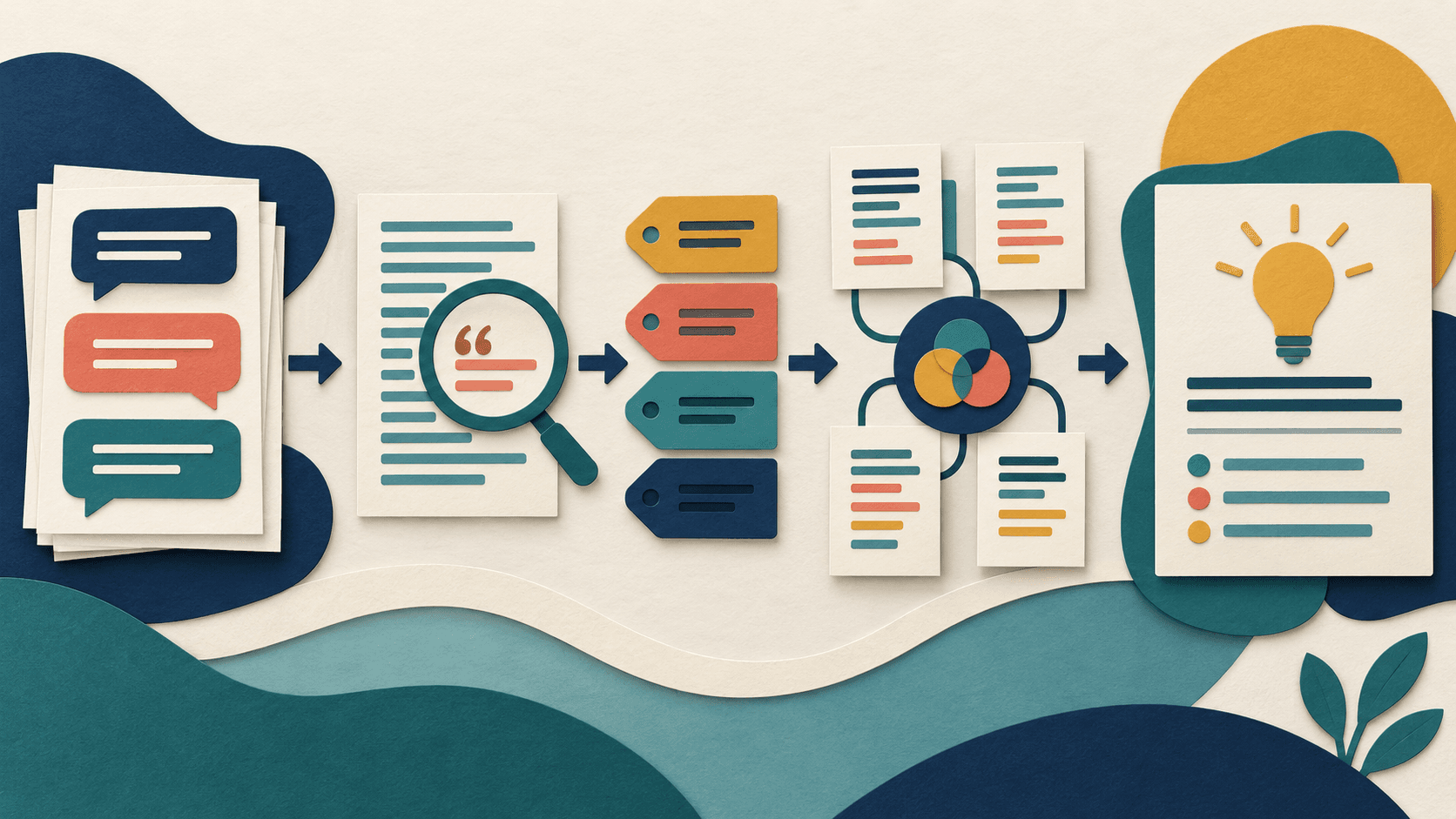
Use AI for the mechanical parts of interview analysis—transcription, segmentation, candidate codes, retrieval, and comparison—but require every finding to retain a link to the original recording or transcript. The safe sequence is consent, clean evidence, a human-owned codebook, AI-assisted first pass, cross-interview comparison, adversarial review, and an evidence-backed deliverable.
1. Confirm permission before upload
Recording consent does not automatically authorize a new AI processor. Check the participant notice, research protocol, customer contract, internal data classification, retention rule, and vendor terms. Remove unnecessary identifiers and exclude material the selected environment is not approved to process.
2. Preserve an immutable source set
Keep the original audio or video, a versioned transcript, participant pseudonym, session metadata, discussion guide, and correction log. Never let an AI-cleaned transcript silently replace the source. Domain terms, accents, overlapping speech, and product names are common transcription failure points.
3. Define the questions and seed codebook
Write the research questions before asking for themes. Create a small starting codebook with definitions, inclusion and exclusion rules, and examples. This prevents the model from deciding that the most frequent topics are automatically the most important.
4. Run a bounded AI first pass
Ask for candidate excerpts and codes, not final conclusions. Require transcript identifiers and exact supporting passages. Review a sample across participants before scaling. If the system cannot show where a claim came from, do not promote it to a finding.
5. Compare across interviews
Build a matrix of participants by research question or code. Look for recurrence, differences by segment, sequences, intensity, and contradictions. Counts can orient the analyst but do not turn a purposive qualitative sample into a representative survey.
6. Search for disconfirming evidence
For every candidate theme, explicitly retrieve exceptions, negative cases, alternate explanations, and passages the first pass could not classify. Revisit recordings when tone, hesitation, or context changes the meaning of a transcript.
7. Publish an auditable finding
A useful finding states the claim, scope, supporting and conflicting evidence, participant coverage, confidence, implication, owner, and next research step. Attach exact quotes or clips with the permission appropriate to the audience. A stakeholder should be able to inspect the evidence without seeing data they are not authorized to access.
Acceptance test
Sample at least 20 material claims. Verify the quotation, participant, context, and recording timestamp; check that the claim does not extend beyond the sample; and ask a second reviewer whether the same evidence supports the interpretation. Track correction time as part of the workflow cost.
Sources and verification
Product details and claims were checked against the following primary sources.
Frequently asked questions
Can AI replace a researcher during interview analysis?
No. It can accelerate retrieval and organization, but humans remain responsible for context, interpretation, consent, sampling limits, and the final claim.
Should interview transcripts be anonymized?
Remove identifiers that are not needed, use pseudonyms where practical, and follow the participant notice, legal basis, research protocol, and organizational retention policy.
How many interviews make a theme valid?
There is no universal count. Relevance depends on the research question, sampling strategy, information power, variation, contradictory cases, and the strength of supporting evidence.
What should every AI-generated insight include?
A source reference, exact supporting evidence, scope, contradictory evidence, analyst review, and an explicit statement of what the sample cannot establish.
Tools mentioned in this article
NotebookLM
A source-grounded Google research workspace for asking questions and generating overviews from a controlled source set
NotebookLM is a strong research companion when you already have a defined source library, but citations, source completeness, privacy, and plan limits still require human review.
ChatGPT
The general-purpose AI assistant that started it all
OpenAI's flagship conversational AI model, powering everything from casual chat to complex reasoning, coding, and creative work.
Claude
Anthropic's thoughtful, safety-focused AI with exceptional long-form reasoning
Claude excels at deep analysis, long-form writing, and nuanced reasoning. Built by Anthropic with a focus on safety and helpfulness.
Read next