Best AI Tools for Qualitative Research in 2026
Choose by evidence traceability, analysis workflow, governance, and export—not by how quickly a tool can generate a polished summary.
Bottom line
A research-based guide to choosing AI software for interviews, open-ended surveys, thematic analysis, and reusable research repositories.
Editorial accountability
Who checked this guide
- Evaluation type
- Research-based verification
- Last materially checked
- Evidence
- 4 listed sources
Hands-on testing is identified explicitly. Research-based coverage uses cited product documentation and other named sources; it does not imply every paid plan was used. Read the full methodology.
Editorial basis
What this guidance is based on
- Editorial basis
- Source-led analysis
- Primary references
- 4
- Products covered
- 3
- Last checked
- 2026-10-02
Important limits
- • DiscoverAI did not run a paid, longitudinal deployment of every listed platform.
- • Capabilities, pricing, data locations, subprocessors, and plan limits can change and require contract-level verification.
In this guide
Short answer
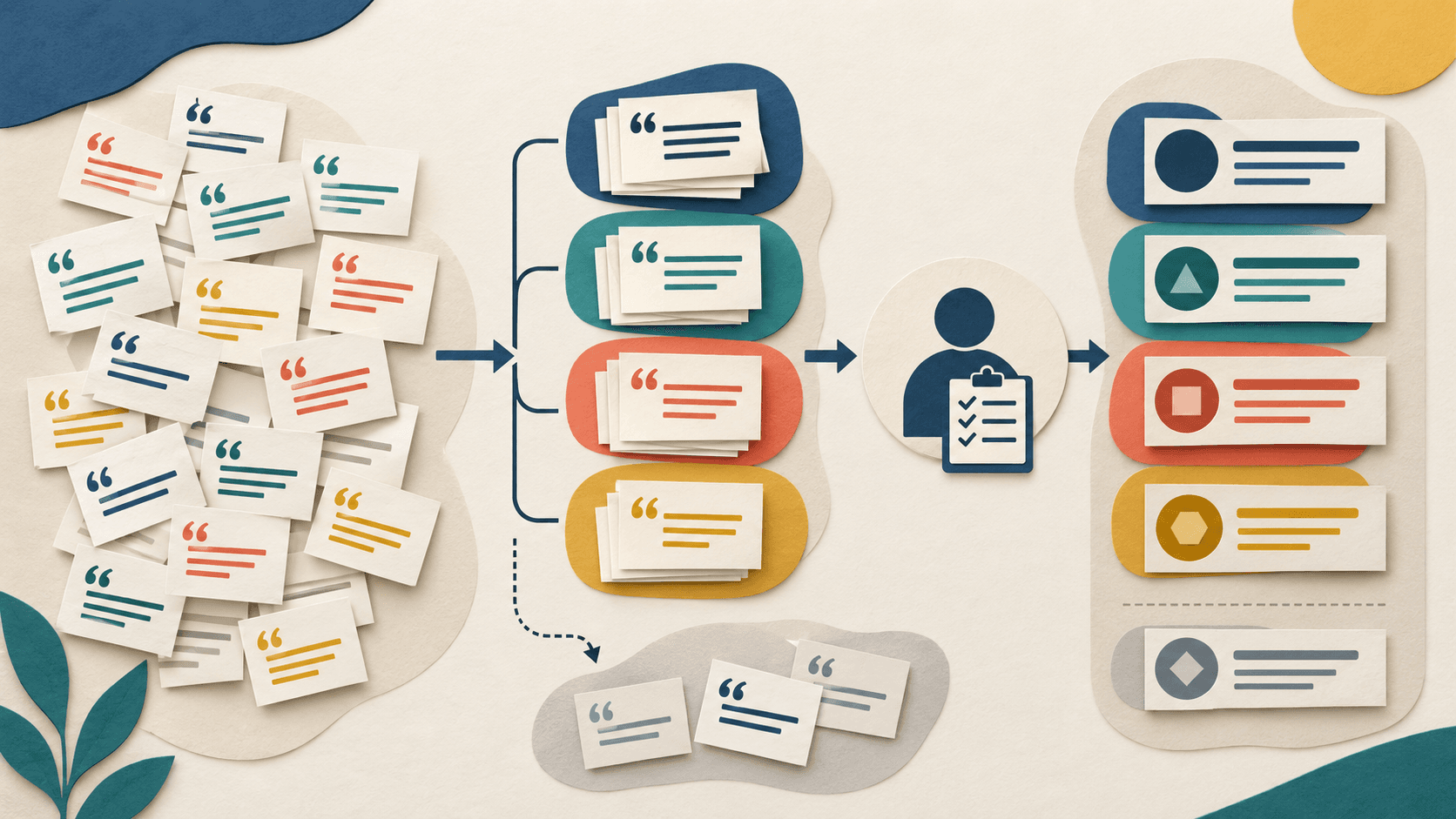
The best AI qualitative research tool is the one that keeps every important finding connected to inspectable source evidence. Dovetail is the broadest fit for teams building a governed, searchable customer-insight repository. Looppanel is a strong shortlist for interview-heavy UX research and discussion-guide analysis. Condens suits teams that want structured research analysis and repository search. ATLAS.ti and NVivo remain relevant when formal coding, methodological control, and mixed research materials matter more than a lightweight product workflow. General assistants can help with bounded tasks, but they are not substitutes for consent, access control, a durable codebook, or source-linked findings.
Choose the workflow before the vendor
Start with the evidence you collect: recorded interviews, transcripts, open-text surveys, support conversations, field notes, documents, or mixed media. Then decide whether the primary job is study-level synthesis, continuous feedback analysis, formal qualitative coding, or organizational memory. A tool optimized for live interview notes can be a poor repository; a rigorous coding environment can be excessive for a five-interview product study.
The shortlist
Dovetail: repository and organization-wide reuse
Dovetail combines projects, transcripts, tagging, search, cited AI answers, redaction, access controls, retention options, and stakeholder sharing. Its current free plan is useful for a bounded trial; broader organizational use is sales-led. Shortlist it when research must compound across teams and findings need to travel into planning with their evidence attached.
Looppanel: interview-centered synthesis
Looppanel centers transcription, discussion-guide notes, cross-interview views, AI-assisted tags, reports, clips, and repository search. It is a practical candidate when moderated interviews and usability sessions dominate the workload. Verify language performance, speaker attribution, correction effort, consent handling, and exports on your own recordings.
Condens: structured analysis and repository search
Condens supports sessions, highlights, tags, findings, and repository-level questions. Its distinction is the path from raw research through reviewed highlights into reusable findings. Test whether permissions and AI answers respect project boundaries, and whether the exported evidence remains usable outside the platform.
ATLAS.ti and NVivo: formal coding environments
These established qualitative-analysis platforms are better candidates when researchers need transparent coding structures, memos, queries, mixed media, and defensible methodological records. AI can accelerate first-pass work, but academic, regulated, or high-stakes studies still need a documented analysis protocol and accountable researchers.
A fair buyer test
Use the same permission-safe dataset in every finalist: 8–12 interviews, one open-ended survey export, a known codebook, several contradictory cases, and deliberately ambiguous passages. Measure transcription corrections, code agreement, unsupported themes, quote accuracy, outlier retention, time to an approved finding, permission behavior, export completeness, and deletion. Do not score the prettiest summary; score the least expensive path to a finding another person can audit.
Bottom line
Choose a purpose-built research platform when participant evidence, repeatability, permissions, and organizational memory matter. Use a general assistant only for data you are authorized to share and only inside a workflow that preserves the originals, sampling decisions, codebook changes, citations, and human sign-off.
Sources and verification
Product details and claims were checked against the following primary sources.
Frequently asked questions
What is an AI qualitative research tool?
It is software that helps transcribe, organize, code, search, synthesize, or share unstructured evidence such as interviews, survey comments, field notes, and feedback.
Can ChatGPT analyze research interviews?
It can assist with authorized, bounded data, but a general assistant may lack repository governance, durable source links, coding history, participant controls, and research-specific exports.
Which feature matters most?
Traceability. A reviewer should be able to move from every material claim to the exact quote, recording moment, survey response, or document passage that supports it.
How should teams compare tools?
Replay the same permission-safe study and measure correction work, quote accuracy, unsupported themes, outlier retention, permissions, export completeness, and time to an approved finding.
Tools mentioned in this article
NotebookLM
A source-grounded Google research workspace for asking questions and generating overviews from a controlled source set
NotebookLM is a strong research companion when you already have a defined source library, but citations, source completeness, privacy, and plan limits still require human review.
ChatGPT
The general-purpose AI assistant that started it all
OpenAI's flagship conversational AI model, powering everything from casual chat to complex reasoning, coding, and creative work.
Claude
Anthropic's thoughtful, safety-focused AI with exceptional long-form reasoning
Claude excels at deep analysis, long-form writing, and nuanced reasoning. Built by Anthropic with a focus on safety and helpfulness.
Read next