In this guide
The news
Google Research’s November 4 report describes Agile Deliberation, a framework for refining subjective image categories with human feedback. This analysis was published November 6, 2026; the announcement was not made today.
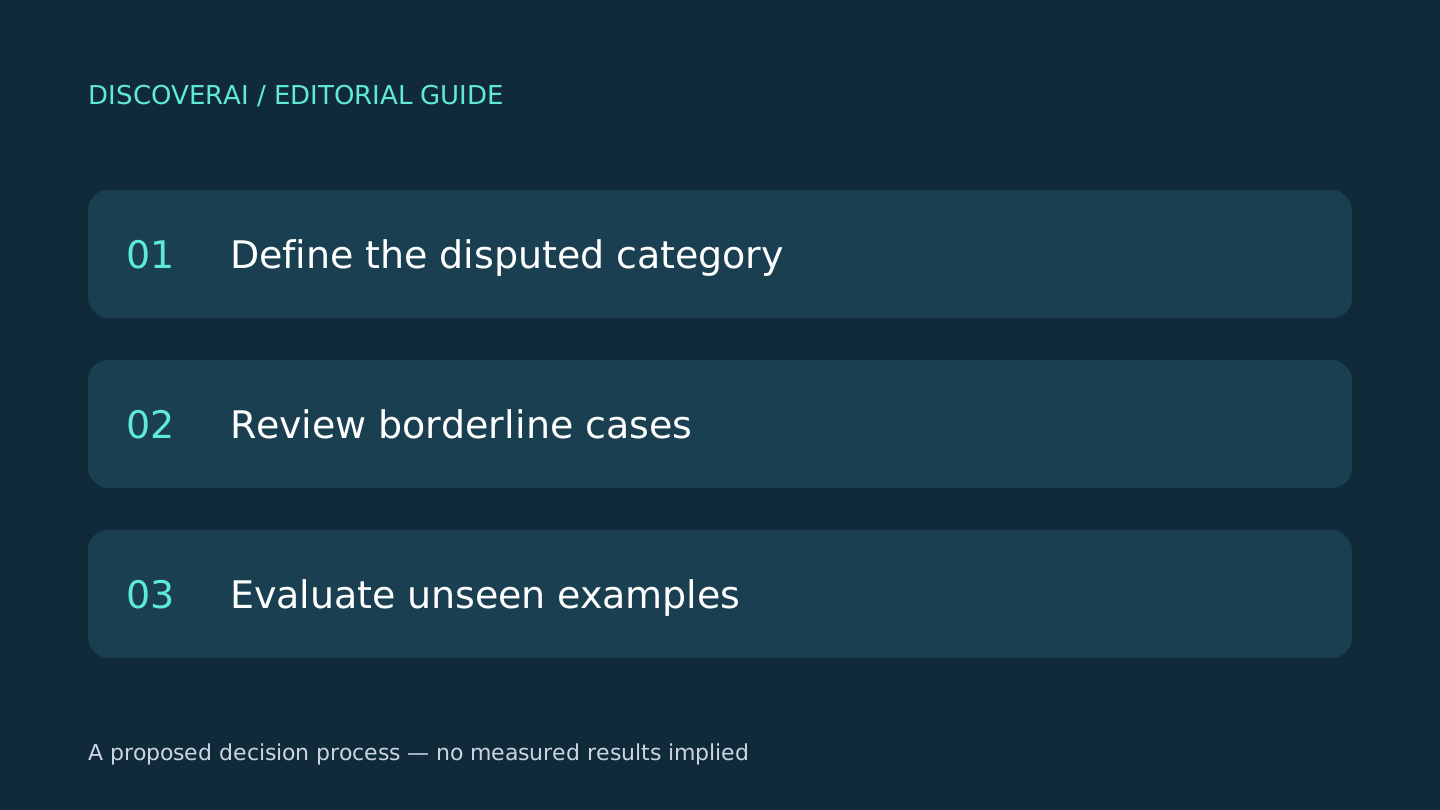
The workflow first scopes a concept and its exclusions, then surfaces borderline images to help users refine the rules. Google reports 18 live sessions lasting 1.5 hours each, covering healthy-food and misleading-reward imagery. It reports better classification and lower participant effort than the evaluated baselines, and links an open-source implementation. DiscoverAI has not reproduced those findings.
Free workflow pilot checklist
Test the workflow before you buy the tool.
Get the buyer checklist, including task, owner, approval, fallback, and time-saved fields—plus one useful briefing a week.
Why the result matters
Our interpretation is that this work addresses an overlooked part of evaluation: deciding what the label means. A team can agree that it wants “appropriate” images while disagreeing about individual cases. Asking a model for a stronger answer cannot settle the team’s policy disagreement.
For an editorial team, a useful question is who can change the definition and how those changes reach reviewers. Imagine a hypothetical image library where “product photography” includes isolated objects but excludes lifestyle scenes. A person holding the product creates a boundary question. The team needs a reviewable decision, rather than confidence that the classifier understood an ambiguous phrase.
What remains open
Eighteen sessions in two domains do not establish universal cultural agreement or production moderation reliability. The report is a research account, not evidence that a general consumer product now provides the workflow. We did not verify deployment requirements or operating costs.
A buyer should distinguish a clearer local policy from a policy that is fair or appropriate for everyone affected. More agreement among a small group can still leave important perspectives unrepresented. The responsible policy owner remains necessary.
A proposed team exercise
Before adopting any classifier, gather permitted examples that your reviewers disagree about. Record each decision and the reason. Reserve another group of images that participants do not use to rewrite the rules.
Have reviewers apply the revised definition independently to that reserved group. Report disagreements and exclusions alongside the accepted labels. If one rule change fixes a case while breaking another, preserve both examples in the review record. This exercise is our suggested evaluation method, not a reproduction of Google’s experiment.
What to watch next
Look for independent testing, implementation costs and evidence of how revised policies behave on unseen material. Ask whether a deployment preserves old decisions and offers a route for appeal when a label has consequences.
For an everyday publishing application, use the AI social-post approval guide. For a different research direction in persistent learning, read our sleep-framework analysis.
Transparency
How this guide was checked
Editorial accountability
Who checked this guide
- Evaluation type
- Research-based verification
- Last materially checked
- Evidence
- 1 listed sources
Hands-on testing is identified explicitly. Research-based coverage uses cited product documentation and other named sources; it does not imply every paid plan was used. Read the full methodology.
Editorial basis
What this guidance is based on
- Editorial basis
- Source-led analysis
- Primary references
- 1
- Products covered
- 0
- Last checked
- 2026-11-06
Important limits
- • Features, availability, and pricing can change after publication; confirm consequential details with the provider.
Sources and references
References cited by this article. Check the original source for scope, dates and current terms.
Frequently asked questions
Is this a new consumer classifier subscription?
The source describes a research framework and links code; this article does not establish a consumer launch.
Does the study resolve every subjective category?
No. Its reported sessions cover two domains, which limits generalization.
Did DiscoverAI reproduce the study?
No. Findings are attributed to Google and proposed exercises are labelled separately.
Read next