In this guide
The news
In an October 27 research report, Google describes alternating active input processing with an offline consolidation phase for continual learning. This November 6 analysis covers that earlier announcement; it does not report a new release today.
The framework transfers temporary information into longer-term parameters and uses generated practice material for further learning. Google reports results across translation, factual learning, long-context tasks and reasoning. Its “sleep” terminology describes a computational process under human-defined rules, not consciousness. The associated paper documents the research. DiscoverAI has not reproduced the experiments.
Free workflow pilot checklist
Test the workflow before you buy the tool.
Get the buyer checklist, including task, owner, approval, fallback, and time-saved fields—plus one useful briefing a week.
What this changes in the discussion
Our interpretation is that the useful distinction is between supplying information for one answer and changing what a system retains for future tasks. Those are different operational decisions. A team should ask which information remains, where it remains and how an incorrect update can be corrected.
A hypothetical assistant might learn that a supplier changed its delivery day. Retaining the new date is useful only if it stops repeating the old one, preserves unrelated facts and can identify the evidence for the update. Fluent answers alone would not establish that all three conditions hold.
Research is not a deployed memory promise
This report does not establish that a particular Gemini account can enable the framework or that waiting overnight changes a commercial assistant. It also does not establish deletion, tenant isolation or production latency for an application you are buying. Ask for product-specific documentation before changing your workflow.
Do not compare a retained-knowledge research result directly with a chatbot’s advertised context window. Evaluation setup, task and architecture matter. We have not independently verified operating cost or performance claims.
A proposed acceptance plan for persistent learning
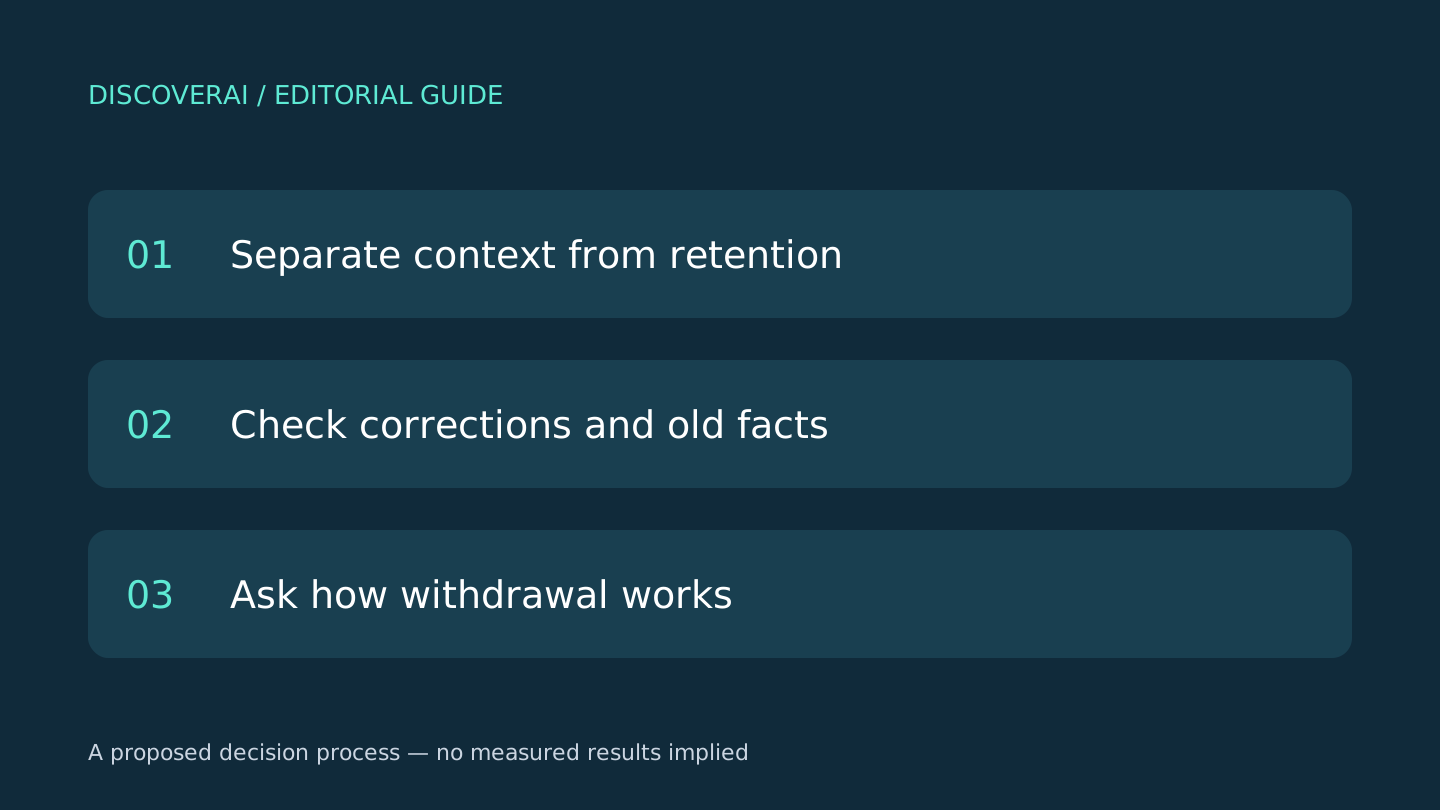
Start with fictional facts, each with an owner and effective date. Introduce a correction, then ask about the current value in a fresh interaction. Check an unrelated fact at the same time. Save the exact configuration and outputs.
Next withdraw one piece of information. Ask the vendor what withdrawal should mean for stored text, derived representations and future answers. Verify against that stated behavior; a single absent answer does not prove deletion.
Keep a comparison configuration that uses explicit source retrieval without persistent updating. Judge both against the same permitted facts and corrections. Count stale answers and uncertainty as well as correct answers. This is our proposed procurement exercise, not a result from the cited paper.
What to watch next
Independent replication, clear update controls and measurable recovery from bad information would help buyers assess this direction. The practical question is whether retained knowledge remains accurate, attributable and governable over time.
For another approach to improving AI decisions, read the Agile Deliberation analysis. Use the buyer checklist to document the controls a real product demonstrates.
Transparency
How this guide was checked
Editorial accountability
Who checked this guide
- Evaluation type
- Research-based verification
- Last materially checked
- Evidence
- 2 listed sources
Hands-on testing is identified explicitly. Research-based coverage uses cited product documentation and other named sources; it does not imply every paid plan was used. Read the full methodology.
Editorial basis
What this guidance is based on
- Editorial basis
- Source-led analysis
- Primary references
- 2
- Products covered
- 0
- Last checked
- 2026-11-06
Important limits
- • Features, availability, and pricing can change after publication; confirm consequential details with the provider.
Sources and references
References cited by this article. Check the original source for scope, dates and current terms.
Frequently asked questions
Does sleep imply that a model is conscious?
No. It is a name for an offline computational consolidation process.
Can every Gemini user enable this now?
The research report does not establish such product availability.
Did DiscoverAI validate production performance?
No. This analysis distinguishes reported research from proposed buyer tests.
Read next