The decision
Should you choose HOL Guard?
Prove coverage in a disposable workflow before considering paid cloud coordination.
Best for
Developers evaluating local agent controls; Teams piloting shared approval governance.
Choose something else if
Buyers expecting universal action interception; Organizations assuming verified SSO or self-hosting without agreement
Evidence
Verified research · rating withheld
Pricing checked
See current vendor pricing · Nov 10, 2026
Free access is available, with limits.
Free open-source local protection; cloud sync and team coordination are optional paid features.
DiscoverAI may earn a commission if you sign up or buy through our HOL Guard affiliate link, at no additional cost to you. This relationship does not determine our verdict.
In this guide
Short answer
HOL Guard is worth evaluating if you want an additional approval and policy layer around supported AI coding-agent actions. Start with the free local workflow and prove coverage for your exact agent, operating system and launch method before considering paid coordination features. Our recommendation is a controlled pilot, not a blanket assurance of protection.
Affiliate disclosure: DiscoverAI may earn a commission if you sign up or buy through our HOL Guard affiliate link, at no additional cost to you. This relationship does not determine our verdict.
Free buyer comparison checklist
Compare this tool before committing.
Use the buyer checklist to compare two tools on the same tasks, including quality, review time and total cost. Get the weekly top 5 AI tools, one practical workflow and one way to reduce AI spending.
Evidence and review scope
This review is based on first-party documentation checked November 10, 2026. We did not install the software, connect a cloud account, run security tests, measure latency, inspect telemetry, purchase a plan or contact support. Ratings are withheld. The pilot below is a proposed evaluation, not a report of tests we performed.
What HOL Guard does
The product overview positions Guard between supported coding agents and consequential actions. The practical goal is to interrupt a risky operation while letting ordinary development continue. It is most relevant to developers introducing agents into repositories and teams that need a consistent review process.
The features page describes policy decisions for supported shell, file, package and MCP surfaces. Available handling includes observation, approval and blocking. Integration-specific hooks determine where pre-action enforcement is possible. A product being listed as supported does not establish that every action it can take is intercepted.
This distinction should drive the buying decision. Map your actual workflow first: how the assistant starts, which tools it invokes, which files it can access and which external systems it reaches. Ask for evidence against those paths. A generic demonstration of one blocked command tells you little about a different connector or launch route.
Free local protection versus paid Cloud
The billing documentation separates local enforcement from paid services. Local approvals, blocking and receipts remain available without an active cloud plan. Cloud adds cross-device history and coordination. Automation credits are a separate balance for cloud automation work; they are not the budget that keeps local protection running.
Solo is described as personal sync across two cloud-connected devices. Pro extends personal history and controls, while Team adds shared administration and review. Device limits apply to cloud participation rather than the ability to install local Guard. Check which capability you actually need before upgrading.
For an individual developer working on one machine, establish a useful local baseline first. For a team, evaluate who can change policy, who approves exceptions and whether a decision remains traceable after staff or repository changes. Shared dashboards are useful only when the responsibility for responding is clear.
Pricing: confirm the selected billing interval
The public pricing page displayed Pro at $15/month during research. It offers monthly and annual selection; verify the selected interval, full charge and renewal terms at checkout. We did not independently confirm current Solo or Team totals and do not infer them from the Pro price.
| Option | Main evaluation question |
|---|---|
| Free local | Does the integration cover your required actions? |
| Solo | Is personal cloud history across two devices useful? |
| Pro | Do the additional history and controls justify the checkout total? |
| Team | Can shared policy and approval ownership fit your operating process? |
| Enterprise | Which identity, deployment and support requirements are confirmed in writing? |
Local use is free and does not require a card. Cloud trial and payment terms depend on current checkout configuration. Treat cancellation and any refund as separate questions; we did not test either. Pricing is marked for re-verification because complete paid-plan totals and interval-specific checkout amounts remain unconfirmed.
Security evidence: a catalog is not a pass rate
The Guard Gauntlet page explicitly reports no published scored live run or third-party validation at the time checked. It provides a scenario catalog and judging rules. A described test suite is useful for planning an evaluation, but it is not measured effectiveness.
Its method distinguishes an attempted action stopped by native enforcement from an assistant simply refusing to try. That is a useful principle for your own pilot. Inspect effects outside the conversation: file contents, process outcome and decision records. A reassuring chat response alone does not prove that a boundary held.
Privacy and enterprise caveats
The security trust packet distinguishes local processing from optional cloud synchronization of redacted decision information. Do not extend a local-only privacy statement to every enabled integration. Review sample records and access permissions before connecting a production workspace.
The packet also leaves SAML/SCIM and self-hosted or VPC deployment subject to confirmation. It cautions against assuming a current-version security-support SLA from older support language. Organizations should ask for an agreed scope covering identity, incident response, retention, export and deletion before adopting the cloud control plane.
A useful internal exercise is to write down what a receipt could reveal about a project even after secrets are removed. Repository identity, action timing and operational context may still matter. Decide who needs that information and how long to retain it. These are evaluation questions; we did not inspect the product's actual traffic or stored records.
Proposed pilot checklist
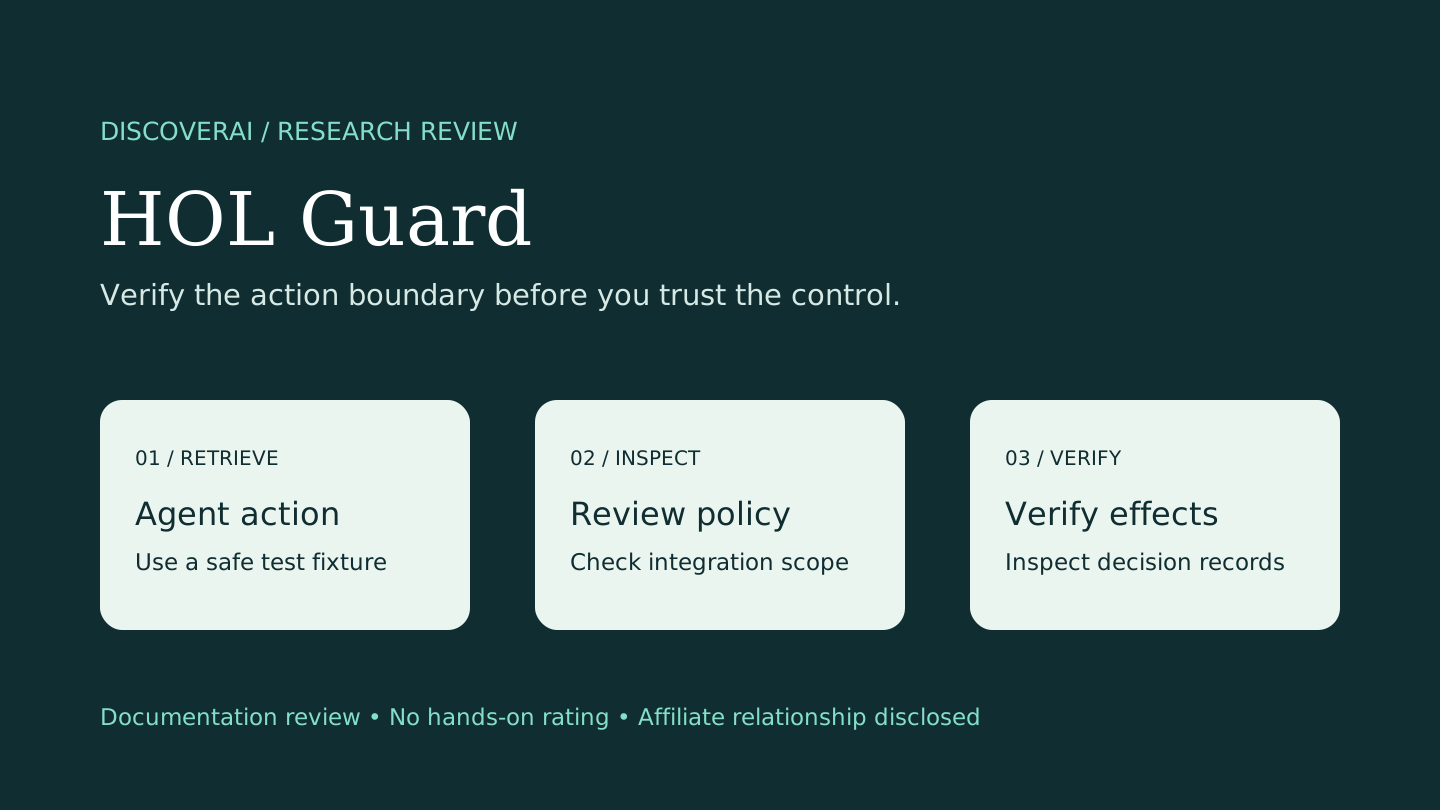
Use a disposable repository and synthetic data. Keep production credentials and real customer records outside the fixture. Agree on expected outcomes before running anything, and record versions and settings so the checks can be repeated.
- Select the exact agent, version, operating system and normal launch route your team uses. Consult the documentation index for the relevant integration guide and verify installation health.
- Run ordinary reading, editing and test tasks. Record interruptions and completion time so friction is assessed alongside protection.
- Use harmless fixtures to evaluate the required sensitive-read and destructive-change boundaries. Confirm both the decision and the external effect without approving the blocked action.
- Check the MCP or extension paths you actually use. Mark unsupported paths explicitly instead of counting them as successful protection.
- Inspect receipts and, if Cloud is enabled, a sample export. Confirm what is shared, who can see it and whether it meets your requirements.
- Test exception ownership and expiry in a controlled environment. Ensure reviewers understand what they are authorizing and can explain the resulting decision.
- Repeat after an agent or Guard upgrade. Keep an owner and a rollback plan for unexpected workflow disruption.
Set your own acceptance criteria: required boundaries must hold, essential work must finish, and the review burden must remain manageable. This checklist is not an exhaustive penetration test or certification.
Alternatives and verdict
Compare Guard with the native approval controls already available in your coding agent. For some individuals, carefully scoped permissions and isolated execution may cover the immediate requirement with less administration. Teams needing shared decisions should compare the complete operating process, including review time, rather than feature counts alone.
Keep backups, least-privilege access and established endpoint controls in your evaluation. Adding Guard should have a specific job and an accountable owner. We have not benchmarked it against competing products and do not claim a performance advantage.
Our verdict: begin with free local Guard if you can validate its integration against a defined workflow. Pay for Cloud when shared history or governance solves a demonstrated need. See the HOL Guard profile and our AI tool buyer checklist. Explore HOL Guard through our affiliate link.
Transparency
How this guide was checked
Editorial accountability
Who checked this guide
- Evaluation type
- Hands-on evaluation
- Last materially checked
- Evidence
- 7 listed sources
Hands-on testing is identified explicitly. Research-based coverage uses cited product documentation and other named sources; it does not imply every paid plan was used. Read the full methodology.
Editorial freshness
Full interval-specific checkout totals and Solo/Team rates were not confirmed.
Review evidence
What this guidance is based on
- Evaluation type
- Official documentation research; no hands-on security testing
- Research date
- November 10, 2026
- Commercial relationship
- Supplied affiliate link; disclosed
Important limits
- • No installation, attack simulation, telemetry audit, cloud purchase or support test performed.
- • Integration coverage and security effectiveness not independently verified.
- • Complete checkout totals and enterprise entitlements require confirmation.
Standardized benchmark coverage
How this review maps to the research benchmark
Citation accuracy
Not applicableThe reviewed workflow does not produce source-grounded research answers, so a citation score would be misleading.
Read protocol v2026.10-v1 →Thematic analysis
Not applicableThe reviewed workflow is not qualitative evidence analysis, so a thematic-analysis score would be misleading.
Read protocol v2026.10-v1 →Eligibility is not a product score. DiscoverAI publishes results only after output collection, blinded adjudication, reproducibility checks, and severe-error review.
Open the optional evaluation worksheet
Reusable trial worksheet
Test HOL Guard before you commit
Turn this review’s buyer test into evidence. Your entries autosave only in this browser and are never added to shared shortlist links.
Confirm the tool meets every must-have workflow and stakeholder requirement.
Review starting point: Developers evaluating local agent controls; Teams piloting shared approval governance
Run the same representative work you would use in production; do not score a polished demo.
Review starting point: Run a bounded set of representative tasks with known acceptable outcomes, then compare the result with your current workflow.
Calculate the effective cost per accepted result, including usage, review, corrections, and required add-ons.
Review starting point: Checked November 10, 2026: local protection free; public Pro display $15/month. Verify monthly/annual selection, checkout total, trial terms and Solo/Team prices. Automation credits are separate from local enforcement.
Define an acceptance threshold, test known answers and edge cases, and record every correction.
Review starting point: Editorial quality signals: features 0.0/5. Validate these signals in your own work.
Verify what data enters the product, who can access it, how long it is retained, and whether it trains models.
Review starting point: Use approved low-risk data first. Check roles, consent, deletion, subprocessors, model-training settings, and the contract—not only the marketing page.
Test the real handoffs, permissions, failure states, and export path your team depends on.
Review starting point: HOL Guard integration requirements are not fully structured in this review; list every required system and test each connection.
Record training, governance, reliability, accessibility, ownership, and change-management risks before rollout.
Review starting point: Coverage depends on agent and event path; No published scored Gauntlet live run at research date; Enterprise identity and deployment scope require confirmation
Loading saved worksheet… · private to this device or your optional account
Community evidence
How verified users put HOL Guard to work
Structured, editor-moderated experience—not star ratings. This complements our independent review and never changes its score.
No approved community evidence yet. Be the first verified user to contribute.
Community choice
Recommend HOL Guard
Loading weekly votes…
One vote per verified account per tool, counted for seven days. Return after your vote expires to support again. Community votes influence homepage trends, never editorial ratings. Voting does not subscribe you to emails.
Sources and references
References cited by this article. Check the original source for scope, dates and current terms.
Frequently asked questions
What is HOL Guard?
HOL Guard applies local policy and approval controls to supported AI-agent actions. Optional Guard Cloud adds shared history and coordination.
Is HOL Guard free?
Local protection is free and open source. A cloud subscription is optional, and local blocking does not depend on cloud billing or automation credits.
How much does HOL Guard cost?
The public pricing page displayed Pro at $15/month on November 10, 2026. Confirm the billing interval and checkout total; Solo and Team totals were not independently confirmed.
Does Guard stop every risky AI action?
No. Coverage depends on the integration, event and configured policy. Unsupported execution paths require other controls.
Does Guard upload my code?
HOL says local evaluation stays on the machine. Enabling Cloud changes the data path: redacted decision information can sync. Check the actual configuration and export contents before rollout.
Has DiscoverAI tested HOL Guard?
No. This is documentation research checked November 10, 2026. We did not install Guard, execute attacks, inspect network traffic or purchase a plan. Ratings are withheld.
Does DiscoverAI earn a commission?
DiscoverAI may earn a commission if you sign up or buy through our HOL Guard affiliate link, at no additional cost to you. This relationship does not determine our verdict.
Recommended tool
Use HOL Guard if this workflow fits your team
Prove coverage in a disposable workflow before considering paid cloud coordination.
DiscoverAI may earn a commission if you sign up or buy through our HOL Guard affiliate link, at no additional cost to you. This relationship does not determine our verdict.
Tools mentioned in this article
HOL Guard
Local policy and approvals for supported AI-agent actions
HOL Guard adds local policy, approval prompts and decision records to supported AI coding-agent workflows, with optional paid cloud coordination.
Read next