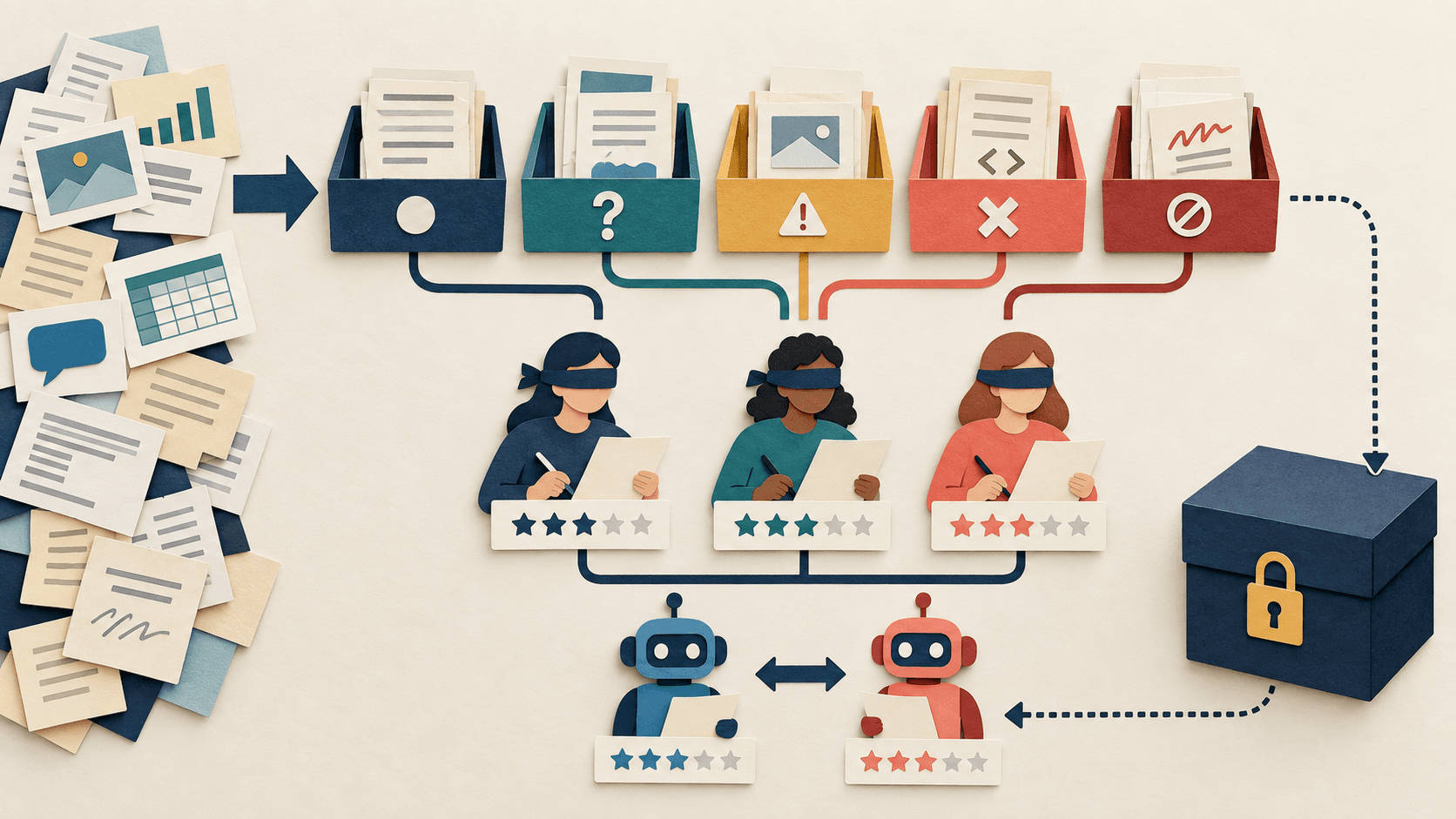
Measure AI Cost Per Accepted Output—not Cost Per Generation
A cheap generation is expensive when reviewers reject it, repair it, rerun it, or absorb the cost of a downstream mistake.

Bottom line
Cost per accepted output equals all workflow costs divided by outputs that pass a written acceptance standard. Include model input, output and cache charges; retrieval and tool calls; failed attempts; orchestration; human review and correction time; monitoring; and expected failure loss. Report it by task segment and severity so a good average cannot hide an expensive failure tail.
Editorial accountability
Who checked this guide
- Evaluation type
- Research-based verification
- Last materially checked
- Evidence
- 4 listed sources
Hands-on testing is identified explicitly. Research-based coverage uses cited product documentation and other named sources; it does not imply every paid plan was used. Read the full methodology.
Editorial basis
What this guidance is based on
- Editorial basis
- Source-led analysis
- Primary references
- 4
- Products covered
- 3
- Last checked
- 2026-09-23
Important limits
- • Vendor tests and launch claims may not generalize to other users or workloads.
- • Availability, policy, pricing, and product behavior can change.
In this guide
Short answer
Cost per accepted output equals all workflow costs divided by outputs that pass a written acceptance standard. Include model input, output and cache charges; retrieval and tool calls; failed attempts; orchestration; human review and correction time; monitoring; and expected failure loss. Report it by task segment and severity so a good average cannot hide an expensive failure tail.
Free workflow pilot checklist
Test the workflow before you buy the tool.
Get the buyer checklist, including task, owner, approval, fallback, and time-saved fields—plus one useful briefing a week.
Define acceptance before measuring
Write the required facts, sources, format, tone, permissions, latency, and prohibited errors before running the model. An output is accepted only when it can enter the next workflow step without unplanned correction. Track partial acceptance separately rather than changing the rubric after seeing results.
Capture the complete numerator
For each request, log input, output, cache, embedding, search, storage, and tool fees; retries and fallbacks; infrastructure; reviewer minutes; correction minutes; and incident costs. Use loaded labor rates consistently. Do not treat subscription fees or unused committed capacity as free.
Segment the denominator
Compare ordinary versus complex work, languages, input quality, customer types, and high-consequence cases. Report first-pass acceptance, eventual acceptance, severe failures, latency, and volume beside cost. A workflow that saves money on routine items may still need manual handling for a risky segment.
What readers should do
Run 100 representative tasks through the current process and the proposed AI workflow. Blind the reviewers, apply the same rubric, record every attempt and minute, and calculate first-pass and eventual cost per accepted output. Adopt only if quality floors hold, severe failures stay below threshold, and the savings survive sensitivity tests for labor and usage growth.
Claims were checked against the linked sources on September 23, 2026. Company announcements, demonstrations, and benchmark results are attributed evidence, not independent guarantees.
Sources and verification
Product details and claims were checked against the following primary sources.
Frequently asked questions
What is cost per accepted AI output?
It is the total cost of an AI workflow—including attempts, tools, labor, and failures—divided by outputs that meet a predefined acceptance standard.
Should human review time be included in AI cost?
Yes. Review and correction are real workflow costs and often determine whether an apparently cheap model actually saves money.
Why is token cost alone misleading?
Token price omits retries, tools, latency, rejected work, corrections, orchestration, monitoring, and downstream error costs.
How many tasks are needed for a cost comparison?
Begin with at least 100 representative tasks when practical, then segment results and expand the sample for rare or high-consequence failures.
Recommended tool
Use ChatGPT if this workflow fits your team
It has one of the clearest workflow fits in its category and is easier to recommend than tools that only look impressive in demos.
Tools mentioned in this article
ChatGPT
The general-purpose AI assistant that started it all
OpenAI's flagship conversational AI model, powering everything from casual chat to complex reasoning, coding, and creative work.
Claude
Anthropic's thoughtful, safety-focused AI with exceptional long-form reasoning
Claude excels at deep analysis, long-form writing, and nuanced reasoning. Built by Anthropic with a focus on safety and helpfulness.
Langfuse
Open-source tracing, evaluation, prompt management, and metrics for LLM applications
Langfuse unifies traces, costs, prompts, datasets, and evaluation with cloud and self-hosted options, but telemetry sensitivity, retention, operational load, and fast-rising plan costs demand a scoped pilot.
Read next