OpenAI Expands ChatGPT Ads With Sponsored Agents and Shopify
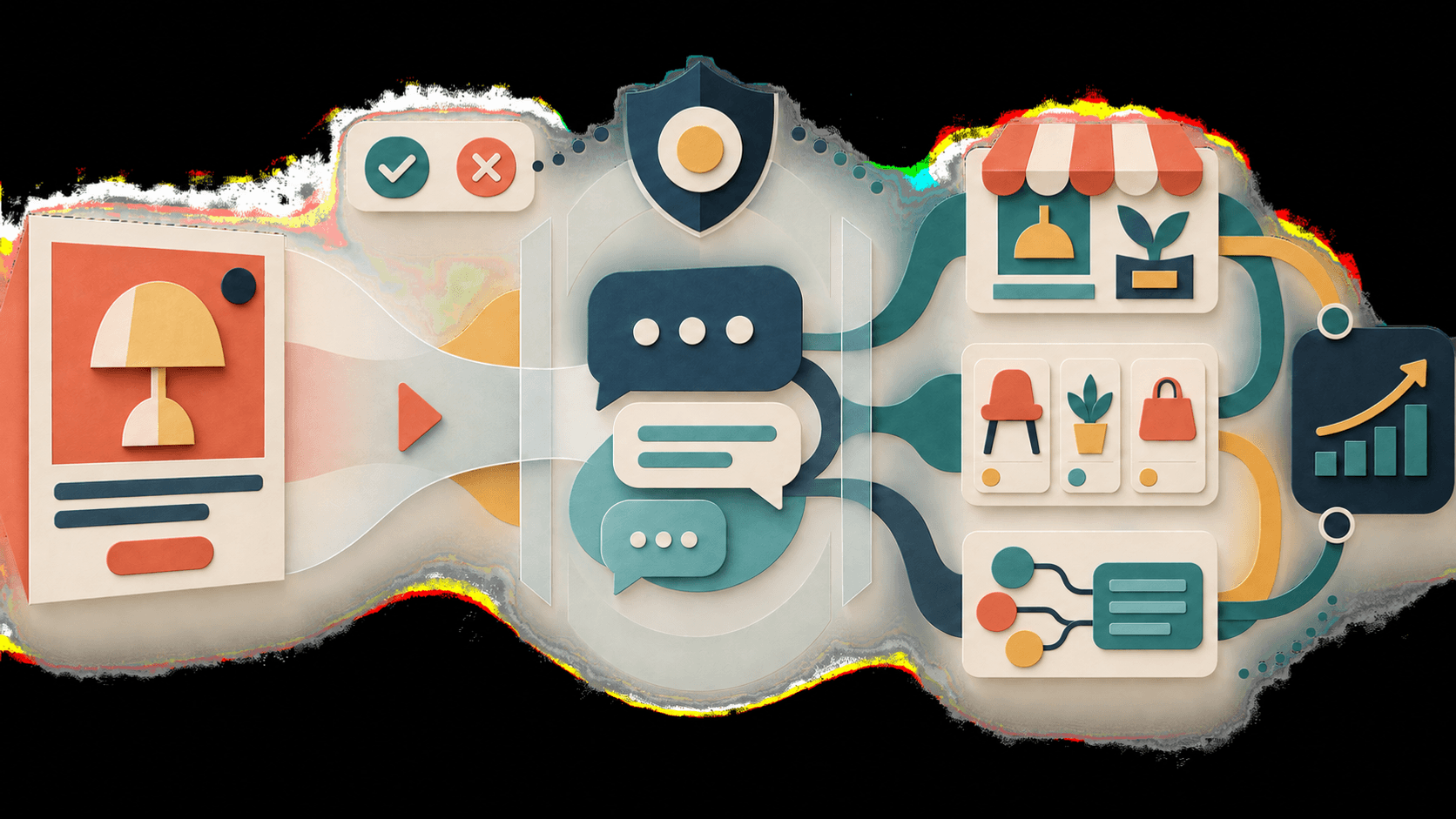
Advertisers can move from a labeled placement into a separate business-sponsored conversation, while new CRM and commerce links bring campaign creation and measurement closer to existing workflows.
Bottom line
ChatGPT Ads now includes a U.S. test of Sponsored Agents plus HubSpot and Shopify integrations. Here is what marketers and users should understand before treating conversation as conversion.
Editorial accountability
Who checked this guide
- Evaluation type
- Research-based verification
- Last materially checked
- Evidence
- 4 listed sources
Hands-on testing is identified explicitly. Research-based coverage uses cited product documentation and other named sources; it does not imply every paid plan was used. Read the full methodology.
Editorial basis
What this guidance is based on
- Editorial basis
- Source-led analysis
- Primary references
- 4
- Products covered
- 1
- Last checked
- 2026-09-16
Important limits
- • Features, availability, and pricing can change after publication; confirm consequential details with the provider.
In this guide
*This research-based analysis covers OpenAI's September 16, 2026 announcement and advertising policies available that day. DiscoverAI has not run a ChatGPT Ads campaign. Availability, performance, and product behavior attributed to OpenAI are provider claims and can change during testing.*
The short answer
OpenAI is testing Sponsored Agents that let a person move from a clearly labeled ChatGPT ad into a separate conversation with a business-sponsored agent. The test is limited to select U.S. advertisers. OpenAI also launched ChatGPT Ads connections for HubSpot and U.S. Shopify merchants, alongside prompt-based campaign creation, text customization, image tools, video generation, and storyboard features.
The important boundary is separation. OpenAI says the sponsored conversation is distinct from ChatGPT's independent answer and from the conversation in which the ad appeared. For marketers, this creates a lower-friction product-discovery channel. It does not prove that a chat is incremental demand, a qualified lead, or an accurate product adviser.
What are Sponsored Agents?
After a relevant ad appears, a user can choose to open a labeled conversation with the advertiser's agent, ask follow-up questions, and follow a link to the advertiser's site. That format can answer questions that do not fit inside a display unit: dimensions, compatibility, availability, care, or which option matches a stated constraint.
The agent is sponsored, so teams should treat every response as advertising. Product claims, prices, inventory, eligibility, disclosures, and comparisons need current source data and monitoring. A fluent conversation can amplify stale catalog data or an unsupported claim more persuasively than a static ad.
What do the HubSpot and Shopify integrations add?
Businesses using HubSpot can connect a ChatGPT Ads account, create campaigns, monitor performance, and follow up on leads using HubSpot context. U.S.-based Shopify merchants can connect catalog and measurement tools through the ChatGPT Ads app; OpenAI says international availability in supported ad markets begins September 23.
These integrations reduce workflow switching, but they also widen the data path. Before connecting them, document which contacts, catalog fields, events, audiences, and conversion signals move between systems. Use least-privilege access, separate test properties, verify deletion and revocation, and ensure consent language covers the actual data flow.
What privacy and policy controls matter?
OpenAI's ad policies prohibit placements in sensitive or brand-unsafe contexts and say machine-learning systems review ads, landing pages, and advertiser signals. Its advertising terms also give OpenAI control over labeling, placement, review, rejection, and delivery. Those safeguards reduce some risks; they do not transfer responsibility for lawful targeting or truthful creative.
The Ad Tools Terms make advertisers responsible for generated creative, substantiation, current pricing and availability, endorsements, rights, and any legally required synthetic-content disclosure. Teams should keep human approval on, archive approved claims, and compare the live agent's answers with the current catalog and landing page.
How should advertisers test ChatGPT Ads?
Run a bounded campaign with one product family and a clean holdout. Track qualified downstream actions—not conversation starts alone—and reconcile OpenAI reporting with CRM, commerce, and first-party analytics. Review transcripts or sampled outputs only under the applicable privacy terms, and test adversarial questions, unavailable products, returns, competitor comparisons, and requests involving sensitive attributes.
Measure cost per accepted lead or sale, assisted-conversion lift, claim-error rate, stale-answer rate, handoff quality, opt-out behavior, and support load. Pause if the sponsored agent invents terms, obscures sponsorship, collects unnecessary data, or cannot reliably escalate.
The verdict
Sponsored Agents are a meaningful shift from ad impression to advertiser-controlled dialogue, while HubSpot and Shopify make the channel easier to operate. The combination could help shoppers evaluate complex products and help businesses connect discovery with follow-up.
But conversational depth is not independent advice, and engagement is not incrementality. Brands should treat the test as a governed sales surface: clearly sponsored, narrowly grounded, privacy-reviewed, independently measured, and continuously checked for claims that a static creative review might miss.
Sources and verification
Product details and claims were checked against the following primary sources.
Frequently asked questions
What is a Sponsored Agent in ChatGPT?
It is a clearly labeled, advertiser-sponsored conversation that a user can choose to open after seeing an ad. OpenAI says it is separate from ChatGPT's independent answer and the original chat.
Who can use Sponsored Agents?
OpenAI is testing Sponsored Agents with select advertisers in the United States. The announcement does not provide general pricing or a universal availability date.
How does ChatGPT Ads work with Shopify and HubSpot?
The integrations let eligible businesses connect campaign creation and performance workflows with Shopify catalog and measurement data or HubSpot CRM context and lead follow-up.
Who is responsible for AI-generated ad claims?
OpenAI's Ad Tools Terms place responsibility on advertisers for generated creative, claim accuracy and substantiation, current pricing and availability, rights, and required disclosures.
Found this useful?
Get the next one in your inbox.
One five-minute briefing a week: a meaningful change, a practical workflow, and a clearer tool decision—already filtered for lean teams.
Free · one email a week · unsubscribe any time
Tools mentioned in this article
ChatGPT
The general-purpose AI assistant that started it all
OpenAI's flagship conversational AI model, powering everything from casual chat to complex reasoning, coding, and creative work.
Read next
Recommended for you

AI Implementation for Small Business: Launch Your First Workflow in 30 Days
A delivery-focused companion to AI readiness: take one approved use case from baseline to a monitored production decision.
A four-week implementation playbook for turning a qualified small-business AI use case into a controlled, measured workflow.
Read guide
How to Automate Business Tasks With Zapier and AI in 2026
Claude vs. ChatGPT for Small Business in 2026: Which Should You Pay For?
JobCopilot Review 2026: Is AI Auto-Apply Worth It?