In this guide
What happened
Anthropic announced Claude Fable 5.2 and Claude Mythos 5.2 on November 9, 2026. The update targets demanding technical work. The important distinction for buyers is which model they can use, under which safeguards, and whether the additional capability is worth the complete task cost.
This November 13 analysis is based on Anthropic’s launch report. DiscoverAI did not run the models, reproduce the benchmarks or verify the reported scientific and engineering outcomes.
Free AI tool buyer checklist
Make the next AI subscription earn its place.
Get the weekly top 5 AI tools, one practical workflow and one way to reduce AI spending. Includes a free buyer checklist.
Access and pricing
Anthropic describes Fable and Mythos as sharing an underlying model, with different safeguards and access. Organizations seeking Mythos for eligible cybersecurity or biomedical work must apply through verification programs. General Fable availability should not be read as unrestricted Mythos availability.
The announcement lists base API rates of $8 per million input tokens and $40 per million output tokens. Optional fast mode is listed at $16 and $80 respectively. Anthropic still recommends starting most coding and knowledge work with Opus 5.5 and changing models when task difficulty warrants it.
The reported coding, science and efficiency improvements come from Anthropic and its testing partners. They provide leads for evaluation, not proof that every organization can reproduce the results.
Why escalation can be more useful than replacement
Our interpretation is that a more capable technical model may be most valuable at a particular bottleneck. Identify where the current workflow stalls: understanding an unfamiliar system, resolving conflicting evidence, planning a risky change or reviewing a complex result. Route that bounded problem to the candidate before moving routine work with it.
This keeps the comparison intelligible. If you change the model, tools, instructions and review process simultaneously, you cannot tell which change helped. Retain a small set of cases that your existing system handles well and some it handles badly.
A proposed technical pilot
For a software team, choose an issue with a reproducible failure and a clear acceptance condition. Give the candidate a separate workspace with the same dependencies and test commands as the baseline. Ask for a plan, a minimal change and evidence that the issue is resolved.
Review whether the patch solves the actual problem, introduces unrelated edits or weakens a check. Record the reviewer’s time and the number of follow-up turns. A successful run should include a useful explanation of what remains unverified.
For analytical work, provide a fixed source packet and a list of claims whose support can be checked. Include one deliberately unanswered question. Reward the model for preserving that uncertainty rather than manufacturing a complete-looking report.
Fast mode needs its own business case
At the stated rates, fast mode doubles the input and output price. That can be sensible when reduced waiting has real value, but token speed and end-to-end completion time are different measures. Tool execution, human review and retries can dominate a workflow.
Set a budget and stop condition before the pilot. For example, decide how much additional cost is acceptable to resolve a task that otherwise requires a specialist’s intervention. This is a proposed evaluation rule, not a claim about savings or an estimate of model reliability.
What readers should do
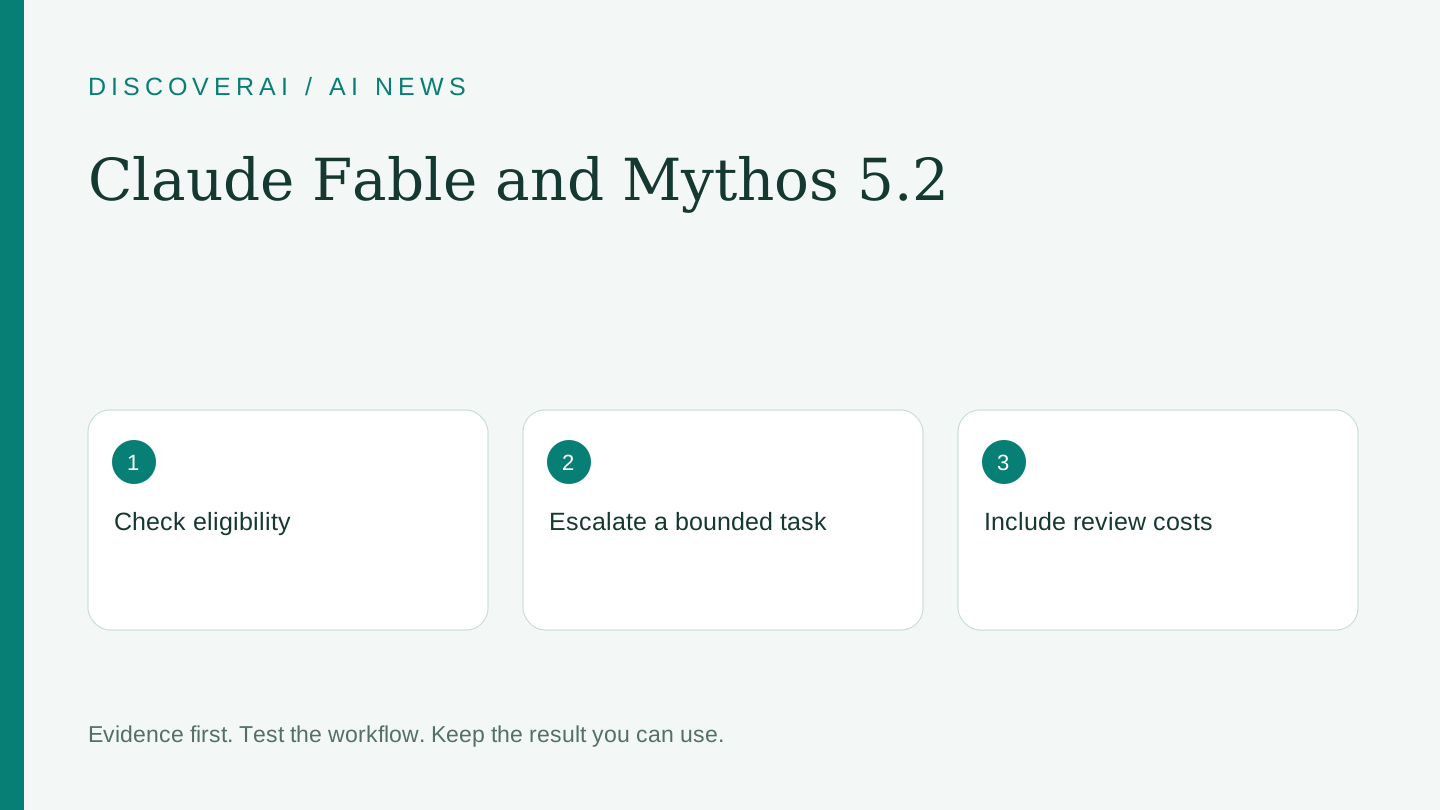
Confirm eligibility, account access and processing terms for the intended use. Keep existing review and approval controls during the pilot. Our AI model router test offers a way to compare routes, while My Tools can hold your private trial notes.
The useful outcome is a documented decision about when to escalate. A compelling launch demonstration alone does not establish that a model should become the default for every task.
Transparency
How this guide was checked
Editorial accountability
Who checked this guide
- Evaluation type
- Research-based verification
- Last materially checked
- Evidence
- 1 listed sources
Hands-on testing is identified explicitly. Research-based coverage uses cited product documentation and other named sources; it does not imply every paid plan was used. Read the full methodology.
Editorial basis
What this guidance is based on
- Editorial basis
- Source-led analysis
- Primary references
- 1
- Products covered
- 1
- Last checked
- 2026-11-13
Important limits
- • Features, availability, and pricing can change after publication; confirm consequential details with the provider.
Sources and references
References cited by this article. Check the original source for scope, dates and current terms.
Frequently asked questions
Is Mythos access the same as Fable access?
No. The announcement describes verification programs for eligible Mythos use.
How does fast-mode pricing differ?
The announced fast-mode input and output rates are double the base rates.
Does this article verify the reported scientific results?
No. Those are attributed provider reports, not independently reproduced findings.
Tools mentioned in this article
Claude
Anthropic's thoughtful, safety-focused AI with exceptional long-form reasoning
Claude excels at deep analysis, long-form writing, and nuanced reasoning. Built by Anthropic with a focus on safety and helpfulness.
Read next