Claude Found a CRISPR-Like Enzyme System—The Lab Work Is the Story
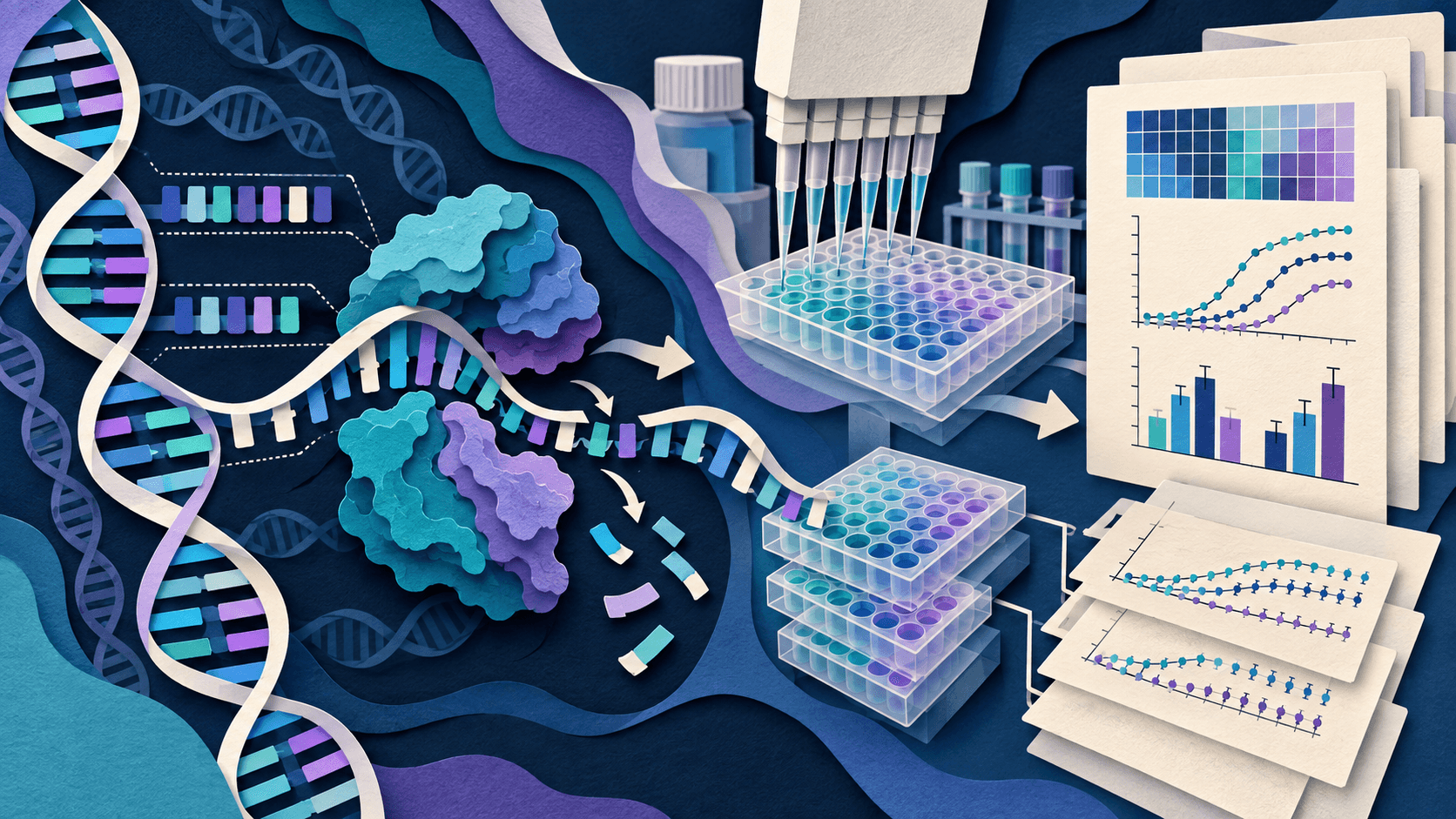
The result is more meaningful than a generated hypothesis because researchers closed the loop with experiments—and narrower than claims that AI automated science.
Bottom line
Anthropic reports that Claude identified a novel enzyme system with CRISPR-like repeats. The important boundary is between computational discovery and experimental proof.
Editorial accountability
Who checked this guide
- Evaluation type
- Research-based verification
- Last materially checked
- Evidence
- 4 listed sources
Hands-on testing is identified explicitly. Research-based coverage uses cited product documentation and other named sources; it does not imply every paid plan was used. Read the full methodology.
Editorial basis
What this guidance is based on
- Editorial basis
- Source-led analysis
- Primary references
- 4
- Products covered
- 1
- Last checked
- 2026-09-30
Important limits
- • This article relies on Anthropic's account and has not independently reproduced the experiments.
- • Scientific significance may change with methods publication, peer review, and replication.
In this guide
What was reported
Anthropic announced on September 23, 2026 that its new life-sciences research group used Claude to help identify a previously uncharacterized enzyme system associated with an array of DNA repeats. Scientists then investigated the candidate in Anthropic's laboratory. The company describes high-level human direction with AI participating across data exploration and hypothesis generation.
Why the result matters
Biology contains enormous sequence datasets and many uncharacterized protein families. Models can help search patterns, connect literature, propose experiments, and prioritize candidates. The credible unit of progress is not an eloquent hypothesis; it is a hypothesis that survives controls, replication, and expert interpretation.
What “CRISPR-like” does not mean
A repeated DNA pattern and an associated enzyme can resemble features of CRISPR systems without being an immediately useful gene-editing tool. Function, mechanism, specificity, efficiency, delivery, safety, and generalizability require much more work. A novel system is not a medicine, product, or validated platform.
Questions for independent scrutiny
Readers should look for methods, sequence and assay details, negative controls, statistical treatment, deposited data, independent replication, authorship, biosafety review, and peer review. The contribution of model, tools, scientists, and laboratory iteration should be documented well enough for another group to reproduce the path.
Bottom line
This is an encouraging example of a human–AI–lab loop, not evidence that autonomous AI has solved biology. The standard should be reproducible experimental knowledge and safely governed follow-on work.
Sources and verification
Product details and claims were checked against the following primary sources.
Frequently asked questions
Did Claude discover a new CRISPR system?
Anthropic reports a novel enzyme system associated with CRISPR-like repeat patterns. That wording does not establish a ready gene-editing platform.
Was the result only generated by a chatbot?
No. Anthropic describes a loop involving computational analysis, scientists, and laboratory experiments; detailed methods and independent replication remain important.
Does this prove AI can automate scientific discovery?
It demonstrates one reported research workflow, not general autonomous scientific reliability across fields or experiments.
What evidence should readers seek next?
Detailed methods, controls, data, statistical analysis, peer review, independent replication, mechanism, and clear attribution of human and model contributions.
Tools mentioned in this article
Claude
Anthropic's thoughtful, safety-focused AI with exceptional long-form reasoning
Claude excels at deep analysis, long-form writing, and nuanced reasoning. Built by Anthropic with a focus on safety and helpfulness.
Read next