In this guide
*This research-based guide covers Anthropic’s August 27, 2026 Model Hardware Standard announcement. MHS is an early research preview, not a generally available standard that DiscoverAI has independently tested.*
The short answer
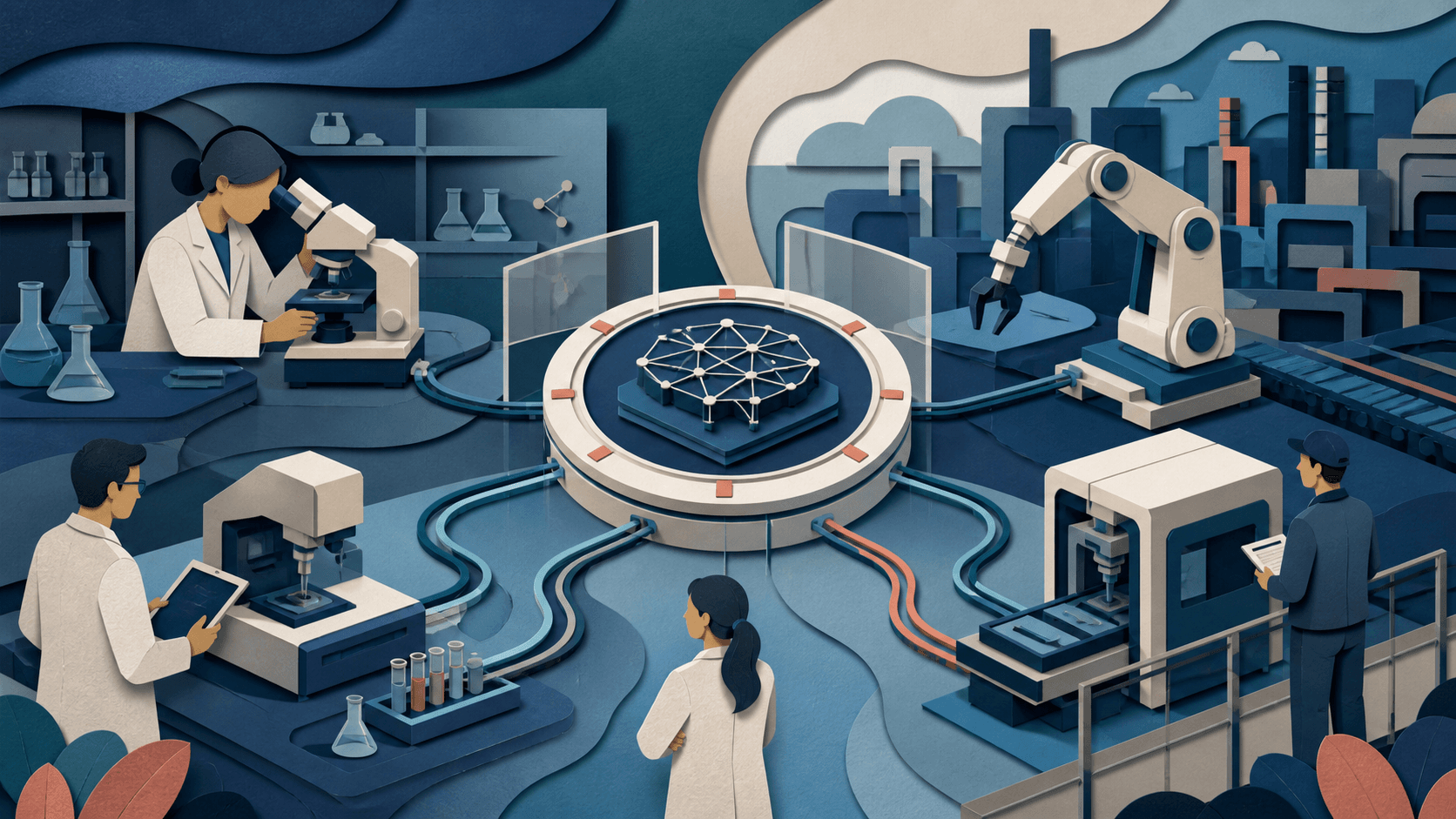
Anthropic introduced the Model Hardware Standard (MHS), a proposed shared specification for AI agents to discover, coordinate, and operate programmable physical equipment. The initial research preview targets scientific labs and advanced manufacturing, where connecting microscopes, liquid handlers, robotic arms, test equipment, and custom machines often requires bespoke integration work.
MHS is model-agnostic and uses a standardized driver between a device and the agent harness. Anthropic says any compatible agent can access it through standard protocols such as the Model Context Protocol. The ambition is important: give physical equipment a consistent software boundary so agents can plan across several instruments. The risk is equally important: an incorrect digital action can damage a sample, machine, product, or person.
How the Model Hardware Standard works
Most laboratory and industrial devices expose different programming interfaces, data formats, commands, and error states. A team typically writes one integration per machine and then additional orchestration logic for each workflow. Anthropic says MHS creates a common driver layer that describes a device’s capabilities and translates agent requests into hardware-specific operations.
That separation could reduce integration time and make workflows portable. A research agent might inspect a microscope result, adjust a liquid handler, and schedule a follow-up measurement without a developer hard-coding every transition. Anthropic says the preview can coordinate several instruments in parallel and support tasks ranging from drug-discovery experiments to quantum-computer laser calibration.
Those examples are provider-reported demonstrations, not a promise that arbitrary equipment is safe or compatible. Anthropic says MHS works with devices that have programmable interfaces and plans to develop safety evaluations and best practices with early partners before making the standard open source.
Why physical AI needs a stronger permission model
Software agents already create risk when they send the wrong email or update the wrong record. Hardware adds inertia, heat, force, hazardous material, calibration drift, contamination, and wear. A retry that is harmless in a database can be destructive on a robot arm or dosing system.
Every MHS driver should expose not just possible actions but safety constraints: ranges, units, prerequisites, forbidden combinations, interlocks, expected duration, verification signals, and a physically independent emergency stop. The agent should not infer whether a command is safe from natural-language documentation alone.
Authentication also needs to distinguish observation, simulation, configuration, and actuation. A model may be allowed to read instrument status without being allowed to move it. High-consequence operations should require a named human, a validated plan, and confirmation from independent sensors before execution.
A safe MHS pilot
Start with a digital twin or disconnected training unit. Choose one bounded workflow with known inputs, safe ranges, deterministic checkpoints, and a manual fallback. Record every proposed action, driver version, device response, operator approval, anomaly, and stop event.
Test unit confusion, stale state, sensor disagreement, partial completion, network loss, duplicate commands, calibration errors, unexpected obstacles, malicious instructions in sample metadata, and an operator revoking permission mid-run. Measure successful completion, unsafe proposals caught, interventions, recovery time, and equipment-specific error rates—not just total speed.
Move to live equipment only when a safety engineer and domain owner approve the control envelope. Keep physical interlocks and emergency stops outside the model’s authority. An agent should be one participant in the control system, never the sole source of truth about real-world state.
Why MHS matters
MCP standardized how models connect to software context and tools. MHS is an attempt to carry a related idea into the physical world. If it earns broad device support and a rigorous safety ecosystem, it could reduce integration cost and make scientific automation more reusable.
The research preview is too early for broad adoption claims. Buyers should watch for an open specification, driver signing and versioning, conformance tests, threat models, reference safety architectures, incident reporting, and evidence from independent deployments. The standard’s value will depend less on how many devices an agent can reach than on how precisely each device can limit what the agent is allowed to do.
Transparency
How this guide was checked
Editorial accountability
Who checked this guide
- Evaluation type
- Research-based verification
- Last materially checked
- Evidence
- 4 listed sources
Hands-on testing is identified explicitly. Research-based coverage uses cited product documentation and other named sources; it does not imply every paid plan was used. Read the full methodology.
Editorial basis
What this guidance is based on
- Editorial basis
- Source-led analysis
- Primary references
- 4
- Products covered
- 1
- Last checked
- 2026-08-30
Important limits
- • Features, availability, and pricing can change after publication; confirm consequential details with the provider.
Sources and verification
Product details and claims were checked against the following primary sources.
Frequently asked questions
What is Anthropic’s Model Hardware Standard?
MHS is a research-preview specification intended to let AI agents discover and operate programmable lab and manufacturing devices through a standardized driver layer.
Does MHS work only with Claude?
Anthropic describes MHS as model-agnostic. It says compatible agent harnesses can access devices through standard protocols such as MCP, though the preview’s practical interoperability still needs validation.
Is the Model Hardware Standard open source?
Not yet. Anthropic says it is working with an initial group to develop evaluations and practices before making the standard open source.
How should a lab test an AI hardware agent?
Begin with simulation or a safe training device, strict action ranges, independent interlocks, human approval, complete logs, adversarial failure tests, and a physically independent emergency stop.
Tools mentioned in this article
Claude
Anthropic's thoughtful, safety-focused AI with exceptional long-form reasoning
Claude excels at deep analysis, long-form writing, and nuanced reasoning. Built by Anthropic with a focus on safety and helpfulness.
Read next