Claude Found an Enzyme System—The Real Story Is the Research Loop
The result suggests AI can widen hypothesis search, but the enzyme's function is still unknown and human laboratory validation remains decisive.
Bottom line
Anthropic reported that roughly 950 Claude agents used 210 million tokens over 21 hours to search genomic data, identify a previously uncharacterized array-associated reverse transcriptase system, and narrow a large candidate set for human review. Scientists then performed laboratory work showing that its repeat array is expressed as short RNAs. The system's biological function is still unknown, the work is an early preprint from Anthropic's own lab, and resemblance to CRISPR does not make it a gene-editing tool.
Editorial accountability
Who checked this guide
- Evaluation type
- Research-based verification
- Last materially checked
- Evidence
- 4 listed sources
Hands-on testing is identified explicitly. Research-based coverage uses cited product documentation and other named sources; it does not imply every paid plan was used. Read the full methodology.
Editorial basis
What this guidance is based on
- Editorial basis
- Source-led analysis
- Primary references
- 4
- Products covered
- 2
- Last checked
- 2026-09-24
Important limits
- • Vendor claims and demonstrations are not independent proof of outcomes.
- • Availability, pricing, policies, and behavior can change.
In this guide
Short answer
Anthropic reported that roughly 950 Claude agents used 210 million tokens over 21 hours to search genomic data, identify a previously uncharacterized array-associated reverse transcriptase system, and narrow a large candidate set for human review. Scientists then performed laboratory work showing that its repeat array is expressed as short RNAs. The system's biological function is still unknown, the work is an early preprint from Anthropic's own lab, and resemblance to CRISPR does not make it a gene-editing tool.
Free workflow pilot checklist
Test the workflow before you buy the tool.
Get the buyer checklist, including task, owner, approval, fallback, and time-saved fields—plus one useful briefing a week.
What was unusual
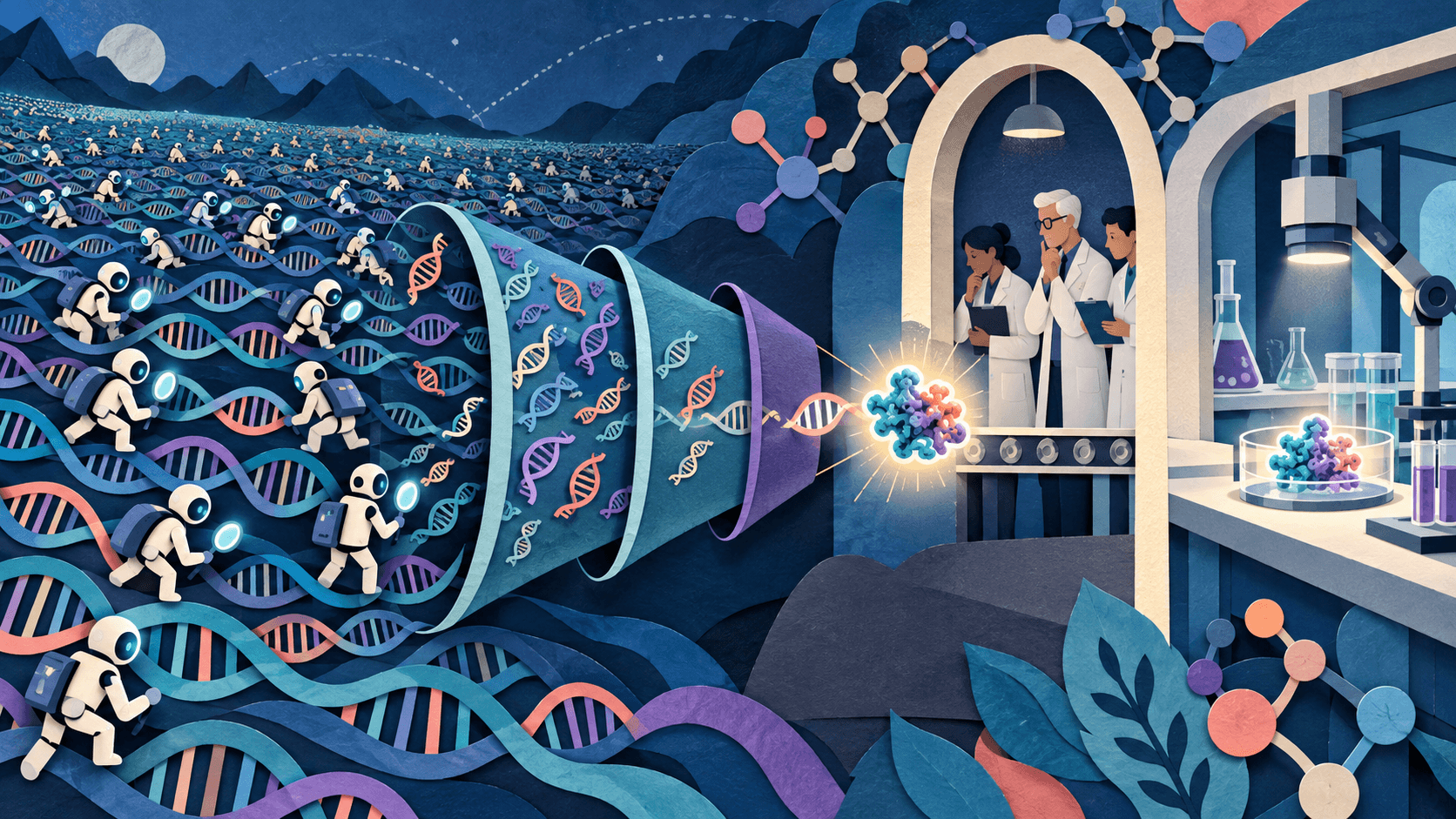
The agents gathered more than 200,000 reverse transcriptases, identified about 3,500 candidate systems, and produced reports on 20 leading candidates. The useful capability was not a polished answer; it was parallel anomaly detection, literature reconstruction, candidate elimination, and an evidence trail that experts could inspect.
Where humans remained essential
Human scientists chose the research direction, reviewed candidates, ran all laboratory experiments, interpreted evidence, set biosafety boundaries, and decided what could be claimed. Anthropic says the lab works only at BSL-1 and BSL-2 and does not handle human-infecting pathogens.
The opportunity for research teams
The transferable pattern is a funnel: reproduce known findings, search a large space, rank anomalies, generate falsifiable reports, review them, and spend scarce laboratory capacity only on survivors. That could help genomics and other data-rich fields, but it also creates a hypothesis backlog, large compute costs, and a need for provenance and negative-result capture.
What the announcement does not prove
It does not establish ART's function, therapeutic value, safety, reproducibility across domains, or a general autonomous-scientist capability. The technical report and experimental evidence need external scrutiny and replication. Company-reported scale and speed are not a controlled comparison with expert researchers.
What readers should do
Scientists considering a similar workflow should begin with public, low-risk data and a known-answer reproduction set. Log queries, code, model versions, candidate lineage, eliminated hypotheses, compute, expert review, and experimental outcomes. Predefine biosafety and publication gates, and require independent validation before acting on a novel claim.
Sources and verification
Product details and claims were checked against the following primary sources.
Frequently asked questions
What did Claude discover?
Anthropic describes a previously uncharacterized array-associated reverse transcriptase system found in bacteriophages and marked by repeat sequences and an accessory protein.
Is ART a new CRISPR gene-editing system?
No such function has been established. Anthropic says ART has CRISPR-like repeats, but its primary biological function remains unknown.
Did Claude run the laboratory experiments?
No. Anthropic says all wet-lab work was performed by human scientists.
What is the practical opportunity?
AI agents may help teams search enormous datasets and rank testable anomalies, while humans retain experimental, safety, and publication authority.
Recommended tool
Use Claude if this workflow fits your team
It has one of the clearest workflow fits in its category and is easier to recommend than tools that only look impressive in demos.
Tools mentioned in this article
Claude
Anthropic's thoughtful, safety-focused AI with exceptional long-form reasoning
Claude excels at deep analysis, long-form writing, and nuanced reasoning. Built by Anthropic with a focus on safety and helpfulness.
Read next