In this guide
Short answer
Anthropic’s October 13 report describes an internal source-control migration; the useful lesson is to measure review and CI pressure before accelerating code production.
What Anthropic reported
In its October 13 engineering report, Anthropic says daily merged changes rose from about 2,500 in May to over 30,000 in September. It reports migrating its monorepo to an internal system called Scion in five months, alongside the Antique review interface. Scion favors online clients and centralized repository operations. These are first-party operational claims, not a benchmark reproduced by DiscoverAI.
The boundary readers should preserve
The company describes an unusually large repository and agent-heavy workload. This is an internal infrastructure case study, not an announcement of a generally available Git replacement. Merged-change counts do not establish correctness, customer value or an appropriate target for another engineering team.
Our analysis: measure the queue that follows generation
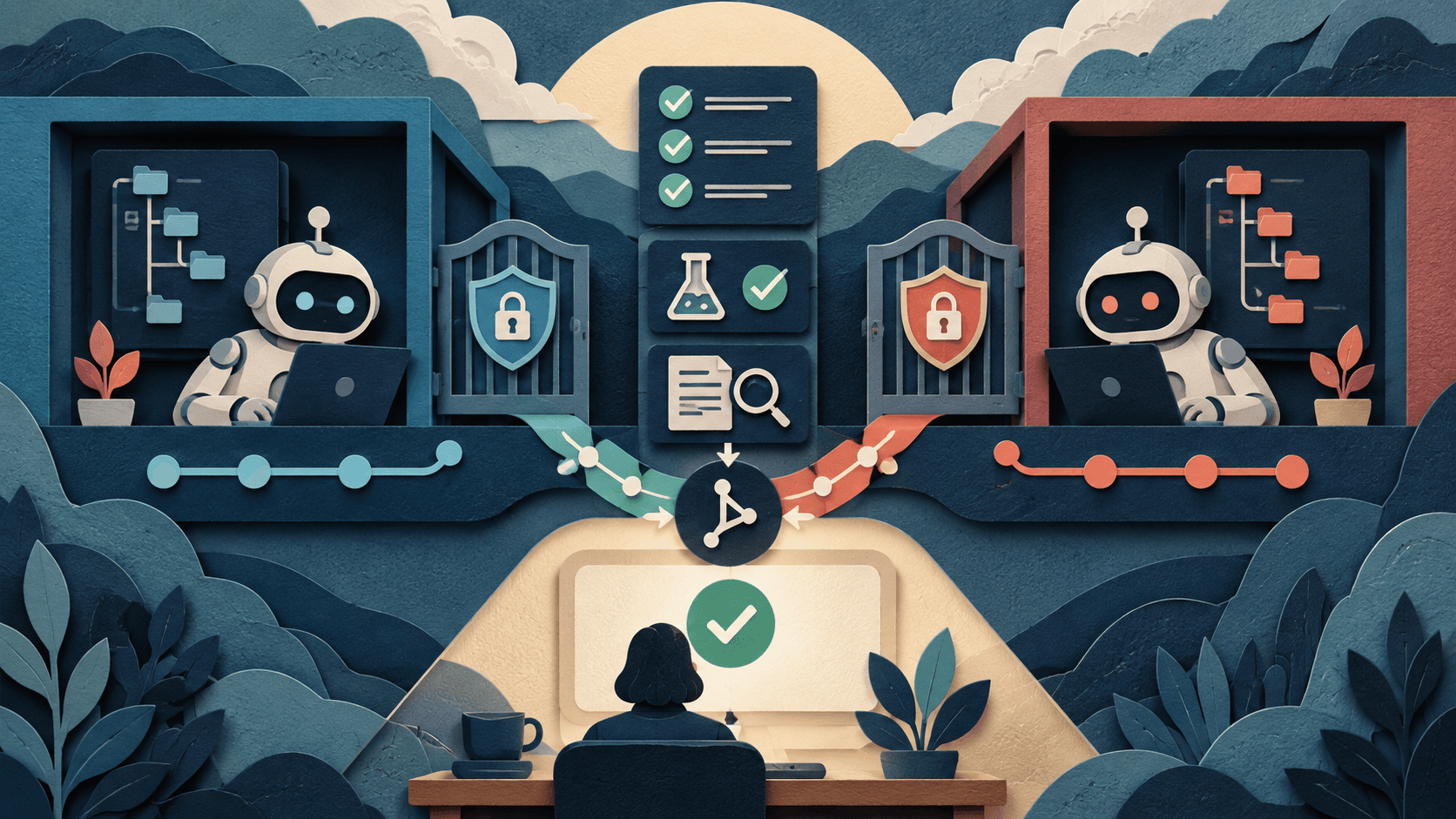
Faster drafting can move the constraint to review. If reviewers cannot explain a patch, a green check is weak evidence that the change belongs in production. More output may also increase the number of CI jobs competing for resources. The right question for a small team is which queue currently delays a useful, accepted change.
Track time from draft to review, review to accepted revision and accepted revision to release. Record reversions and defects beside throughput. Compare changes of similar scope so a formatting patch does not count as equal to a risky integration. Keep the denominator visible: accepted improvements, rather than raw lines written.
A practical response for smaller teams
Choose a two-week pilot with one owner and a narrow task class. Require each AI-assisted patch to explain the user-visible behavior, affected permissions and rollback path. Set a limit on concurrent review requests. When the queue reaches that limit, finish revisions before generating another pile of drafts.
Keep CI failure categories separate: test failures, environment failures and resource contention need different remedies. A team that is waiting on flaky checks should fix those checks before considering a new repository architecture. This is our editorial implementation advice, not a claim that Anthropic measured the same intervention.
What to watch next
Look for independently documented reliability, migration costs and workloads where online-only assumptions fail. For most readers, the immediate action is better queue measurement. Read our automation retry guide for another case where more AI output creates operational work.
Transparency
How this guide was checked
Editorial accountability
Who checked this guide
- Evaluation type
- Research-based verification
- Last materially checked
- Evidence
- 1 listed sources
Hands-on testing is identified explicitly. Research-based coverage uses cited product documentation and other named sources; it does not imply every paid plan was used. Read the full methodology.
Editorial basis
What this guidance is based on
- Editorial basis
- Source-led analysis
- Primary references
- 1
- Products covered
- 1
- Last checked
- 2026-10-14
Important limits
- • Features, availability, and pricing can change after publication; confirm consequential details with the provider.
Sources and verification
Product details and claims were checked against the following primary sources.
Frequently asked questions
Is Scion a public Git replacement?
The report describes Anthropic’s internal migration; it does not establish general product availability.
Do more merged changes prove better software?
No. Quality, defects and delivered user value need separate measurement.
Tools mentioned in this article
Claude
Anthropic's thoughtful, safety-focused AI with exceptional long-form reasoning
Claude excels at deep analysis, long-form writing, and nuanced reasoning. Built by Anthropic with a focus on safety and helpfulness.
Read next