The decision
Should you choose Unstract?
Unstract earns a pilot for document-heavy teams that need more than OCR and value deployable extraction workflows. Start with the smallest representative corpus, not polished samples. Keep human review for material fields until measured error rates and downstream controls justify automation.
Best for
Teams extracting structured data from variable business documents; Enterprises needing cloud or customer-controlled deployment.
Choose something else if
Simple native-text PDFs needing only basic parsing; Low-volume buyers unable to justify the Cloud platform minimum
Evidence
Editorial research pending · 8.2/10
Pricing checked
See current vendor pricing · Sep 11, 2026
Free access is available, with limits.
Yes. Unstract has an open-source edition, and standalone LLMWhisperer lists 100 free pages per day.
In this guide
Short answer
Unstract is worth testing when documents vary too much for templates but the business still needs structured APIs or ETL output. Its mix of parsing, extraction, prompt tooling, deployment, and self-hosting is unusually complete. Buyers should judge field-level accuracy and exception cost, because a successfully processed page is billable even when extracted values are imperfect.
Free buyer comparison checklist
Compare this tool before committing.
Use the buyer checklist to compare two tools on the same tasks, including quality, review time and total cost. Get the weekly top 5 AI tools, one practical workflow and one way to reduce AI spending.
Best for
- Teams extracting structured data from variable business documents
- Enterprises needing cloud or customer-controlled deployment
- Developers exposing document workflows through APIs, ETL, or MCP
Look elsewhere if
- Simple native-text PDFs needing only basic parsing
- Low-volume buyers unable to justify the Cloud platform minimum
- High-stakes extraction without ground truth and human exception review
What Unstract verifiably does
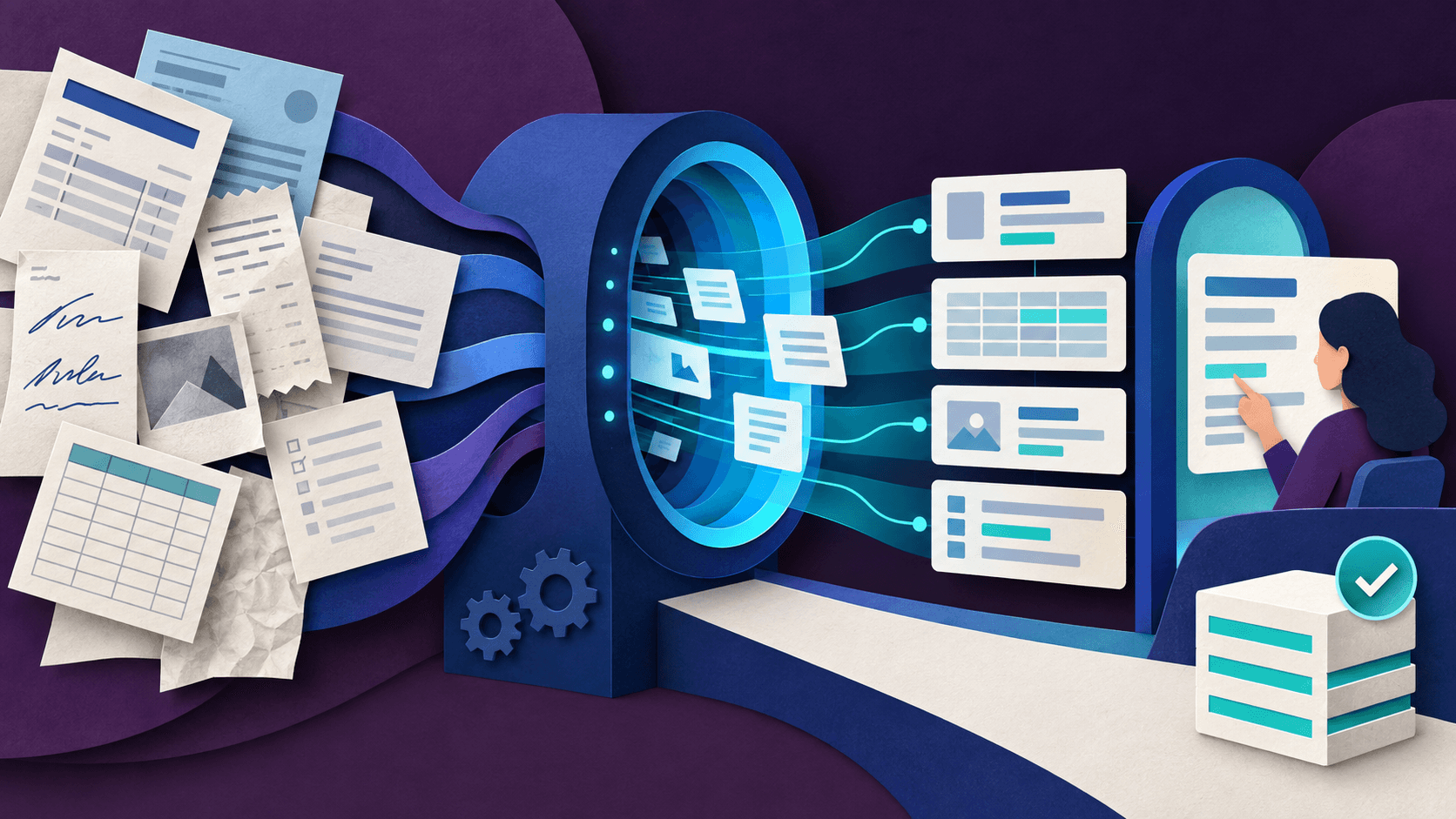
Unstract combines LLMWhisperer document parsing with Prompt Studio, structured extraction, API deployments, ETL and task pipelines, human review, and MCP access. Cloud, cloud enterprise, on-premises enterprise, and open-source editions cover different control requirements. LLMWhisperer offers modes for native PDFs, scans, handwriting, forms, and tables.
Important limitations
Document AI can silently transpose digits, miss handwriting, merge table cells, or produce valid but wrong fields. Cloud platform pricing starts well above lightweight OCR APIs, and page charges do not represent the full cost of LLM inference, review, reprocessing, and downstream corrections. Self-hosting shifts operations and security work to the buyer.
Unstract pricing
Unstract Cloud lists Starter at $499 monthly for 5,000 pages with $0.10 overage and Growth at $2,249 monthly for 25,000 pages with $0.09 overage; annual billing lowers the displayed monthly equivalents. Enterprise and self-hosted terms are custom. Standalone LLMWhisperer includes 100 free pages daily, then lists $1 to $15 per 1,000 pages depending on mode. Reviewed September 11, 2026.
A fair buyer test
Build a stratified 1,000-page set across vendors, languages, scans, tables, handwriting, rotations, blank pages, duplicate files, and adversarial instructions. Create field-level ground truth before configuration. Measure precision and recall by field, straight-through rate, human minutes per document, failed-page handling, latency, cost per accepted document, data deletion, and downstream reconciliation errors.
Final verdict
Unstract earns a pilot for document-heavy teams that need more than OCR and value deployable extraction workflows. Start with the smallest representative corpus, not polished samples. Keep human review for material fields until measured error rates and downstream controls justify automation.
This is a research-based product assessment, not a claim of hands-on long-term testing. Product, pricing, privacy, security, and usage claims were checked against the first-party sources below on September 11, 2026. Verify current terms and run the proposed test with approved data before adoption.
Transparency
How this guide was checked
Editorial accountability
Who checked this guide
- Evaluation type
- Hands-on evaluation
- Last materially checked
- Evidence
- 4 listed sources
Hands-on testing is identified explicitly. Research-based coverage uses cited product documentation and other named sources; it does not imply every paid plan was used. Read the full methodology.
Editorial freshness
Pricing and material product claims were checked September 11, 2026.
Review evidence
What this guidance is based on
- Review type
- Research-based product assessment
- Material review date
- September 11, 2026
- Evidence
- Current first-party product, pricing, documentation, privacy, and security material
- Buyer test
- Controlled quality, cost, permissions, privacy, reliability, and failure-path evaluation
Important limits
- • DiscoverAI did not complete the proposed long-term paid deployment for this review.
- • Features, prices, limits, security controls, and provider data paths can change; verify the linked first-party pages before purchase.
Standardized benchmark coverage
How this review maps to the research benchmark
Citation accuracy
Eligible · not yet runThis review describes source-grounded research, retrieval, or document work. A controlled product run is required before scoring.
Read protocol v2026.10-v1 →Thematic analysis
Not applicableThe reviewed workflow is not qualitative evidence analysis, so a thematic-analysis score would be misleading.
Read protocol v2026.10-v1 →Eligibility is not a product score. DiscoverAI publishes results only after output collection, blinded adjudication, reproducibility checks, and severe-error review.
Open the optional evaluation worksheet
Reusable trial worksheet
Test Unstract before you commit
Turn this review’s buyer test into evidence. Your entries autosave only in this browser and are never added to shared shortlist links.
Confirm the tool meets every must-have workflow and stakeholder requirement.
Review starting point: Teams extracting structured data from variable business documents; Enterprises needing cloud or customer-controlled deployment; Developers exposing document workflows through APIs, ETL, or MCP
Run the same representative work you would use in production; do not score a polished demo.
Review starting point: Build a stratified 1,000-page set across vendors, languages, scans, tables, handwriting, rotations, blank pages, duplicate files, and adversarial instructions. Create field-level ground truth before configuration. Measure precision and recall by field, straight-through rate, human minutes per document, failed-page handling, latency, cost per accepted document, data deletion, and downstream reconciliation errors.
Calculate the effective cost per accepted result, including usage, review, corrections, and required add-ons.
Review starting point: Unstract Cloud lists Starter at $499 monthly for 5,000 pages with $0.10 overage and Growth at $2,249 monthly for 25,000 pages with $0.09 overage; annual billing lowers the displayed monthly equivalents. Enterprise and self-hosted terms are custom. Standalone LLMWhisperer includes 100 free pages daily, then lists $1 to $15 per 1,000 pages depending on mode.…
Define an acceptance threshold, test known answers and edge cases, and record every correction.
Review starting point: Editorial quality signals: features 4.3/5; AI quality 4.1/5. Validate these signals in your own work.
Verify what data enters the product, who can access it, how long it is retained, and whether it trains models.
Review starting point: Use approved low-risk data first. Check roles, consent, deletion, subprocessors, model-training settings, and the contract—not only the marketing page.
Test the real handoffs, permissions, failure states, and export path your team depends on.
Review starting point: OpenAI, Azure OpenAI, Postgres, Cloud storage, n8n, MCP
Record training, governance, reliability, accessibility, ownership, and change-management risks before rollout.
Review starting point: Cloud platform starts at $499 monthly; Processed pages can be billable despite imperfect output; Self-hosting adds operational responsibility
Loading saved worksheet… · private to this device or your optional account
Community evidence
How verified users put Unstract to work
Structured, editor-moderated experience—not star ratings. This complements our independent review and never changes its score.
No approved community evidence yet. Be the first verified user to contribute.
Community choice
Recommend Unstract
Loading weekly votes…
One vote per verified account per tool, counted for seven days. Return after your vote expires to support again. Community votes influence homepage trends, never editorial ratings. Voting does not subscribe you to emails.
Sources and references
References cited by this article. Check the original source for scope, dates and current terms.
Frequently asked questions
What is Unstract?
Unstract is a document AI platform for parsing files, extracting structured fields, and deploying the result through APIs, ETL pipelines, or MCP.
How much does Unstract cost?
Cloud starts at $499 monthly; LLMWhisperer lists 100 free pages daily and then $1 to $15 per 1,000 pages by processing mode; Enterprise is custom.
Can Unstract be self-hosted?
Yes. Unstract offers an open-source edition and custom on-premises Enterprise deployment, with feature and support differences between editions.
Does Unstract guarantee correct extraction?
No. It does not charge for provider-side technical failures, but successfully processed pages can still contain imperfect extraction and require validation.
Recommended tool
Use Unstract if this workflow fits your team
End-to-end parsing, extraction, and deployment
Tools mentioned in this article
Unstract
Turn complex business documents into structured data through cloud or self-hosted workflows
Unstract is an intelligent document-processing platform that combines parsing, OCR, LLM-based structured extraction, prompt tooling, API deployment, ETL workflows, and optional human review.
LlamaCloud
Parse difficult files, extract structured fields, and build managed document indexes for AI workflows
LlamaCloud is LlamaIndex's hosted document platform for parsing complex files, extracting schemas, and building searchable indexes for agents and retrieval applications.
Airweave
Continuously sync app and database content into a shared search layer for AI agents
Airweave offers an open-source context retrieval layer that syncs many source systems into reusable collections, but freshness, permissions, deletion, retrieval quality, and entity-based limits need proof.
Read next