Recall Review 2026: Pricing, AI Knowledge Base, and Fit
Recall can turn scattered reading into a connected personal library, but summary accuracy, retrieval quality, privacy, and export completeness decide whether it lasts.
Bottom line
Recall combines read-later capture, summaries, a knowledge graph, AI chat, quizzes, API, and MCP. Test it against a real archive before committing.
The decision
Should you choose Recall?
Shortlist Recall when the job is turning personal reading and viewing into a connected, reusable learning library. Test capture accuracy, retrieval, source traceability, export, and correction effort before moving an existing archive.
Best for
Individuals building a long-lived research or learning library; Readers who want saved sources to resurface automatically.
Choose something else if
Teams needing shared permissions and enterprise administration; Users who require local-only storage for all content
Evidence
Verified research · rating withheld
Pricing checked
See current vendor pricing · 2026-10-03
Free access is available, with limits.
Unlimited read-later saves and notes, with 10 AI summaries per month according to the current pricing page.
Editorial accountability
Who checked this guide
- Evaluation type
- Hands-on evaluation
- Last materially checked
- Evidence
- 5 listed sources
Hands-on testing is identified explicitly. Research-based coverage uses cited product documentation and other named sources; it does not imply every paid plan was used. Read the full methodology.
Editorial freshness
Pricing and material product claims were checked October 3, 2026.
Review evidence
What this guidance is based on
- Evaluation type
- Research-based product assessment
- Material review date
- October 3, 2026
- Evidence
- Current first-party product materials and authoritative implementation guidance
Important limits
- • DiscoverAI did not run a long-term paid Recall deployment or a controlled retrieval benchmark.
- • Pricing, limits, supported formats, model routing, integrations, privacy practices, storage, and export behavior can change.
Standardized benchmark coverage
How this review maps to the research benchmark
Citation accuracy
Eligible · not yet runThis review describes source-grounded research, retrieval, or document work. A controlled product run is required before scoring.
Read protocol v2026.10-v1 →Thematic analysis
Not applicableThe reviewed workflow is not qualitative evidence analysis, so a thematic-analysis score would be misleading.
Read protocol v2026.10-v1 →Eligibility is not a product score. DiscoverAI publishes results only after output collection, blinded adjudication, reproducibility checks, and severe-error review.
In this guide
Short answer
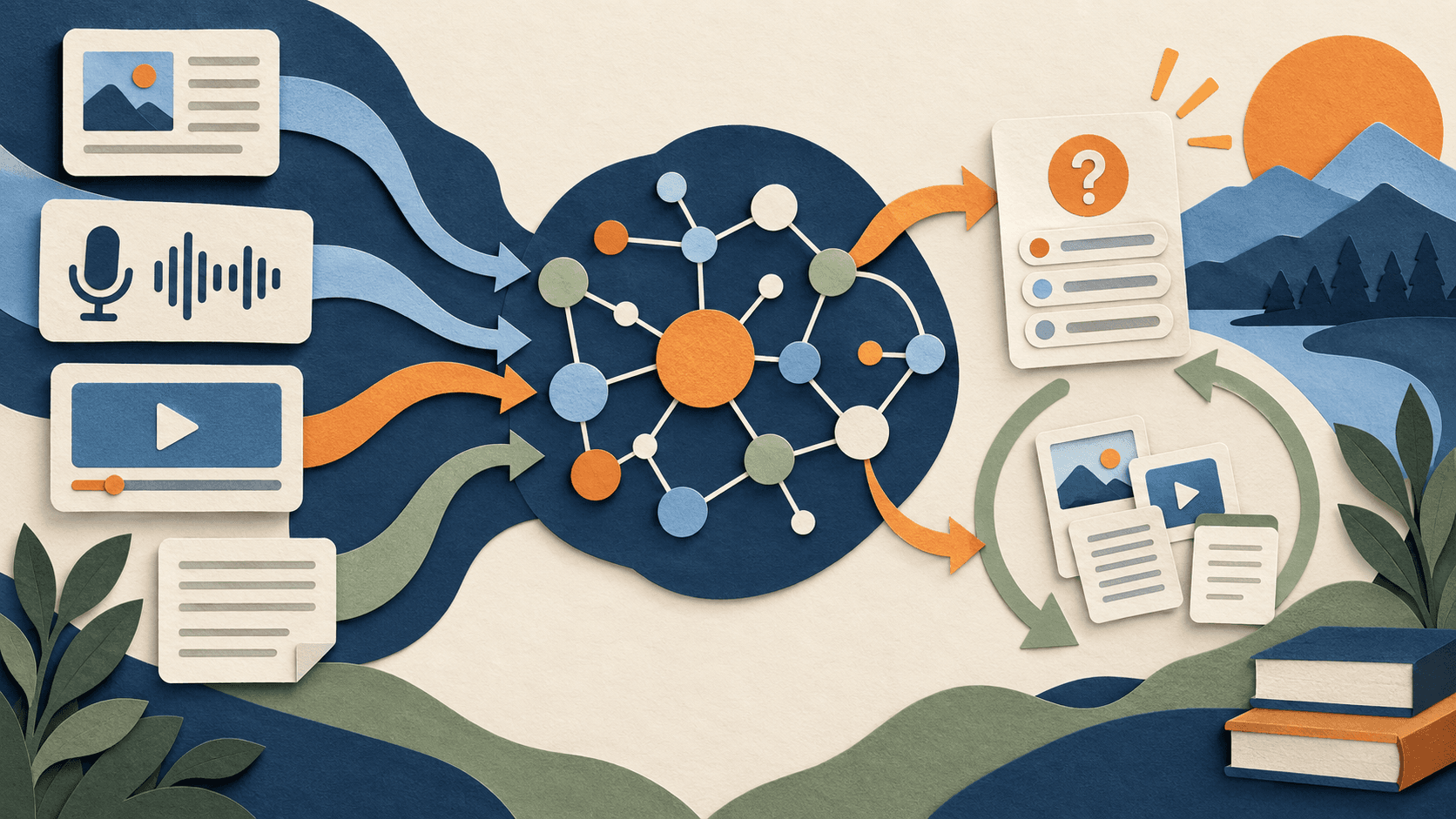
Recall is worth testing for researchers, students, analysts, writers, and developers who want the material they consume to become a searchable, connected personal knowledge base. It captures articles, videos, podcasts, PDFs, and notes, then adds summaries, automatic tags, graph links, chat, quizzes, spaced repetition, API access, and MCP.
Choose it for a personal learning system, not a governed team wiki. Its AI output remains a navigation aid: verify consequential claims, quotes, and interpretations against the original source.
Plans and pricing
Recall currently advertises a free plan with unlimited read-later saves and notes plus 10 AI summaries monthly. Plus is $10 per month billed annually; Max is $38 per month billed annually and adds model choice, bulk AI actions, and onboarding. “Unlimited” paid usage remains subject to fair-use review. Check monthly prices, taxes, refund conditions, and exact limits at checkout.
Capture, organization, and chat
The product's advantage is continuity. A saved source can become a summary, tagged card, graph node, chat context, resurfaced browser connection, and quiz item without moving through several apps. That reduces filing work, but automatic structure can be confidently wrong. Users need fast editing, source links, and a habit of distinguishing the source from Recall's generated layer.
Plus automatically selects models; Max allows model choice. Model flexibility is useful, yet it can make output quality, privacy, and reproducibility vary by task. Record the selected model when a result matters and do not assume two runs are comparable.
Privacy and portability
Recall says it does not use content for advertising, profiling, or AI-model training. Its policy names cloud, analytics, error-monitoring, embedding, ranking, and connected assistant providers. It describes Augmented Browsing as local-first and saved content as retained until deletion. Review downstream provider terms before connecting an assistant or uploading confidential material.
Markdown export is a meaningful exit control. Test it: export a mixed library and verify source URLs, notes, tags, links, attachments, dates, Unicode, and usable structure. Portability claims are only valuable when the exported archive can be read and rebuilt elsewhere.
A fair buyer test
Import 30 representative sources: long and short articles, a scanned PDF, a structured PDF, videos with imperfect captions, a podcast, duplicate URLs, and personal notes. Prepare 20 answer-keyed questions plus five unanswerable questions. Measure capture failures, summary omissions, quote traceability, retrieval precision, unsupported answers, graph usefulness, correction time, mobile friction, and export completeness.
Verdict
Recall has a coherent proposition: make personal knowledge compound instead of disappear into bookmarks. Start free. Pay when automatic summaries, cross-library chat, connections, and review practice save more time than they create in correction. Keep the originals authoritative and do not put sensitive material into a personal cloud tool without approval.
Open the optional evaluation worksheet
Reusable trial worksheet
Test Recall before you commit
Turn this review’s buyer test into evidence. Your entries autosave only in this browser and are never added to shared shortlist links.
Confirm the tool meets every must-have workflow and stakeholder requirement.
Review starting point: Individuals building a long-lived research or learning library; Readers who want saved sources to resurface automatically; People who will verify summaries against originals
Run the same representative work you would use in production; do not score a polished demo.
Review starting point: Import 30 representative sources: long and short articles, a scanned PDF, a structured PDF, videos with imperfect captions, a podcast, duplicate URLs, and personal notes. Prepare 20 answer-keyed questions plus five unanswerable questions. Measure capture failures, summary omissions, quote traceability, retrieval precision, unsupported answers, graph usefulness, correction time, mobile friction, and export completeness.
Calculate the effective cost per accepted result, including usage, review, corrections, and required add-ons.
Review starting point: The free plan includes unlimited read-later saves and notes plus 10 AI summaries monthly. Plus is advertised at $10 per month billed annually; Max is $38 per month billed annually. Verify monthly prices, taxes, fair-use limits, and model access at checkout.
Define an acceptance threshold, test known answers and edge cases, and record every correction.
Review starting point: Editorial quality signals: features 0.0/5. Validate these signals in your own work.
Verify what data enters the product, who can access it, how long it is retained, and whether it trains models.
Review starting point: Use approved low-risk data first. Check roles, consent, deletion, subprocessors, model-training settings, and the contract—not only the marketing page.
Test the real handoffs, permissions, failure states, and export path your team depends on.
Review starting point: Chrome, Firefox, Edge, Safari, iOS, Android, MCP clients, API
Record training, governance, reliability, accessibility, ownership, and change-management risks before rollout.
Review starting point: Designed primarily for personal rather than governed team knowledge; AI summaries and links can omit nuance or create misleading connections; Paid prices emphasize annual billing
Loading saved worksheet… · private to this device or your optional account
Community evidence
How verified users put Recall to work
Structured, editor-moderated experience—not star ratings. This complements our independent review and never changes its score.
No approved community evidence yet. Be the first verified user to contribute.
Sources and verification
Product details and claims were checked against the following primary sources.
Frequently asked questions
What is Recall?
Recall is a personal AI knowledge base that captures articles, videos, podcasts, PDFs, and notes, then summarizes, tags, connects, searches, and quizzes that saved material.
How much does Recall cost?
Recall advertises a free plan, Plus at $10 per month billed annually, and Max at $38 per month billed annually. Confirm current monthly billing and fair-use terms before purchase.
Does Recall train AI models on saved content?
Recall's privacy policy says it does not use customer content for advertising, profiling, or AI-model training. Connected model providers can process requested content under their own terms, so review each connection.
Can Recall data be exported?
Yes. Recall says users can export their library as zipped Markdown files. Test a representative export, including metadata and links, before relying on it as an exit path.
Recommended tool
Use Recall if this workflow fits your team
It combines broad capture, automatic organization, library-wide chat, recall practice, and portable Markdown export in one personal workflow.
Tools mentioned in this article
Recall
Capture, summarize, connect, query, and revisit the material you read and watch
Recall is a personal AI knowledge base for saved articles, videos, podcasts, PDFs, and notes, with automatic summaries, a knowledge graph, chat, quizzes, API, and MCP access.
NotebookLM
A source-grounded Google research workspace for asking questions and generating overviews from a controlled source set
NotebookLM is a strong research companion when you already have a defined source library, but citations, source completeness, privacy, and plan limits still require human review.
Read next