The decision
Should you choose Haystack?
Haystack earns a shortlist for engineering teams wanting a transparent Python RAG framework and willing to own production operations. Begin with retrieval evaluation and access filtering before adding agents, then pin components and preserve source lineage.
Best for
Python RAG engineering; Modular search pipelines.
Choose something else if
No-code buyers; RAG without relevance evaluation
Evidence
Editorial research pending · 8.0/10
Pricing checked
No paid entry price required · 2026-09-02
Free access is available, with limits.
Yes. The framework is open source; connected providers and infrastructure determine cost.
In this guide
Short answer
Haystack is worth evaluating for Python teams wanting explicit modular retrieval and agent pipelines instead of a monolithic hosted builder. Its component graph makes data flow inspectable. Flexibility also means the buyer owns relevance, permissions, deployment, compatibility, monitoring, and incidents.
Best for
- Python RAG engineering
- Modular search pipelines
- Teams owning deployment
Look elsewhere if
- No-code buyers
- RAG without relevance evaluation
- Assuming self-hosting solves governance
What Haystack verifiably does
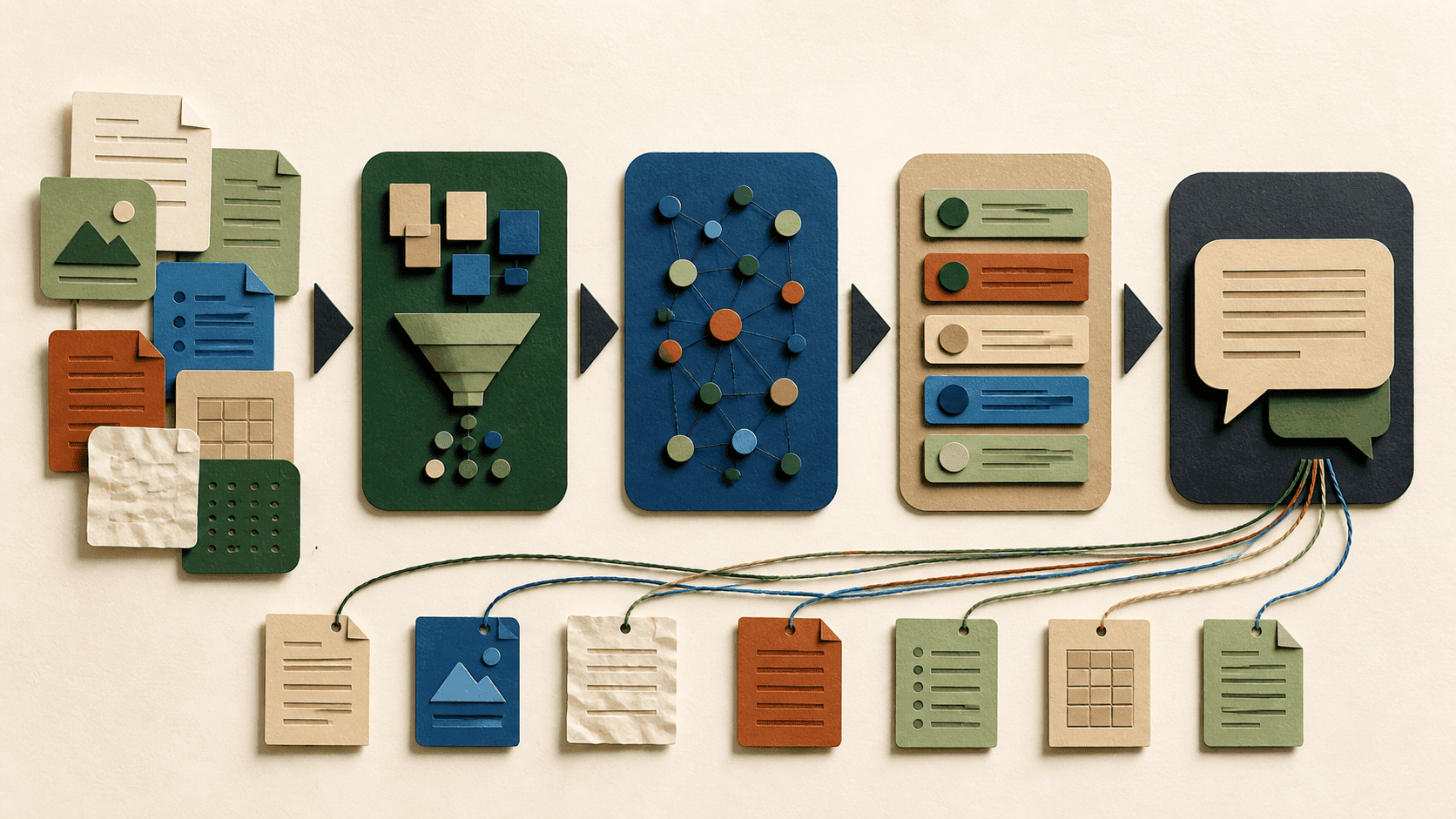
Official documentation describes converters, preprocessors, embedders, retrievers, rankers, generators, routers, tools, agents, evaluation, tracing, serialization, async pipelines, document stores, model providers, and custom components.
Important limitations
A working pipeline can retrieve incomplete, stale, or unauthorized evidence. Stores differ in filters and consistency. Component upgrades can change outputs. Self-hosting does not prevent configured external models, embeddings, or telemetry from receiving data.
Pricing snapshot
Haystack is open source and has no framework subscription fee. Teams pay separately for models, embeddings, document stores, search, hosting, monitoring, evaluation, security, and maintenance. deepset commercial services have separate terms. Reviewed September 2, 2026.
A fair buyer test
Build an authorized 1,000-document corpus with duplicates, revisions, access groups, tables, scans, missing answers, and adversarial text. Compare keyword, dense, and hybrid retrieval; measure citation support, leakage, abstention, freshness, latency, cost, deletion, and upgrade reproducibility.
Final verdict
Haystack earns a shortlist for engineering teams wanting a transparent Python RAG framework and willing to own production operations. Begin with retrieval evaluation and access filtering before adding agents, then pin components and preserve source lineage.
This is a research-based assessment, not a claim of hands-on product testing. Product, pricing, privacy, security, licensing, and usage claims were checked against the first-party sources below on September 2, 2026. Verify current terms and run the proposed test with approved data before adoption.
Transparency
How this guide was checked
Editorial accountability
Who checked this guide
- Evaluation type
- Hands-on evaluation
- Last materially checked
- Evidence
- 4 listed sources
Hands-on testing is identified explicitly. Research-based coverage uses cited product documentation and other named sources; it does not imply every paid plan was used. Read the full methodology.
Editorial freshness
Pricing and material product claims were checked September 2, 2026.
Review evidence
What this guidance is based on
- Editorial basis
- Current first-party product, pricing, documentation, privacy, security, and license material
- Review type
- Research-based product assessment
- Material review date
- September 2, 2026
- Buyer test
- Controlled workflow test with evidence, cost, permission, privacy, and ownership checks
Important limits
- • DiscoverAI did not complete the proposed long-term paid deployment for this research-based review.
- • Features, prices, limits, security controls, privacy terms, licensing, and provider data paths can change; verify the linked first-party pages before purchase.
Standardized benchmark coverage
How this review maps to the research benchmark
Citation accuracy
Eligible · not yet runThis review describes source-grounded research, retrieval, or document work. A controlled product run is required before scoring.
Read protocol v2026.10-v1 →Thematic analysis
Not applicableThe reviewed workflow is not qualitative evidence analysis, so a thematic-analysis score would be misleading.
Read protocol v2026.10-v1 →Eligibility is not a product score. DiscoverAI publishes results only after output collection, blinded adjudication, reproducibility checks, and severe-error review.
Open the optional evaluation worksheet
Reusable trial worksheet
Test Haystack before you commit
Turn this review’s buyer test into evidence. Your entries autosave only in this browser and are never added to shared shortlist links.
Confirm the tool meets every must-have workflow and stakeholder requirement.
Review starting point: Python RAG engineering; Modular search pipelines; Teams owning deployment
Run the same representative work you would use in production; do not score a polished demo.
Review starting point: Build an authorized 1,000-document corpus with duplicates, revisions, access groups, tables, scans, missing answers, and adversarial text. Compare keyword, dense, and hybrid retrieval; measure citation support, leakage, abstention, freshness, latency, cost, deletion, and upgrade reproducibility.
Calculate the effective cost per accepted result, including usage, review, corrections, and required add-ons.
Review starting point: Haystack is open source and has no framework subscription fee. Teams pay separately for models, embeddings, document stores, search, hosting, monitoring, evaluation, security, and maintenance. deepset commercial services have separate terms. Reviewed September 2, 2026.
Define an acceptance threshold, test known answers and edge cases, and record every correction.
Review starting point: Editorial quality signals: features 4.1/5; AI quality 4.0/5. Validate these signals in your own work.
Verify what data enters the product, who can access it, how long it is retained, and whether it trains models.
Review starting point: Use approved low-risk data first. Check roles, consent, deletion, subprocessors, model-training settings, and the contract—not only the marketing page.
Test the real handoffs, permissions, failure states, and export path your team depends on.
Review starting point: Python, OpenAI, Anthropic, Elasticsearch, Weaviate, OpenTelemetry
Record training, governance, reliability, accessibility, ownership, and change-management risks before rollout.
Review starting point: Operations are buyer-owned; Compatibility needs testing; Retrieval quality is not automatic
Loading saved worksheet… · private to this device or your optional account
Community evidence
How verified users put Haystack to work
Structured, editor-moderated experience—not star ratings. This complements our independent review and never changes its score.
No approved community evidence yet. Be the first verified user to contribute.
Community choice
Recommend Haystack
Loading weekly votes…
One vote per verified account per tool, counted for seven days. Return after your vote expires to support again. Community votes influence homepage trends, never editorial ratings. Voting does not subscribe you to emails.
Sources and verification
Product details and claims were checked against the following primary sources.
Frequently asked questions
Is Haystack free?
Yes. The framework is open source; model APIs, document stores, hosting, and operations cost separately.
What is Haystack used for?
It composes retrieval, generation, search, evaluation, and agent workflows from reusable Python components.
Does Haystack include a vector database?
It integrates with multiple document stores rather than requiring one bundled database.
Can Haystack build agents?
Yes. Current docs include tools and agents; teams still own permissions and reliability.
Recommended tool
Use Haystack if this workflow fits your team
Modular pipeline architecture
Tools mentioned in this article
Haystack
An open-source Python framework for modular retrieval and agents
Haystack offers composable RAG and agent pipelines, but quality depends on retrieval evidence, component compatibility, observability, and infrastructure ownership.
Dify
A visual platform for building model-agnostic AI apps, agents, workflows, and knowledge systems
Dify combines visual AI workflows, agents, knowledge retrieval, plugins, logs, and APIs across cloud and self-hosted editions, but credit rules, licensing, provider data paths, and production governance deserve scrutiny.
Ragas
Evaluate RAG, prompts, and agent behavior
Ragas is an open-source evaluation framework for RAG systems, prompts, workflows, and agents using configurable datasets and metrics.
Arize Phoenix
Trace, evaluate, and experiment on AI applications
Arize Phoenix is an open-source observability and evaluation platform for tracing AI applications, scoring outputs, managing prompts, and running experiments.
Read next