Google Is Sending a TPU to Orbit—What Project Suncatcher Must Prove
The first orbital hardware test can answer survival and cooling questions, but it is a long way from proving that space-based AI compute is economical or scalable.
Bottom line
Google is preparing an orbital TPU test for Project Suncatcher, its research effort to explore solar-powered AI compute in space.
Editorial accountability
Who checked this guide
- Evaluation type
- Research-based verification
- Last materially checked
- Evidence
- 4 listed sources
Hands-on testing is identified explicitly. Research-based coverage uses cited product documentation and other named sources; it does not imply every paid plan was used. Read the full methodology.
Editorial basis
What this guidance is based on
- Editorial basis
- Source-led analysis
- Primary references
- 4
- Products covered
- 2
- Last checked
- 2026-09-24
Important limits
- • Reported results come from Google and are not independent proof of general production outcomes.
- • Timelines, architecture, performance, and availability can change as these projects develop.
In this guide
Short answer
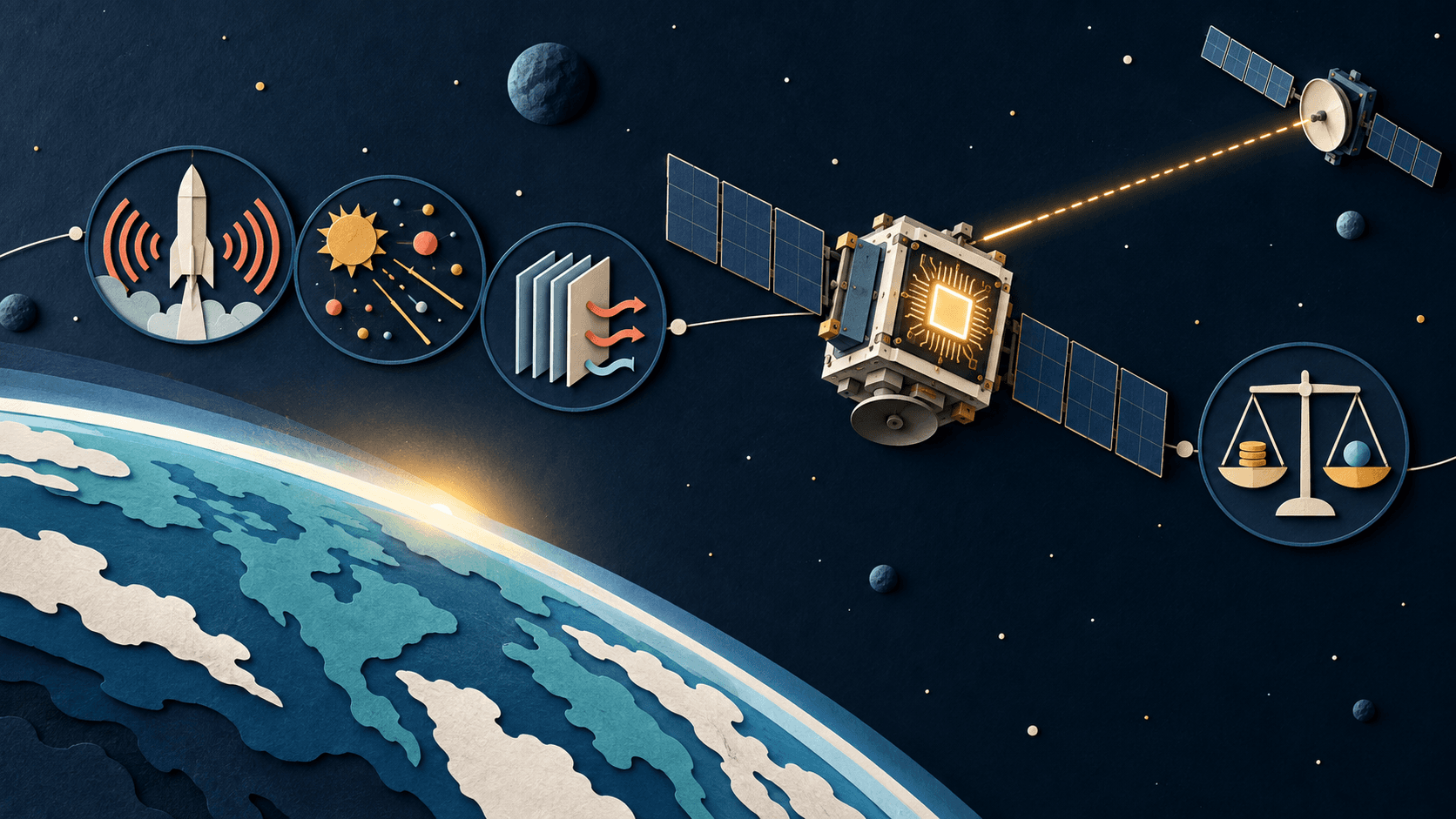
Google says Project Suncatcher will place a Trillium TPU in low Earth orbit on SpaceX's Transporter-18 mission to measure how AI hardware handles launch vibration, radiation, vacuum cooling, and thermal extremes. The experiment is meaningful because it moves the idea from simulation toward real flight data. It does not establish that an orbital AI data center is technically complete, cheaper, environmentally preferable, or commercially viable.
Free workflow pilot checklist
Test the workflow before you buy the tool.
Get the buyer checklist, including task, owner, approval, fallback, and time-saved fields—plus one useful briefing a week.
What Google is testing now
The immediate question is deliberately narrow: can TPU hardware and its cooling system operate reliably in orbit? Google reports that components survived ground vibration testing, proton-beam testing suggested a Trillium TPU could tolerate more total ionizing radiation than expected during a five-year mission, and a thermal-vacuum chamber was used to test heat pipes and radiators. Flight data is still necessary because ground facilities cannot reproduce every interaction in orbit.
Why put AI compute in space
Google's long-term thesis is that satellites in low Earth orbit can receive near-continuous sunlight and eventually form compute clusters linked by lasers. The company says the available solar energy could be substantially greater than at typical terrestrial sites. In principle, that could add a new place to run large machine-learning workloads when land, grid interconnection, and power availability constrain data-center growth.
The unsolved engineering stack
Surviving one flight is only the first gate. A useful orbital cluster would also need high-bandwidth inter-satellite links, precise formation control, radiation-tolerant systems, reliable power conversion, heat rejection without airflow, fault recovery, secure command paths, launch capacity, maintenance strategy, deorbit plans, and an economical way to move data to and from Earth. Google's planned two-satellite laser-link test in 2027 addresses only part of that stack.
What the announcement does not prove
The mission does not show total cost per useful computation, end-to-end energy use, launch and replacement emissions, usable bandwidth, workload latency, service life, repairability, collision risk, or regulatory feasibility. Near-constant sunlight is an input advantage, not a lifecycle assessment. The orbital environment can also convert a routine hardware failure into a stranded asset.
The opportunity for AI infrastructure teams
Project Suncatcher is best read as an option-building experiment. Hardware vendors, satellite operators, optical-networking teams, cooling specialists, and workload schedulers can use the published constraints to explore where space compute might actually fit. Delay-tolerant training or scientific workloads may have a different case than interactive inference that depends on terrestrial data.
A credible scorecard for the mission
Watch for measured radiation errors during live workloads, stable junction temperatures, power efficiency, recovery from faults, sustained useful compute, downlink constraints, and a transparent comparison with an equivalent terrestrial system. Future claims should include launch, networking, redundancy, replacements, ground stations, and deorbiting—not only the electricity available in sunlight.
Bottom line
The orbital TPU test is a real engineering milestone, not evidence that data centers are about to leave Earth. Its value is the failure data it can produce. Project Suncatcher becomes a credible infrastructure path only if later missions close the interconnect, cooling, reliability, economics, environmental, and governance gaps together.
Sources and verification
Product details and claims were checked against the following primary sources.
Frequently asked questions
What is Google Project Suncatcher?
It is a long-term Google research project exploring whether solar-powered satellite clusters equipped with TPUs could eventually run large machine-learning workloads in orbit.
What will the first Suncatcher mission test?
The mission will gather flight data on TPU operation, radiation, launch vibration, thermal extremes, and a vacuum cooling design. It is a hardware-learning mission, not a full orbital data center.
Why might AI compute move to space?
Low Earth orbit can provide long periods of solar exposure and may offer another source of power and physical capacity, but networking, cooling, reliability, launch, maintenance, and lifecycle economics remain unresolved.
Does Suncatcher make space AI practical now?
No. One prototype can validate selected engineering assumptions. Commercial practicality requires a complete, reliable cluster with competitive total cost, useful connectivity, responsible end-of-life handling, and regulatory approval.
Recommended tool
Use Google Gemini if this workflow fits your team
It has one of the clearest workflow fits in its category and is easier to recommend than tools that only look impressive in demos.
Tools mentioned in this article
Google Gemini
Google's deeply integrated AI assistant with unmatched access to Google's ecosystem
Gemini combines powerful AI with Google's vast data ecosystem — Search, Gmail, Docs, YouTube, and more — for a uniquely integrated experience.
Read next
Recommended for you

Google PageBreak Makes AI Prove the Exploit Before Raising the Alarm
PageBreak's important idea is not another vulnerability hypothesis—it is a deterministic validator that must reproduce the exploit before a product team sees it.
Google says its internal PageBreak agent found more than 500 XSS vulnerabilities while keeping speculative AI findings away from product teams.
Read guide
TypeSafe AI Review 2026: Is Jev Ready for Production?
AI Implementation for Small Business: Launch Your First Workflow in 30 Days
TypingMind Review 2026: Multi-Model Chat, Pricing, and Privacy