AI Meeting Notes Consent Checklist: Before, During, and After the Call
A visible bot is not meaningful consent. Set the purpose, participants, boundaries, review owner, retention, and deletion path first.
Bottom line
Use AI meeting notes only when participants understand the purpose, can decline, know who receives the output, and have correction and deletion routes.
Editorial accountability
Who checked this guide
- Evaluation type
- Research-based verification
- Last materially checked
- Evidence
- 4 listed sources
Hands-on testing is identified explicitly. Research-based coverage uses cited product documentation and other named sources; it does not imply every paid plan was used. Read the full methodology.
Editorial basis
What this guidance is based on
- Editorial basis
- Source-led analysis
- Primary references
- 4
- Products covered
- 4
- Last checked
- 2026-09-27
Important limits
- • Operational information, not legal advice.
- • Recording, biometric, employment, health, education, and cross-border rules vary.
Short answer
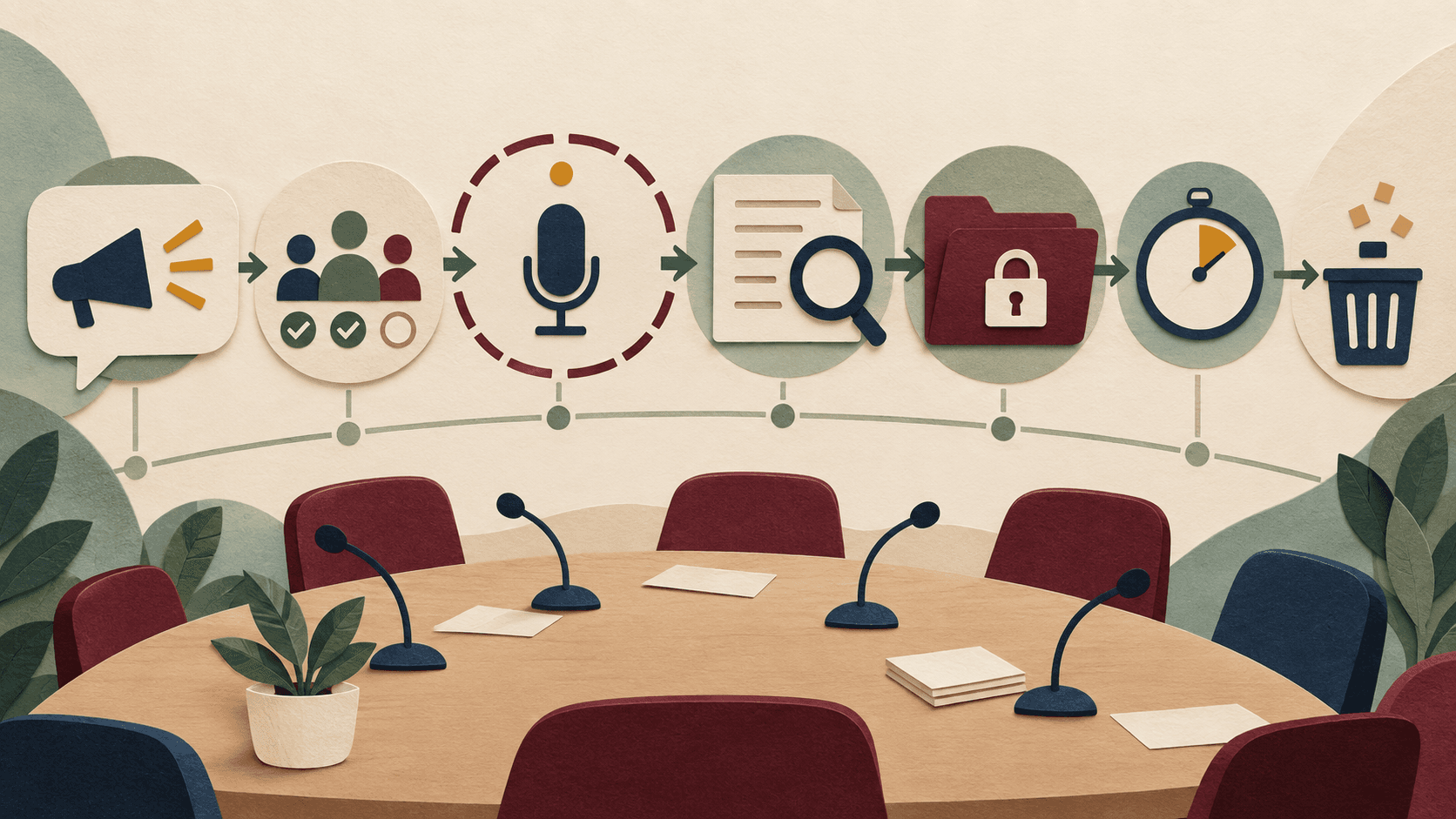
Before an AI note taker joins, name the purpose, data captured, provider, recipients, retention, and human owner. Give participants a real way to decline or use a non-recorded alternative. During the meeting, pause for sensitive sections. Afterward, a named person should correct the record, restrict access, remove unnecessary data, and delete it on schedule.
Before the meeting
- Decide whether recording is necessary; a human decision log may be enough.
- Check law, contracts, funder rules, client expectations, employment policy, and sector obligations.
- Put the tool and purpose in the invitation—not only in a bot name after joining.
- State whether audio, video, transcript, chat, screen content, names, voiceprints, or summaries are retained.
- Name recipients, storage, retention, and correction or deletion routes.
- Offer a practical alternative.
During the call
Repeat the notice plainly and obtain the required agreement before capture. Check late joiners. If discussion moves into health, personnel, legal, safeguarding, donor, customer, or confidential information, pause unless the approved purpose and controls cover it.
Do not treat a live summary as verified. AI can merge speakers, omit disagreement, turn a proposal into a decision, or assign an action incorrectly.
After the meeting
A named reviewer should verify decisions, owners, dates, quotations, disagreement, and sensitive details. Mark the approved version separately from the transcript. Share narrowly, remove broad links, and do not feed notes into another model without checking the original permission.
Apply retention by purpose. Delete raw media when an approved summary is sufficient, subject to obligations. Confirm deletion across exports, integrations, backups, and vendor retention. Keep a correction route.
Host script
“We use an AI note taker to draft decisions and actions. It captures [data], the draft goes to [people], and it is retained for [period]. You can ask us to pause it, correct the notes, or use a non-recorded option. Is everyone comfortable proceeding?” Adapt this to the tool, meeting, law, and organization; it is not legal advice.
Bottom line
Good governance makes capture proportionate, understandable, optional where feasible, human-reviewed, narrowly shared, and deleted when its purpose ends.
Sources and verification
Product details and claims were checked against the following primary sources.
Frequently asked questions
Do I need consent for an AI note taker?
Requirements depend on jurisdiction and context. Give advance notice, confirm the lawful basis, and provide a decline or pause route where feasible.
Is a visible bot enough notice?
No. Explain what it captures, recipients, retention, and how to object.
How long should transcripts be kept?
Only as long as the purpose requires; raw media can often go after an approved summary, subject to obligations.
Who should review notes?
A named owner who understands the meeting should verify decisions, owners, dates, quotations, disagreement, and sensitive content.
Tools mentioned in this article
Granola
Granola is a bot-free AI notepad that captures device audio, combines a transcript with a user's notes, and produces searchable meeting summaries
Granola is a bot-free AI notepad that captures device audio, combines a transcript with a user's notes, and produces searchable meeting summaries.
Fathom
A practical AI tool for productivity workflows
Fathom helps professionals improve productivity workflows with AI-assisted drafting, automation, analysis, or production features.
Fireflies.ai
An AI meeting assistant for transcription, summaries, search, action items, analytics, and follow-up
Fireflies can turn meetings into searchable follow-up, but consent, transcript accuracy, storage, AI credits, retention, and plan-specific governance determine whether it belongs in every call.
Read next