In this guide
Short answer
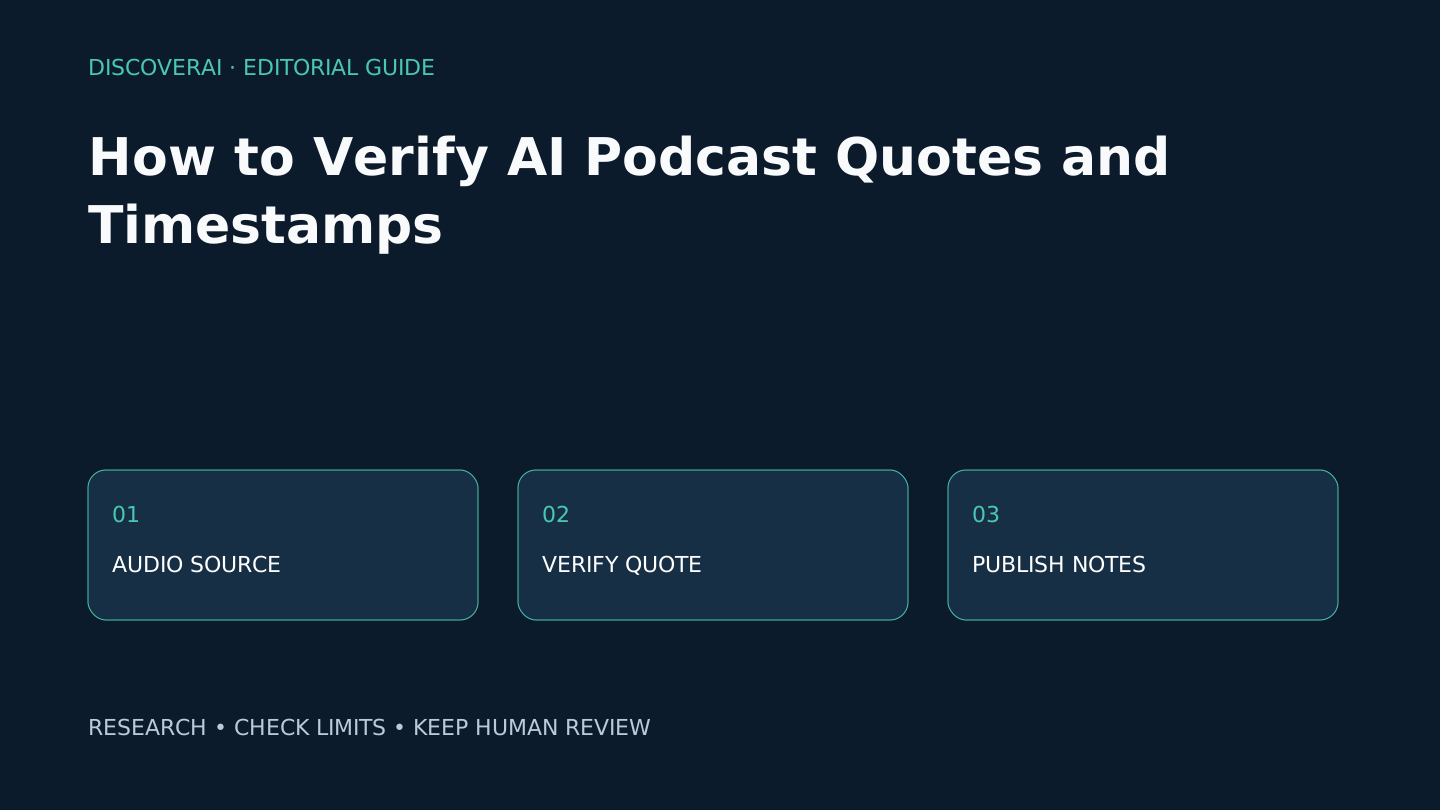
Verify every published quote against the original audio, identify its speaker and test timestamps in the final edited file. Keep paraphrases out of quotation marks. This checklist is an editorial workflow, not a report of measured transcription accuracy.
Start with the final episode file
Use a recording you own or have permission to process. Save its version and duration before generating notes. If you later trim the introduction, the old timestamps may no longer match. Treat notes from an earlier edit as a draft requiring another timing check.
The audien.to workflow page illustrates common generated outputs: summaries, chapter times, quotations and resources. Each needs a different kind of verification. A convincing summary does not validate a quotation.
Keep an evidence row for each quote
Record the proposed text, speaker, start and end times, exact heard wording, decision and reviewer. Play enough audio before and after the proposed quote to understand its context. Check negations, amounts, names and whether an interruption changed the apparent meaning.
For example, a fictional speaker says, “We did not double revenue; we doubled the number of trials.” A note that quotes “We doubled revenue” fails even if it sounds plausible. A shortened quote must preserve the meaning. If cleaning up speech requires rewriting the claim, publish a clearly attributed paraphrase instead. Never invent an exact quotation from a summary.
Verify chapter links and resources separately
Open the final episode at each proposed timestamp. The chapter should begin where the named topic becomes useful, not halfway through its conclusion. Check the first and last chapters after any edit, then spot-check transitions throughout the file.
For a resource, record the spoken name and its time before searching for a link. Open the destination and confirm the organization, title and context. If the speaker mentions a book without enough identifying detail, mark it unresolved or ask the speaker. Do not link the first plausible search result as though it were established.
Set a release rule
Require a verified source row for every published direct quote, working chapter times and no unresolved commercial or factual claims. A second reviewer should check sensitive quotes. Keep the source recording under your own retention policy; a transcription service’s audio deletion does not necessarily delete its text outputs.
Measure total approval time and count material corrections across several episodes before deciding that the workflow saves effort. Download the verification sheet, then see our audien.to review for product-specific limits and retention questions.
Transparency
How this guide was checked
Editorial accountability
Who checked this guide
- Evaluation type
- Research-based verification
- Last materially checked
- Evidence
- 2 listed sources
Hands-on testing is identified explicitly. Research-based coverage uses cited product documentation and other named sources; it does not imply every paid plan was used. Read the full methodology.
Editorial basis
What this guidance is based on
- Editorial basis
- Source-led analysis
- Primary references
- 2
- Products covered
- 1
- Last checked
- 2026-10-23
Important limits
- • Features, availability, and pricing can change after publication; confirm consequential details with the provider.
Sources and verification
Product details and claims were checked against the following primary sources.
Frequently asked questions
Can AI-cleaned wording be a direct quote?
Only if it faithfully matches what was said under your editorial policy. Rewritten claims should be attributed as paraphrases, without quotation marks.
Why do chapter timestamps drift?
Notes generated from an earlier edit can point to the wrong moment after an introduction, advertisement or section is trimmed.
Tools mentioned in this article
audien.to
audien.to turns recordings into transcripts and drafts. Compare its free allowance, conflicting file limits and audio-versus-transcript retention before uploading.
audien.to turns recordings into transcripts and drafts. Compare its free allowance, conflicting file limits and audio-versus-transcript retention before uploading.
Read next