The decision
Should you choose Superblocks?
Superblocks earns a pilot when governed enterprise integration and deployment matter more than the lowest-cost app generator. It is overbuilt for a simple public prototype and under-governed if teams accept Clark's output without review. Map every data path, choose the deployment model deliberately, and test generated permissions and writes before production.
Best for
Internal applications on enterprise databases and SaaS systems; Business builders operating under IT governance.
Choose something else if
Simple public prototypes with no private data; Teams seeking a permanent free plan
Evidence
Editorial research pending · 8.2/10
Pricing checked
From $100 · Sep 10, 2026
Free access is available, with limits.
No permanent free tier is listed. The Teams plan advertises a 14-day free trial.
In this guide
Short answer
Superblocks is worth considering when business teams need AI-assisted internal apps but IT must retain control over data connections, permissions, secrets, auditing, deployment, and source review. Clark can generate application code and interfaces using organizational and integration context. That governance surface is the differentiator; generated applications still require tests, least-privilege data access, code review, and an accountable production owner.
Free buyer comparison checklist
Compare this tool before committing.
Use the buyer checklist to compare two tools on the same tasks, including quality, review time and total cost. Get the weekly top 5 AI tools, one practical workflow and one way to reduce AI spending.
Best for
- Internal applications on enterprise databases and SaaS systems
- Business builders operating under IT governance
- Organizations needing hybrid or customer-cloud deployment options
Look elsewhere if
- Simple public prototypes with no private data
- Teams seeking a permanent free plan
- High-risk applications without engineering and security review
What Superblocks verifiably does
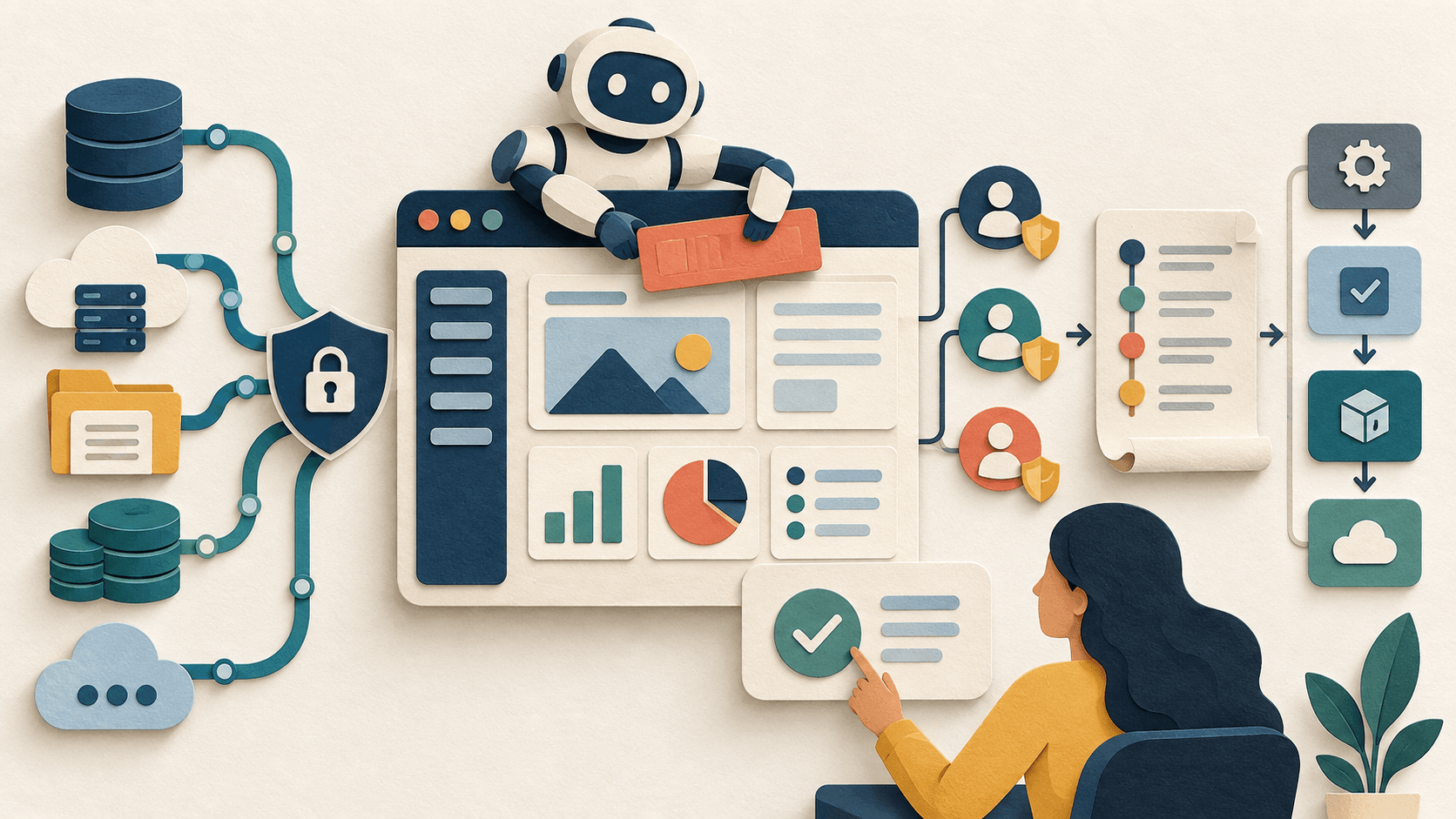
Superblocks documents natural-language application generation with Clark, planning and build modes, application checkpoints, automated testing, and connections to more than 50 enterprise systems. Admins can manage integrations, secrets, environments, roles, audit trails, source control, and organizational knowledge. Cloud, Hybrid, and Cloud-Prem deployments place the data plane and AI inference in different locations depending on the selected architecture.
Important limitations
Clark can generate plausible SQL, API calls, permissions, and interfaces that are functionally or semantically wrong. The Teams price includes only one hosted app and a finite GAU allowance, so application and agent usage can expand cost. Deployment labels do not all mean data stays in the buyer's environment: Superblocks says Cloud and Hybrid use Superblocks Cloud for Clark inference, while Cloud-Prem can place inference in the customer cloud. Model requests and responses are retained for chat according to the deployment documentation.
Superblocks pricing
Superblocks lists Teams at $125 per month on monthly billing or $100 per month billed annually. The plan includes 100 Governed Agent Units per month, Clark, user memory, more than 50 integrations, one hosted application, and unlimited end users; additional hosted applications cost $10 each per month and GAU packs are sold separately. Enterprise uses custom application, deployment, security, and support terms. Reviewed September 10, 2026.
A fair buyer test
Build one operational app with three roles, two write-capable integrations, a private database, and a staged deployment. Seed an unauthorized record, prompt injection in source data, a destructive query, schema drift, a failed API, and a rollback. Measure build time, generated-code defects, permission escapes, audit completeness, deployment recovery, end-user task success, GAU consumption, hosted-app cost, and the effort required for an engineer to understand and maintain the result.
Final verdict
Superblocks earns a pilot when governed enterprise integration and deployment matter more than the lowest-cost app generator. It is overbuilt for a simple public prototype and under-governed if teams accept Clark's output without review. Map every data path, choose the deployment model deliberately, and test generated permissions and writes before production.
This is a research-based product assessment, not a claim of hands-on long-term testing. Product, pricing, privacy, security, and usage claims were checked against the first-party sources below on September 10, 2026. Verify current terms and run the proposed test with approved data before adoption.
Transparency
How this guide was checked
Editorial accountability
Who checked this guide
- Evaluation type
- Hands-on evaluation
- Last materially checked
- Evidence
- 4 listed sources
Hands-on testing is identified explicitly. Research-based coverage uses cited product documentation and other named sources; it does not imply every paid plan was used. Read the full methodology.
Editorial freshness
Pricing and material product claims were checked September 10, 2026.
Review evidence
What this guidance is based on
- Review type
- Research-based product assessment
- Material review date
- September 10, 2026
- Evidence
- Current first-party product, pricing, documentation, privacy, and security material
- Buyer test
- Controlled quality, cost, permissions, privacy, reliability, and failure-path evaluation
Important limits
- • DiscoverAI did not complete the proposed long-term paid deployment for this review.
- • Features, prices, limits, security controls, and provider data paths can change; verify the linked first-party pages before purchase.
Standardized benchmark coverage
How this review maps to the research benchmark
Citation accuracy
Not applicableThe reviewed workflow does not produce source-grounded research answers, so a citation score would be misleading.
Read protocol v2026.10-v1 →Thematic analysis
Not applicableThe reviewed workflow is not qualitative evidence analysis, so a thematic-analysis score would be misleading.
Read protocol v2026.10-v1 →Eligibility is not a product score. DiscoverAI publishes results only after output collection, blinded adjudication, reproducibility checks, and severe-error review.
Open the optional evaluation worksheet
Reusable trial worksheet
Test Superblocks before you commit
Turn this review’s buyer test into evidence. Your entries autosave only in this browser and are never added to shared shortlist links.
Confirm the tool meets every must-have workflow and stakeholder requirement.
Review starting point: Internal applications on enterprise databases and SaaS systems; Business builders operating under IT governance; Organizations needing hybrid or customer-cloud deployment options
Run the same representative work you would use in production; do not score a polished demo.
Review starting point: Build one operational app with three roles, two write-capable integrations, a private database, and a staged deployment. Seed an unauthorized record, prompt injection in source data, a destructive query, schema drift, a failed API, and a rollback. Measure build time, generated-code defects, permission escapes, audit completeness, deployment recovery, end-user task success, GAU consumption, hosted-app cost, and the effort required for an engineer to understand and maintain the result.
Calculate the effective cost per accepted result, including usage, review, corrections, and required add-ons.
Review starting point: Superblocks lists Teams at $125 per month on monthly billing or $100 per month billed annually. The plan includes 100 Governed Agent Units per month, Clark, user memory, more than 50 integrations, one hosted application, and unlimited end users; additional hosted applications cost $10 each per month and GAU packs are sold separately. Enterprise uses custom…
Define an acceptance threshold, test known answers and edge cases, and record every correction.
Review starting point: Editorial quality signals: features 4.3/5; AI quality 4.1/5. Validate these signals in your own work.
Verify what data enters the product, who can access it, how long it is retained, and whether it trains models.
Review starting point: Use approved low-risk data first. Check roles, consent, deletion, subprocessors, model-training settings, and the contract—not only the marketing page.
Test the real handoffs, permissions, failure states, and export path your team depends on.
Review starting point: Postgres, Snowflake, Salesforce, Databricks, GitHub, Okta and Entra
Record training, governance, reliability, accessibility, ownership, and change-management risks before rollout.
Review starting point: One hosted app and finite agent units on Teams; Generated access logic still needs adversarial testing; Data paths vary materially by deployment model
Loading saved worksheet… · private to this device or your optional account
Community evidence
How verified users put Superblocks to work
Structured, editor-moderated experience—not star ratings. This complements our independent review and never changes its score.
No approved community evidence yet. Be the first verified user to contribute.
Community choice
Recommend Superblocks
Loading weekly votes…
One vote per verified account per tool, counted for seven days. Return after your vote expires to support again. Community votes influence homepage trends, never editorial ratings. Voting does not subscribe you to emails.
Sources and references
References cited by this article. Check the original source for scope, dates and current terms.
Frequently asked questions
What is Superblocks Clark?
Clark is the Superblocks AI agent for planning, generating, editing, and testing internal applications connected to approved enterprise data and integrations.
How much does Superblocks cost?
Teams is listed at $125 monthly or $100 monthly billed annually, with 100 monthly Governed Agent Units and one hosted app; Enterprise is custom.
Can Superblocks keep data in a customer cloud?
Its Cloud-Prem deployment places the full platform and Clark inference in the customer's AWS, GCP, or Azure environment; Cloud and Hybrid have different data paths.
Does Clark make generated internal apps secure automatically?
No. Central controls help, but buyers must still review generated code, permissions, queries, data paths, secrets, tests, and audit evidence.
Recommended tool
Use Superblocks if this workflow fits your team
AI generation inside a governed app platform
Tools mentioned in this article
Superblocks
Generate internal business applications on enterprise data within centrally governed access controls
Superblocks is an enterprise internal-app platform whose Clark AI agent generates interfaces and code against approved databases, APIs, SaaS systems, and organizational standards.
n8n
A flexible workflow-automation platform for AI agents, APIs, data, code, and human approvals
n8n offers unusually deep automation and deployment control, but workflow ownership, execution economics, credentials, failures, and self-hosting operations determine its real value.
Read next