StackAI Review 2026: Enterprise Agents, Pricing, and Governance
A research-based StackAI review covering capabilities, pricing, privacy, limitations, alternatives, and a practical buyer test.
Bottom line
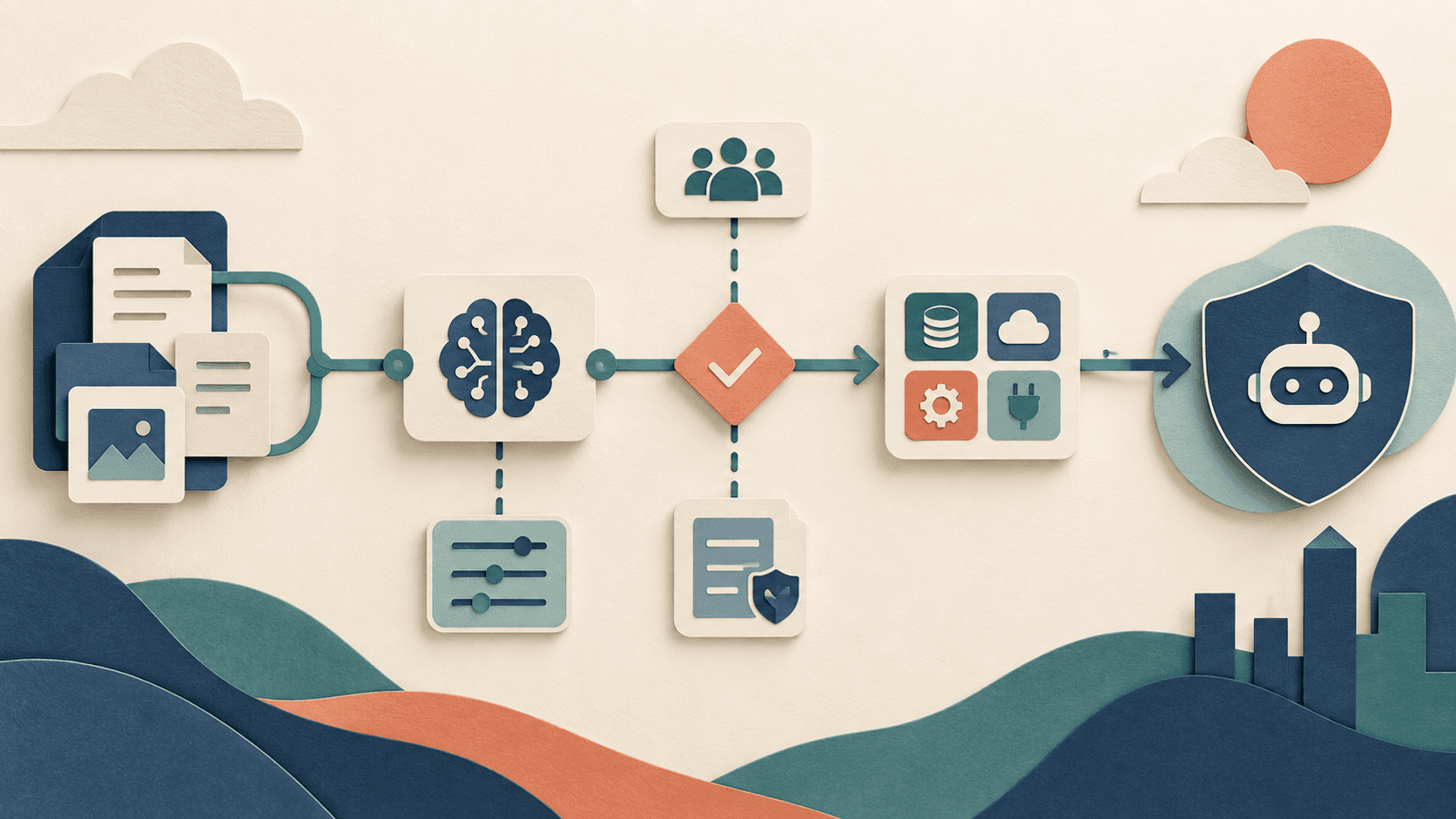
StackAI is a visual enterprise platform for building agents and workflows that use company knowledge, models, integrations, code, approvals, and managed or private deployment.
Editorial accountability
Who checked this guide
- Evaluation type
- Hands-on evaluation
- Last materially checked
- Evidence
- 4 listed sources
Hands-on testing is identified explicitly. Research-based coverage uses cited product documentation and other named sources; it does not imply every paid plan was used. Read the full methodology.
Editorial freshness
Pricing and material product claims were checked September 14, 2026.
Review evidence
What this guidance is based on
- Review type
- Research-based product assessment
- Material review date
- September 14, 2026
- Evidence
- Current first-party product, pricing, documentation, privacy, security, and terms material
- Buyer test
- Controlled quality, cost, privacy, reliability, and failure-path evaluation
Important limits
- • DiscoverAI did not complete the proposed long-term paid deployment for this review.
- • Features, prices, limits, security controls, and provider data paths can change; verify the linked first-party pages before purchase.
In this guide
Short answer
StackAI is worth shortlisting when a regulated or data-sensitive team wants a visual agent builder plus enterprise deployment and governance options. It is excessive for a simple chatbot, and a polished canvas does not remove the need for permissions, evaluations, or failure recovery.
Best for
- Regulated enterprise agent programs
- Document-heavy operational workflows
- Teams needing private deployment options
Look elsewhere if
- Simple single-model chatbots
- Buyers needing transparent self-serve paid pricing
- Consequential actions without approvals
What StackAI verifiably does
StackAI documents a visual workflow builder, agents, knowledge bases, multimodal inputs, Python and JavaScript, APIs, analytics and execution logs, more than 300 integrations, major model providers, MCP connections, citations, guardrails, and cloud, VPC, on-premises, or dedicated deployment options.
Important limitations
Public pricing stops at Free and custom Enterprise. Connected agents can expose sensitive data or take incorrect actions; model behavior, retrieval quality, integration drift, and run definitions all affect cost and reliability. StackAI announced in May 2026 that it is joining Asana while continuing the product.
StackAI pricing
StackAI's Free plan lists 500 runs per month, two projects, and one seat. Enterprise pricing is custom and can include unlimited projects, tailored run and seat limits, dedicated infrastructure, VPC or on-premises deployment, access control, SSO, and dedicated support. Confirm what counts as a run and whether model usage is included. Reviewed September 14, 2026.
Privacy and security questions
Before connecting real data, document which files, conversations, credentials, and systems the product and its model providers can access; who can view logs; how retention, deletion, regional processing, and model training work; and which actions require approval. Verify contract terms rather than inferring protection from a badge or feature name.
A fair buyer test
Pilot one bounded document-to-system workflow with 200 labeled cases, malformed files, conflicting evidence, prompt injection, revoked access, duplicate actions, and provider outages. Measure field accuracy, unsupported claims, permission enforcement, recovery, p95 latency, human review time, and all-in cost per accepted result.
Final verdict
Shortlist StackAI when governance and private deployment matter as much as low-code speed. Require a written run definition, complete cost model, least-privilege connections, evaluation gates, audit logs, rollback, and an ownership roadmap after the Asana transaction.
This is a research-based product assessment, not a claim of hands-on long-term testing. Product, pricing, privacy, security, and usage claims were checked against the first-party sources below on September 14, 2026. Verify current terms and run the proposed test with approved data before adoption.
Reusable trial worksheet
Test StackAI before you commit
Turn this review’s buyer test into evidence. Your entries autosave only in this browser and are never added to shared shortlist links.
Confirm the tool meets every must-have workflow and stakeholder requirement.
Review starting point: Regulated enterprise agent programs; Document-heavy operational workflows; Teams needing private deployment options
Run the same representative work you would use in production; do not score a polished demo.
Review starting point: Pilot one bounded document-to-system workflow with 200 labeled cases, malformed files, conflicting evidence, prompt injection, revoked access, duplicate actions, and provider outages. Measure field accuracy, unsupported claims, permission enforcement, recovery, p95 latency, human review time, and all-in cost per accepted result.
Calculate the effective cost per accepted result, including usage, review, corrections, and required add-ons.
Review starting point: StackAI's Free plan lists 500 runs per month, two projects, and one seat. Enterprise pricing is custom and can include unlimited projects, tailored run and seat limits, dedicated infrastructure, VPC or on-premises deployment, access control, SSO, and dedicated support. Confirm what counts as a run and whether model usage is included. Reviewed September 14,…
Define an acceptance threshold, test known answers and edge cases, and record every correction.
Review starting point: Editorial quality signals: features 4.2/5; AI quality 4.0/5. Validate these signals in your own work.
Verify what data enters the product, who can access it, how long it is retained, and whether it trains models.
Review starting point: Use approved low-risk data first. Check roles, consent, deletion, subprocessors, model-training settings, and the contract—not only the marketing page.
Test the real handoffs, permissions, failure states, and export path your team depends on.
Review starting point: OpenAI, Anthropic, Google, Asana, Salesforce, SharePoint
Record training, governance, reliability, accessibility, ownership, and change-management risks before rollout.
Review starting point: Paid pricing requires sales; Agent reliability remains buyer work; Asana ownership transition adds roadmap questions
Loading saved worksheet… · private to this device or your optional account
Community evidence
How verified users put StackAI to work
Structured, editor-moderated experience—not star ratings. This complements our independent review and never changes its score.
No approved community evidence yet. Be the first verified user to contribute.
Sources and verification
Product details and claims were checked against the following primary sources.
Frequently asked questions
What is StackAI?
StackAI is a visual enterprise platform for building agents and workflows that use company knowledge, models, integrations, code, approvals, and managed or private deployment.
How much does StackAI cost?
StackAI's Free plan lists 500 runs per month, two projects, and one seat. Enterprise pricing is custom and can include unlimited projects, tailored run and seat limits, dedicated infrastructure, VPC or on-premises deployment, access control, SSO, and dedicated support. Confirm what counts as a run and whether model usage is included. Reviewed September 14, 2026.
Who should use StackAI?
Regulated enterprise agent programs, Document-heavy operational workflows, Teams needing private deployment options.
What should buyers test before choosing StackAI?
Pilot one bounded document-to-system workflow with 200 labeled cases, malformed files, conflicting evidence, prompt injection, revoked access, duplicate actions, and provider outages. Measure field accuracy, unsupported claims, permission enforcement, recovery, p95 latency, human review time, and all-in cost per accepted result.
Found this useful?
Get the next one in your inbox.
One five-minute briefing a week: a meaningful change, a practical workflow, and a clearer tool decision—already filtered for lean teams.
Free · one email a week · unsubscribe any time
Recommended tool
Use StackAI if this workflow fits your team
Strong enterprise deployment choices
Tools mentioned in this article
StackAI
Build governed AI agents for enterprise workflows
StackAI is a visual enterprise platform for building agents and workflows that use company knowledge, models, integrations, code, approvals, and managed or private deployment.
MindStudio
Build, deploy, and govern low-code AI agents
MindStudio is a visual platform for building and deploying AI agents with multiple models, data sources, triggers, integrations, custom code, testing, and human approval.
Relevance AI
A no-code platform for building AI agents, tools, and coordinated workforces
Relevance AI can make agent orchestration accessible, but action limits, model credits, permissions, evaluation, retention, and human escalation determine production readiness.
Superblocks
Generate internal business applications on enterprise data within centrally governed access controls
Superblocks is an enterprise internal-app platform whose Clark AI agent generates interfaces and code against approved databases, APIs, SaaS systems, and organizational standards.
Read next
Recommended for you
VectorShift Review 2026: AI Workflows, Pricing, and Limits
A research-based VectorShift review covering capabilities, pricing, privacy, limitations, alternatives, and a practical buyer test.
VectorShift combines a no-code pipeline builder with an SDK, API, knowledge bases, integrations, scheduled automations, and deployable chatbot or search interfaces.
Read guide
MindStudio Review 2026: Is Its AI Agent Builder Worth It?
Superblocks Review 2026: Clark AI, Pricing, and Governance
Langfuse Review 2026: LLM Observability, Pricing, Security, and Fit