Microsoft’s School AI Safety Pledge Needs a Procurement Test
Principles are a useful floor; schools still need product-specific data maps, age controls, oversight, accessibility, evidence, and enforceable remedies.
Bottom line
Microsoft outlined school AI principles covering privacy, human oversight, learning, system support, and readiness. Districts should translate them into contract tests.
Editorial accountability
Who checked this guide
- Evaluation type
- Research-based verification
- Last materially checked
- Evidence
- 4 listed sources
Hands-on testing is identified explicitly. Research-based coverage uses cited product documentation and other named sources; it does not imply every paid plan was used. Read the full methodology.
Editorial basis
What this guidance is based on
- Editorial basis
- Source-led analysis
- Primary references
- 4
- Products covered
- 1
- Last checked
- 2026-09-30
Important limits
- • The article evaluates public commitments, not every Microsoft education product or school contract.
- • Legal, safeguarding, accessibility, and procurement duties vary by jurisdiction and student population.
In this guide
Short answer
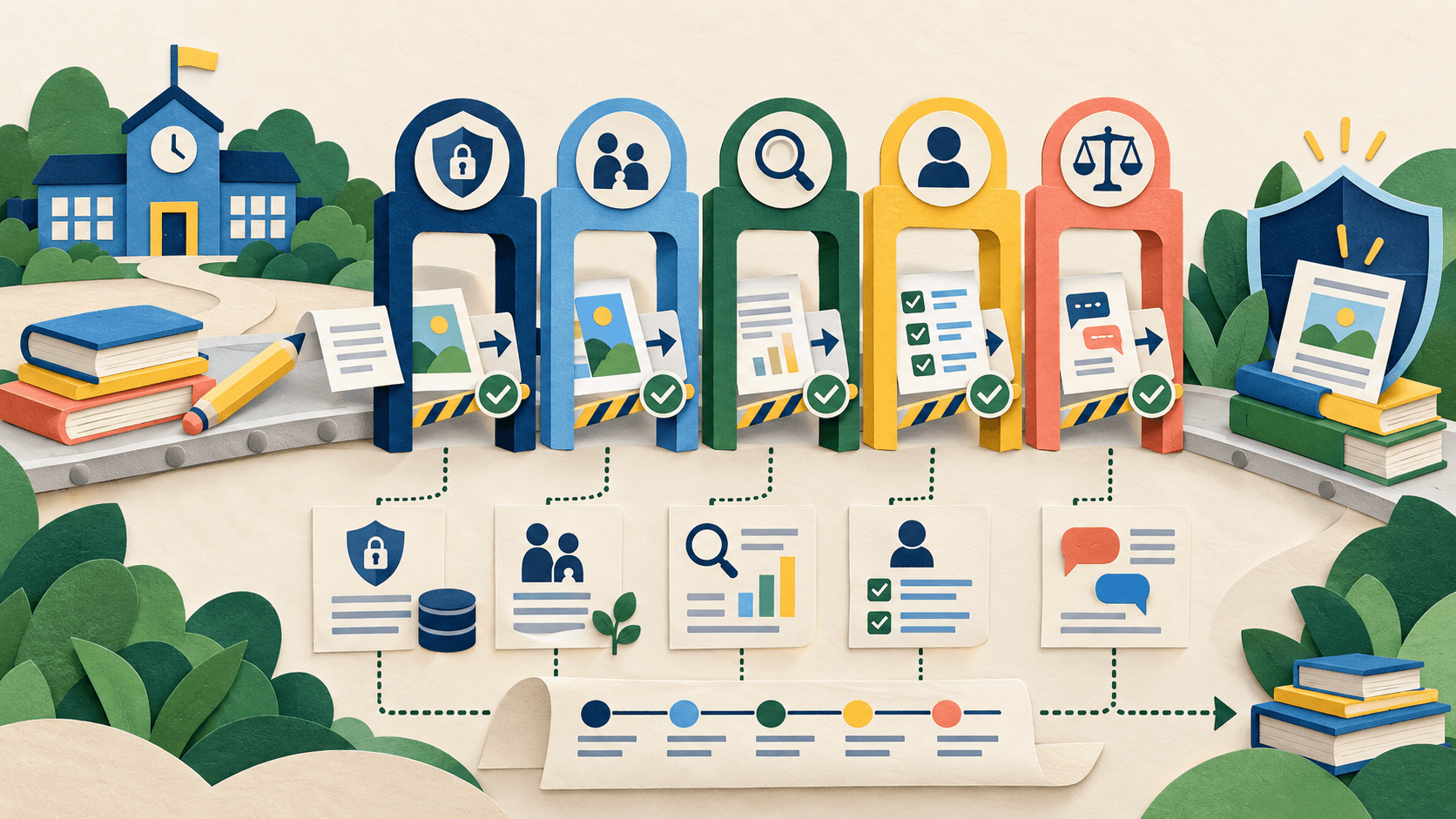
Microsoft published five commitments for AI in education on September 16, 2026: privacy and safety by design; educators in control; support for student learning rather than replacement of thinking; stronger education systems; and preparation for an AI-powered future. It also described a Privacy & Safety Standard for Schools developed with the American Federation of Teachers. Schools should treat these as procurement inputs, not proof that every Microsoft AI feature is appropriate for every student or task.
Turn principles into product requirements
For each proposed feature, document the data collected, purpose, legal basis, retention, deletion, training use, subprocessors, region, access, family notice, age eligibility, default settings, and route to export or appeal. A suite-level statement cannot substitute for the behavior of the exact product, license, tenant, and configuration.
Preserve educator and student agency
Human oversight must mean more than a person being nearby. Define which decisions AI may inform, which it may never make, how teachers see sources and uncertainty, how students disclose assistance, and how a learner can challenge a wrong flag or recommendation without penalty. Do not use engagement as a proxy for learning.
Test learning, safety, and access
Pilot with educators, students, families, privacy officers, accessibility specialists, and security staff. Include minors of different ages, disability access, multiple languages, sensitive topics, prompt injection, account recovery, bullying or self-harm signals, hallucinated citations, service outages, and offboarding. Measure learning evidence and severe failures, not only adoption.
Bottom line
Microsoft's commitments provide a useful checklist, especially their emphasis on educators and human accountability. A responsible purchase still requires product-specific evidence, enforceable contract terms, minimal data collection, independent review, accessible alternatives, incident duties, and a clear stop rule.
Sources and verification
Product details and claims were checked against the following primary sources.
Frequently asked questions
What did Microsoft commit to for school AI?
Microsoft listed privacy and safety, educator control, support for learning, stronger education systems, and preparation for an AI-powered future.
Does the pledge prove a product is safe for children?
No. Schools still need product-, age-, region-, license-, and configuration-specific evidence plus enforceable contractual protections.
What should a school AI pilot measure?
Measure learning outcomes, factual errors, privacy incidents, harmful responses, accessibility, appeals, teacher workload, equity, and severe failures—not logins alone.
Should AI make consequential student decisions?
Schools should keep admissions, discipline, grading, accommodations, safety, and other consequential judgments under accountable human processes with explanation and appeal.
Tools mentioned in this article
Microsoft Copilot
Workplace AI grounded in Microsoft 365 apps, organizational data, and governed agents
Microsoft Copilot is strongest for organizations already operating in Microsoft 365, but licensing, permission hygiene, content quality, agent usage, and change management determine the return.
Read next