Microsoft Moves Robot AI Offboard—Latency Becomes a Safety Boundary
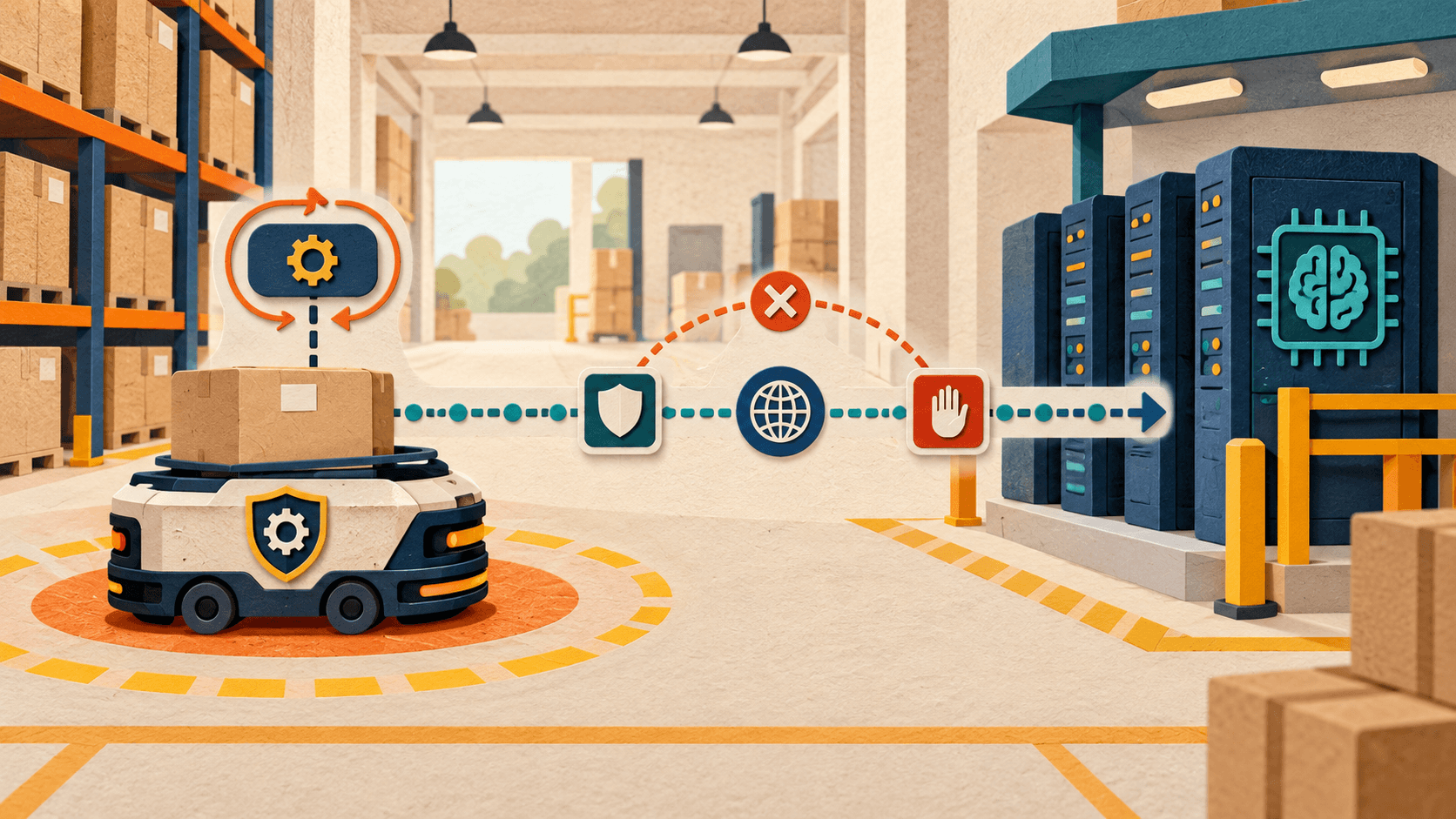
Remote GPUs can unlock larger models and longer battery life, but a network path must never become an unexamined control dependency.
Bottom line
Microsoft Research reported that moving physical-AI inference from onboard robot GPUs to nearby edge or cloud compute improved task success in representative mobile-manipulation workloads, supported larger models, and could extend battery life. It also added offloaded inference to the open-source Physical AI Toolchain. The opportunity is more capable robots with lighter onboard compute; the engineering constraint is that latency, jitter, bandwidth, loss, and remote availability become part of the robot's safety case.
Editorial accountability
Who checked this guide
- Evaluation type
- Research-based verification
- Last materially checked
- Evidence
- 4 listed sources
Hands-on testing is identified explicitly. Research-based coverage uses cited product documentation and other named sources; it does not imply every paid plan was used. Read the full methodology.
Editorial basis
What this guidance is based on
- Editorial basis
- Source-led analysis
- Primary references
- 4
- Products covered
- 2
- Last checked
- 2026-09-24
Important limits
- • Vendor and lab-reported results are not independent proof of outcomes.
- • Availability, pricing, policies, and behavior can change.
In this guide
Short answer
Microsoft Research reported that moving physical-AI inference from onboard robot GPUs to nearby edge or cloud compute improved task success in representative mobile-manipulation workloads, supported larger models, and could extend battery life. It also added offloaded inference to the open-source Physical AI Toolchain. The opportunity is more capable robots with lighter onboard compute; the engineering constraint is that latency, jitter, bandwidth, loss, and remote availability become part of the robot's safety case.
Free workflow pilot checklist
Test the workflow before you buy the tool.
Get the buyer checklist, including task, owner, approval, fallback, and time-saved fields—plus one useful briefing a week.
What Microsoft changed
The toolchain can separate GPU inference into a container and orchestrate it across robot, edge, and cloud infrastructure with Kubernetes. Microsoft documents examples involving SO-101 and UR10e systems, plus offloading its Rho model for a Mobile Aloha robot. This is infrastructure for distributing inference—not a general claim that every control loop should move offboard.
Why offloading can help
Onboard GPUs add cost, weight, heat, and power draw, and may be too small for newer vision-action models. A shared edge GPU can serve larger models and multiple robots while hardware on each machine stays lighter. Centralized compute may also simplify model deployment and utilization.
The failure boundary moves to the network
A delayed action can be as dangerous as a wrong one. Round-trip latency, jitter, packet loss, handoffs, congestion, authentication failure, regional outage, and overloaded GPU queues all need bounded behavior. Local emergency stops, collision avoidance, and a safe degraded mode must remain available when remote inference disappears.
What the research does not prove
Microsoft's results cover selected workloads and infrastructure. They do not establish safe performance for every robot, facility, network, model, or human-interaction scenario. Battery and task-success gains are workload dependent, and production deployment still requires domain safety engineering, independent validation, and compliance.
A practical deployment test
Replay representative tasks across onboard, local-edge, and remote configurations. Inject delay, jitter, loss, disconnection, stale actions, GPU saturation, clock drift, and failover. Measure deadline misses, unsafe motion, recovery, task success, energy, cost, operator interventions, and time spent in degraded mode before granting remote inference any consequential control.
Sources and verification
Product details and claims were checked against the following primary sources.
Frequently asked questions
What is offloaded inference for robots?
It moves some AI-model computation from hardware onboard a robot to an edge or cloud GPU, then returns predictions or actions over a network.
Why move robot AI offboard?
Remote compute can support larger models, reduce onboard power and heat, share expensive GPUs, and potentially extend operating time.
What is the main risk?
Network latency, jitter, loss, congestion, authentication, or outages can delay or remove model output, so safety-critical local controls and degraded modes remain essential.
Is Microsoft's toolchain production proof?
No. It is useful open-source infrastructure and reported research evidence, but each robot, network, task, and safety case still needs independent validation.
Read next