RetroChimera Maps How to Make Molecules—Chemists Still Hold the Gate
The open model can widen retrosynthesis search, but its own maintainers warn that predictions can hallucinate and require expert verification.
Bottom line
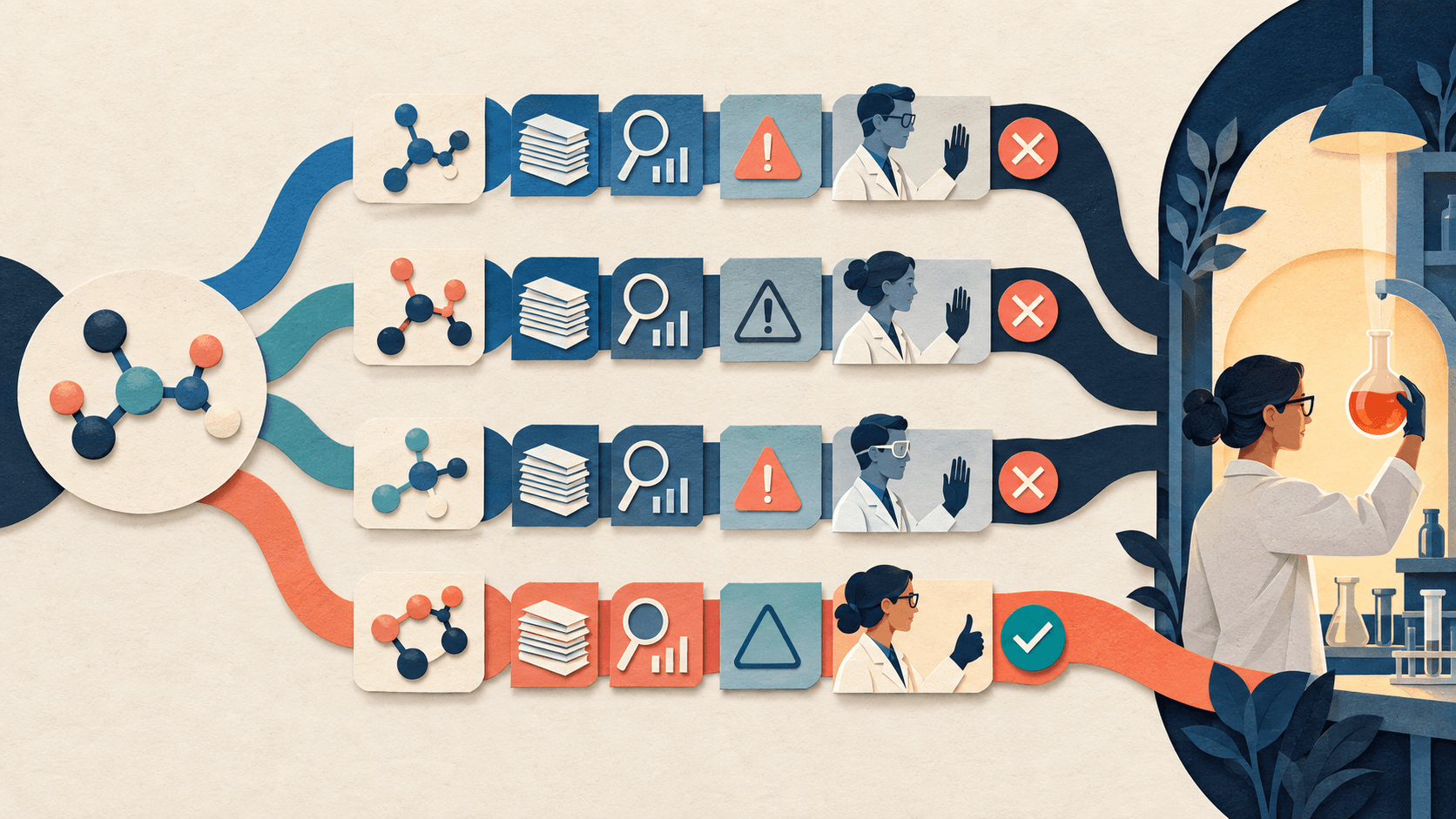
Microsoft Research, GSK, Novartis, and collaborators introduced RetroChimera, an open retrosynthesis model that works backward from a desired small molecule to propose reactions that might make it. Microsoft reports stronger benchmark and chemist-preference results than comparison systems, plus adaptation to proprietary chemistry data. The opportunity is faster candidate planning—not autonomous drug creation. Suggested reactions can be wrong, out of distribution, unsafe, impractical, or economically useless.
Editorial accountability
Who checked this guide
- Evaluation type
- Research-based verification
- Last materially checked
- Evidence
- 4 listed sources
Hands-on testing is identified explicitly. Research-based coverage uses cited product documentation and other named sources; it does not imply every paid plan was used. Read the full methodology.
Editorial basis
What this guidance is based on
- Editorial basis
- Source-led analysis
- Primary references
- 4
- Products covered
- 1
- Last checked
- 2026-09-24
Important limits
- • Vendor and lab-reported results are not independent proof of outcomes.
- • Availability, pricing, policies, and behavior can change.
In this guide
Short answer
Microsoft Research, GSK, Novartis, and collaborators introduced RetroChimera, an open retrosynthesis model that works backward from a desired small molecule to propose reactions that might make it. Microsoft reports stronger benchmark and chemist-preference results than comparison systems, plus adaptation to proprietary chemistry data. The opportunity is faster candidate planning—not autonomous drug creation. Suggested reactions can be wrong, out of distribution, unsafe, impractical, or economically useless.
Free workflow pilot checklist
Test the workflow before you buy the tool.
Get the buyer checklist, including task, owner, approval, fallback, and time-saved fields—plus one useful briefing a week.
What is technically different
RetroChimera ensembles models with complementary inductive biases instead of relying on one representation. Paired with route-search software, it can generate possible precursor reactions and assemble multi-step pathways. Microsoft publishes code and checkpoints for research and experimentation.
What the reported evidence shows
Microsoft says experts fully accepted proposed sequences for nine of 10 selected benchmark molecules, versus two to five for comparison models. In a separate blind preference exercise, nine Ph.D.-level organic chemists preferred RetroChimera's top suggestion about 64% of the time. Those are promising reported results, but the selected tasks, evaluators, proprietary data, and laboratory feasibility limit generalization.
The practical opportunity
A chemistry team could use the model to widen route ideation, expose uncommon reaction classes, adapt planning to internal electronic-lab-notebook data, and prioritize routes for expert review. Open code also supports reproduction, stress testing, and domain fine-tuning instead of a closed recommendation endpoint.
The limitations matter
The project's own documentation warns that predictions may hallucinate, especially outside the training distribution; lower-ranked reactions become less reliable; the main checkpoint uses data available through 2023; and dataset noise can propagate. A plausible reaction diagram is not evidence that a route is safe, selective, scalable, affordable, or physically reproducible.
How a research team should test it
Begin with a blinded set of known internal routes plus hard negatives. Compare expert review time, top-k route acceptance, novelty, literature support, reagent availability, hazard, predicted selectivity, route cost, and actual laboratory success. Keep model suggestions separate from approved procedures, require chemistry and safety review, and record failed experiments so benchmark gains do not hide real-world attrition.
Sources and verification
Product details and claims were checked against the following primary sources.
Frequently asked questions
What is RetroChimera?
RetroChimera is an open AI model that proposes precursor reactions for making a target small molecule and can be paired with search software to build synthesis routes.
Did RetroChimera discover a new drug?
No. It predicts possible synthesis routes. Drug discovery also requires design, experiments, safety, efficacy, manufacturing, and regulatory evidence.
Can chemists trust its top route?
Not automatically. Microsoft warns that the model can hallucinate and requires independent literature, feasibility, hazard, and laboratory verification by chemistry experts.
Is RetroChimera open source?
Yes. Microsoft publishes code and several checkpoints for research and experimentation, with limitations and verification guidance in the repository.
Read next