Lambda Plans an Oklahoma AI Data Center—The Claims Communities Should Track
A promised $500 million tax contribution and closed-loop cooling are starting claims; the useful public record begins with contracts, meters, milestones, and enforcement.
Bottom line
Lambda plans a Mayes County AI data center with ratepayer, water, jobs, and tax commitments. Communities should turn each promise into a measurable obligation.
Editorial accountability
Who checked this guide
- Evaluation type
- Research-based verification
- Last materially checked
- Evidence
- 4 listed sources
Hands-on testing is identified explicitly. Research-based coverage uses cited product documentation and other named sources; it does not imply every paid plan was used. Read the full methodology.
Editorial basis
What this guidance is based on
- Editorial basis
- Source-led analysis
- Primary references
- 4
- Products covered
- 1
- Last checked
- 2026-09-28
Important limits
- • Project details, permits, contracts, capacity, schedule, and forecasts can change.
- • Economic, energy, and water claims have not yet been independently audited against operating data.
In this guide
What was announced
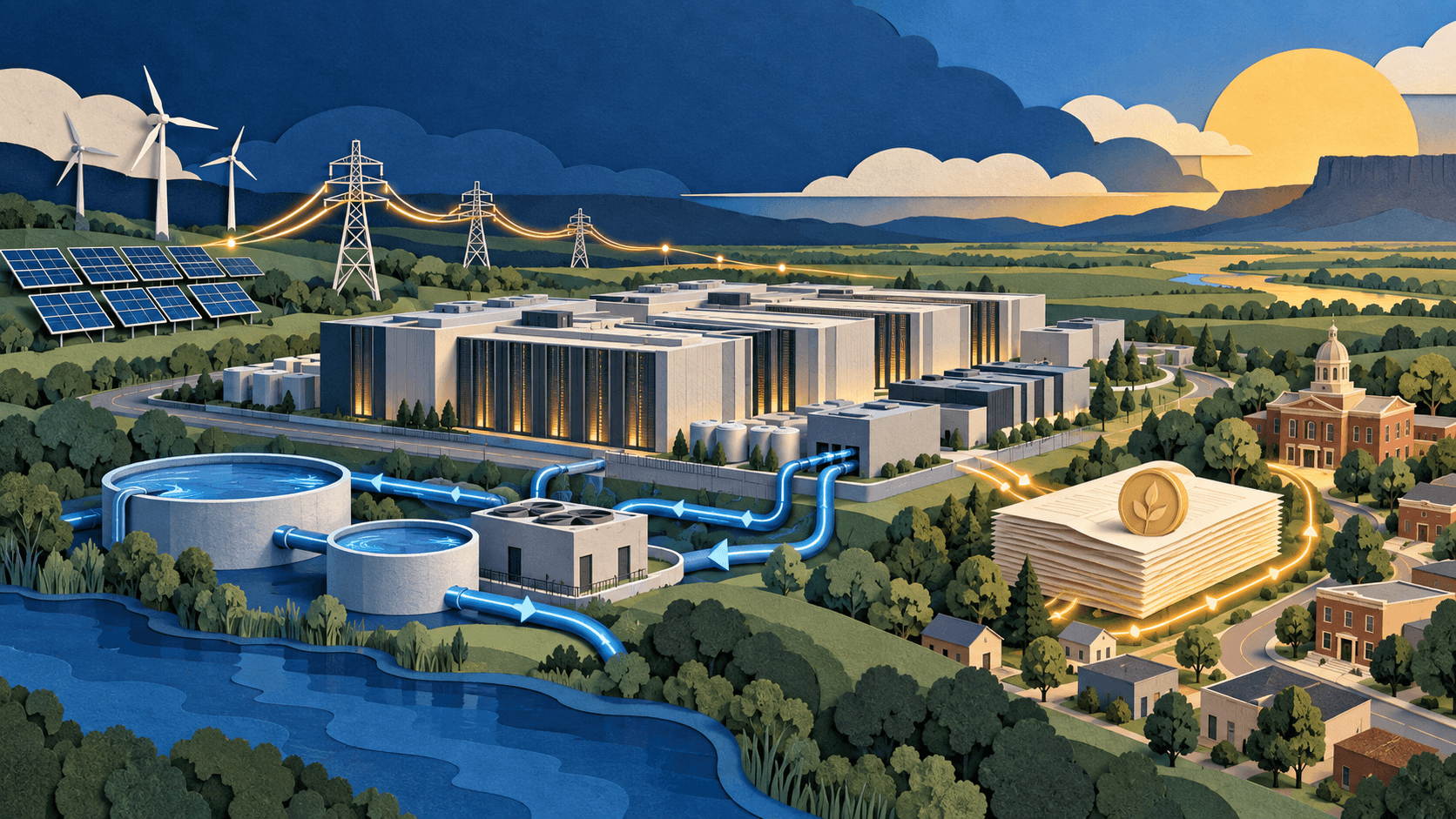
Lambda announced plans on September 27, 2026 for a data center at MidAmerica Industrial Park in Mayes County, Oklahoma. The company estimates $500 million in taxes over ten years at current rates, up to 1,000 construction jobs, and up to 100 permanent positions. It says the site will use closed-loop cooling, fund required energy infrastructure, pay its electricity costs, and explore shifting compute during grid peaks.
Those are company and partner projections, not completed outcomes.
Why this matters beyond one site
AI infrastructure is becoming a local public-finance, electricity, water, land-use, and workforce decision. The useful question is not whether a project is simply “good” or “bad,” but which benefits and costs are contractual, independently measured, enforceable, and visible over the facility's life.
Turn the announcement into a scorecard
Publish annual property, sales, and other tax payments rather than repeating a ten-year estimate. Separate construction from permanent jobs; report local hiring, wages, contractors, and training. Disclose peak and annual electricity demand, infrastructure upgrades, curtailment events, backup generation, emissions assumptions, and who pays when forecasts change.
For water, “closed loop” still needs numbers: initial fill, makeup water, discharge, drought plans, source, quality, and measurement. Report both withdrawal and consumption. For ratepayers, publish the tariff, deposits, minimum obligations, exit provisions, and stranded-asset protections.
What is not yet established
The announcement does not provide the finished capacity, hardware mix, construction schedule, total investment, final load, audited water budget, binding tax schedule, or complete community agreement. Expected taxes depend on current rates and realized development. Flexible load is useful only if grid operators can call it, verify it, and rely on it.
Bottom line
Treat the project as an auditable infrastructure contract, not a press-release total. A public dashboard should compare promised and actual taxes, employment, power, water, grid events, incidents, and community investment each year.
Sources and verification
Product details and claims were checked against the following primary sources.
Frequently asked questions
Where is Lambda planning the data center?
At MidAmerica Industrial Park in Mayes County, Oklahoma, within the Chouteau-Mazie school district tax boundary.
How much tax revenue is promised?
Lambda estimates $500 million over ten years at current rates. That is a forward-looking estimate, not tax already paid.
Will the data center use no water?
No such claim was made. Lambda says it plans closed-loop cooling, which can reduce ongoing cooling water but still requires a quantified water budget.
What should residents monitor?
Contracts, taxes paid, permanent jobs, local hiring, peak and annual power, infrastructure costs, curtailment, water withdrawal and consumption, incidents, and enforcement.
Tools mentioned in this article
RunPod
Deploy GPU Pods, autoscaling inference, and clusters for AI workloads
RunPod is an AI infrastructure platform for on-demand GPU Pods, autoscaling Serverless endpoints, public model APIs, persistent storage, and reserved clusters.
Read next