How to Fact-Check AI Citations and Sources
A real link is not enough: the source must exist, support the exact claim, use the stated context, and deserve the weight placed on it.
Bottom line
A repeatable citation audit for AI answers covering source identity, claim support, quote context, dates, statistics, and contradictions.
Editorial accountability
Who checked this guide
- Evaluation type
- Research-based verification
- Last materially checked
- Evidence
- 4 listed sources
Hands-on testing is identified explicitly. Research-based coverage uses cited product documentation and other named sources; it does not imply every paid plan was used. Read the full methodology.
Editorial basis
What this guidance is based on
- Editorial basis
- Source-led analysis
- Primary references
- 4
- Products covered
- 3
- Last checked
- 2026-10-01
Important limits
- • A completed checklist cannot guarantee truth.
- • Consequential claims may require a qualified subject-matter reviewer.
In this guide
*This is an editorial verification method, not a guarantee that a source or conclusion is correct. Increase review for medical, legal, financial, safety, or other consequential claims.*
Short answer
Fact-check an AI citation by opening the original source and proving that it supports the exact claim. Then verify the author, publisher, date, version, definitions, sample, limitations, and whether stronger or contradictory evidence exists. Never approve a paragraph merely because it contains links.
The eight-step citation audit
For the wider output-review process, begin with the [AI-generated work verification guide](/articles/how-to-verify-ai-generated-work-errors-misinformation-2026). This checklist goes deeper on citations and source claims.
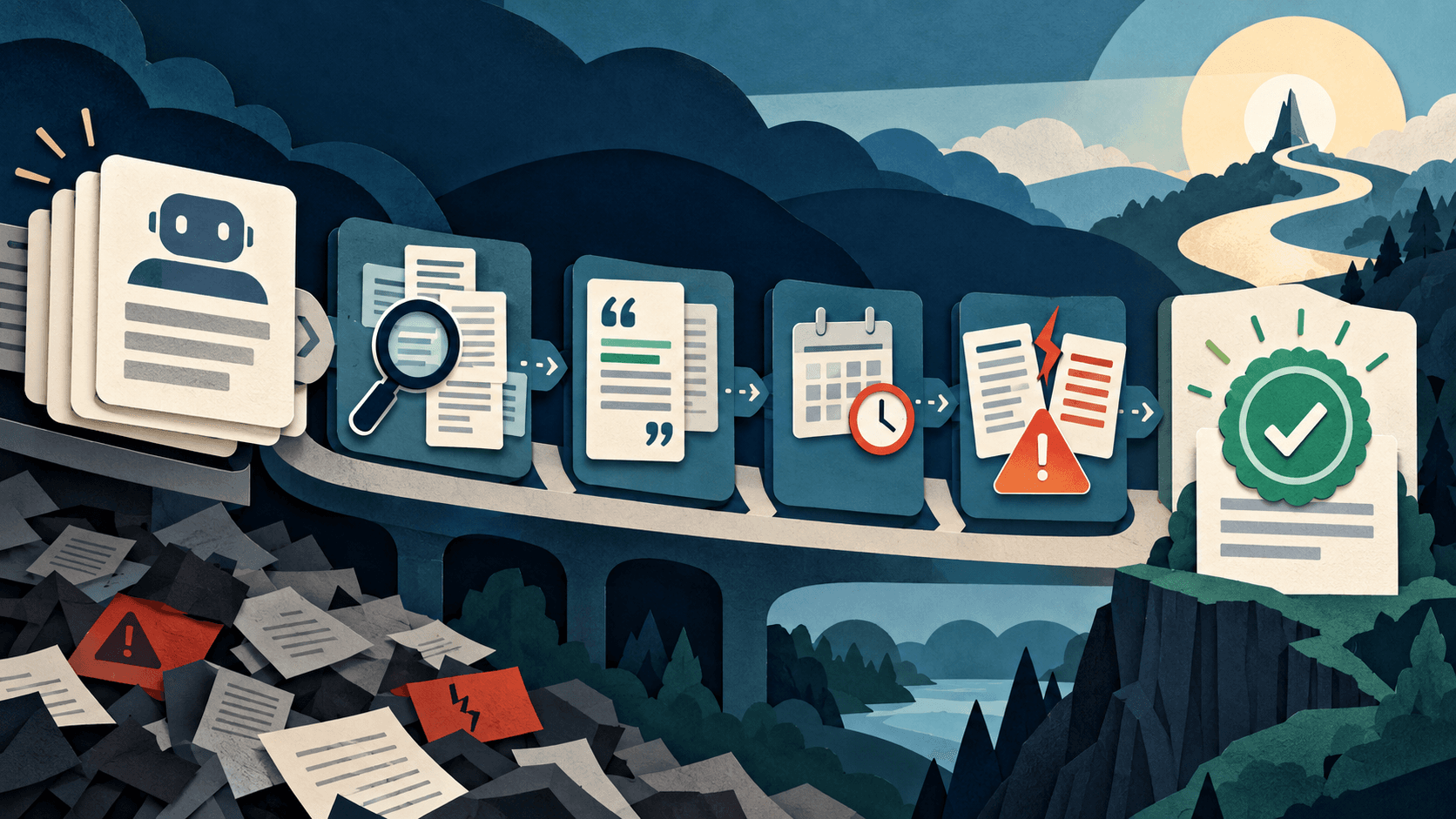
- Extract material claims. Mark every name, date, number, quote, comparison, cause, recommendation, and “first,” “best,” or “proven” assertion.
- Open the source. Reject citations that do not resolve, point only to search results, or lead to a different title.
- Confirm identity. Match author, publisher, date, document type, version, DOI or report number, and correction status.
- Find exact support. Locate the relevant passage, table, dataset, or method. Record page or section—not just the homepage.
- Read the context. Check population, geography, dates, exclusions, definitions, confidence intervals, and whether the source states correlation or causation.
- Trace secondary reporting. When a blog quotes a paper, dataset, court filing, standard, or announcement, inspect the original.
- Look for contradiction. Search independent authoritative sources and later versions. One supporting document cannot establish consensus.
- Rewrite to the evidence. Narrow or remove any claim stronger than its source. State uncertainty and vendor-reported status visibly.
Verify quotes and numbers separately
For a quote, compare every word and preserve the speaker, venue, date, and nearby qualifiers. For a statistic, reproduce the denominator, unit, time period, and calculation. Watch for percentages turned into percentage points, annual figures described as monthly, survey respondents described as all users, and benchmark results generalized to real work.
Use a claim ledger
Maintain columns for claim, importance, source URL, source type, supporting passage, date checked, verifier, contradiction, decision, and next review. Require two independent sources for consequential factual claims when practical. Vendor documentation is appropriate for current product features and prices; it is weaker evidence for superiority or business outcomes.
Test AI browsing behavior
Give the system answerable, ambiguous, outdated, and unanswerable questions. Score citation existence, direct support, source authority, freshness, contradictions, and correct abstention. Include a fake premise and a source that changed after publication. The goal is not citation volume; it is traceable support.
Bottom line
The safest AI-research workflow is claim-first and source-first: isolate what is being asserted, verify it in the original material, and edit the prose until it says no more than the evidence.
Sources and verification
Product details and claims were checked against the following primary sources.
Frequently asked questions
Can AI make up citations?
Yes. Models can invent titles, authors, URLs, quotes, and identifiers or attach a real source to an unsupported claim.
Is a working link proof that an AI claim is true?
No. The page may be unrelated, outdated, secondary, methodologically weak, or narrower than the claim.
How do I verify an AI-generated quote?
Find the original transcript or document, compare the exact wording, and preserve the speaker, date, venue, and qualifying context.
How many sources should an AI answer use?
Use enough independent, authoritative evidence for the claim's consequence and uncertainty. Quality and direct support matter more than link count.
Tools mentioned in this article
ChatGPT
The general-purpose AI assistant that started it all
OpenAI's flagship conversational AI model, powering everything from casual chat to complex reasoning, coding, and creative work.
Claude
Anthropic's thoughtful, safety-focused AI with exceptional long-form reasoning
Claude excels at deep analysis, long-form writing, and nuanced reasoning. Built by Anthropic with a focus on safety and helpfulness.
Perplexity AI
AI-powered search engine with real-time citations and research capabilities
Perplexity combines AI chat with real-time web search, delivering cited, verifiable answers. Think Google Search meets ChatGPT.
Read next
Recommended for you

JobCopilot Review 2026: Is AI Auto-Apply Worth It?
JobCopilot can remove hours of repetitive application work, but match quality, truthful answers, and human review matter more than raw submission volume.
A research-based JobCopilot review covering automated applications, current pricing, privacy, risks, alternatives, and a practical buyer test.
Read guide
AI Tools for Nonprofits in 2026: Build a Practical Mission-First Stack
Best AI Tools Under $50 a Month for Small Business in 2026
Best AI Writing Tools in 2026: 9 Picks by Use Case, Budget, and Workflow