Google Earth AI Health Research: Local Validation Still Matters
Google’s October 6 research explores geospatial AI for public health. We explain the case-study limits, preview access, and questions for local evaluation.
Bottom line
Google’s October 6 research explores geospatial AI for public health. We explain the case-study limits, preview access, and questions for local evaluation.
Editorial accountability
Who checked this guide
- Evaluation type
- Research-based verification
- Last materially checked
- Evidence
- 3 listed sources
Hands-on testing is identified explicitly. Research-based coverage uses cited product documentation and other named sources; it does not imply every paid plan was used. Read the full methodology.
Editorial basis
What this guidance is based on
- Editorial basis
- Source-led analysis
- Primary references
- 3
- Products covered
- 0
- Last checked
- 2026-10-07
Important limits
- • DiscoverAI has not independently reproduced the reported evaluations or tested the announced offering.
- • Vendor announcements and research results do not establish production safety, universal effectiveness, or return on investment.
In this guide
Short answer
Google’s new research suggests place-based AI inputs can help some public-health models, but results depend on the task and location. This is evidence to examine with a qualified research team, not a ready-made diagnosis service or a reason to replace local surveillance.
What Google announced
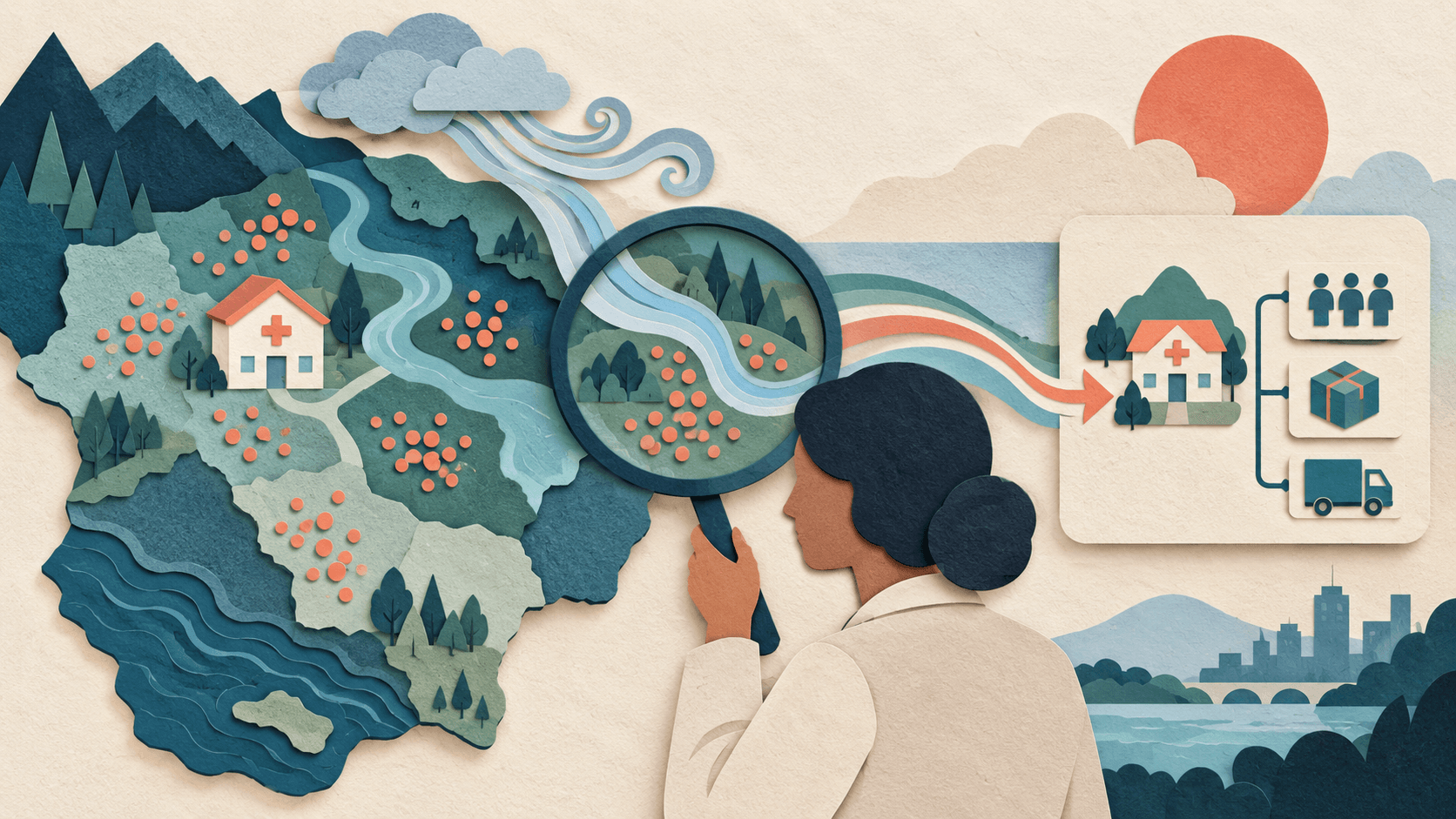
The October 6 Google Research post describes five partner-led case studies using the Population Dynamics Foundation Model, or PDFM. It represents places through aggregated search, mobility, built-environment, and environmental signals that can become inputs to existing models.
The reported results vary. Cardiovascular mortality nowcasting had no statistically significant difference from census-based inputs. Dengue gains were concentrated in active-transmission areas. Cholera forecasts showed benefits at four to eight weeks, without significant gains at one to two weeks. Postpartum-depression prediction showed small AUC gains. These are research-reported results, not DiscoverAI measurements.
Read the research status carefully
The preprint, submitted October 5, covers the United States, Canada, Mexico, and the Democratic Republic of the Congo. It studies different forecasting, estimation, and risk-stratification tasks. Its abstract explicitly says the maternal-health signal does not replace individual socioeconomic information or close demographic screening gaps. An arXiv posting alone does not establish peer-reviewed clinical effectiveness.
Our editorial interpretation is that a reusable representation can reduce the need to assemble every input from scratch. That possibility still leaves the hardest operational questions open: whether the representation is useful for a specific community, whether errors are acceptable, and whether staff can act on the output.
A result on one disease or forecasting horizon should not become a claim about all public-health planning. Compare the model with the actual local baseline and the same information available at the time of the decision. Otherwise, an apparent advantage may reflect a comparison that would never occur in practice.
Access is distinct from operational readiness
The research post says the embeddings are commercially available in Preview as Population Dynamics Insights. It also points to no-cost access requests for selected non-operational academic and public-health research. That is not universal free access or authorization for operational deployment.
The Maps Platform product announcement provides the product context. Prospective users should confirm geography, licensing, delivery format, preview terms, refresh coverage, and total processing costs before planning a pilot. This article does not assign a verified price or assert that a particular region is eligible.
What a nonprofit should ask a research partner
Start with one decision you already make, such as where to focus an outreach campaign. Identify the existing information, the person responsible, and the consequence of a wrong recommendation. Ask a qualified partner whether a place representation adds useful information for that task; do not begin by collecting more personal records.
Our proposed evaluation uses historical, appropriately governed data and a held-out period or region. Define the outcome and baseline before comparing models. Keep enough detail to distinguish better prediction from better service delivery. A more accurate map is of limited practical value if the team cannot reach the suggested locations.
Inspect performance across areas with different data coverage and service access. A model may look useful overall while performing poorly where connectivity or reporting is sparse. Ask how missing inputs and uncertainty appear in the output, and what happens when the local situation changes. These are evaluation questions, not findings from a DiscoverAI test.
Place-based signals need human interpretation
Aggregated geography is not a person’s medical history. In an editorial example, an outreach team could use an area-level signal to choose where to offer a public information session. It should not infer a named resident’s condition from the neighborhood alone.
Review the information flow with the responsible research and privacy teams before linking any additional records. Use the minimum information needed for the defined task and document how results will be reviewed. The research describes privacy-preserving inputs; we have not audited the underlying protections or a buyer’s implementation.
The next evidence to look for
Useful follow-up evidence would show repeatable local performance, uncertainty that decision-makers can understand, and benefits that persist after accounting for staffing and follow-up effort. Prospective evaluation of the service outcome would answer a different question from retrospective prediction accuracy.
For related environmental coverage, read our [methane-detection analysis](/articles/google-mapl-emit-methane-detection-validation-2026). Browse the [nonprofit AI guide](/articles/best-ai-tool-for-nonprofits-2026) for everyday operational workflows. This public-health research should be evaluated through a qualified partner with a defined research or service need.
Sources and verification
Product details and claims were checked against the following primary sources.
Frequently asked questions
Is PDFM a diagnostic chatbot?
No. The work concerns place representations used as inputs to research models, not a consumer diagnosis service.
Did every case study show a clear improvement?
No. Results differ by task, baseline, location, and forecast horizon.
Is research access the same as production access?
No. Selected non-operational research access and commercial preview terms are distinct; verify the applicable agreement.
Has DiscoverAI independently tested these models?
No. This is source-based analysis; local evaluation steps are recommendations rather than measured results.
Read next