Google AI Atlas Finds Science Gains—and a Validation Bottleneck
Nearly half of surveyed scientists use AI daily and report saving almost seven hours a week, but faster hypothesis generation is colliding with slower experiments and clinical validation.
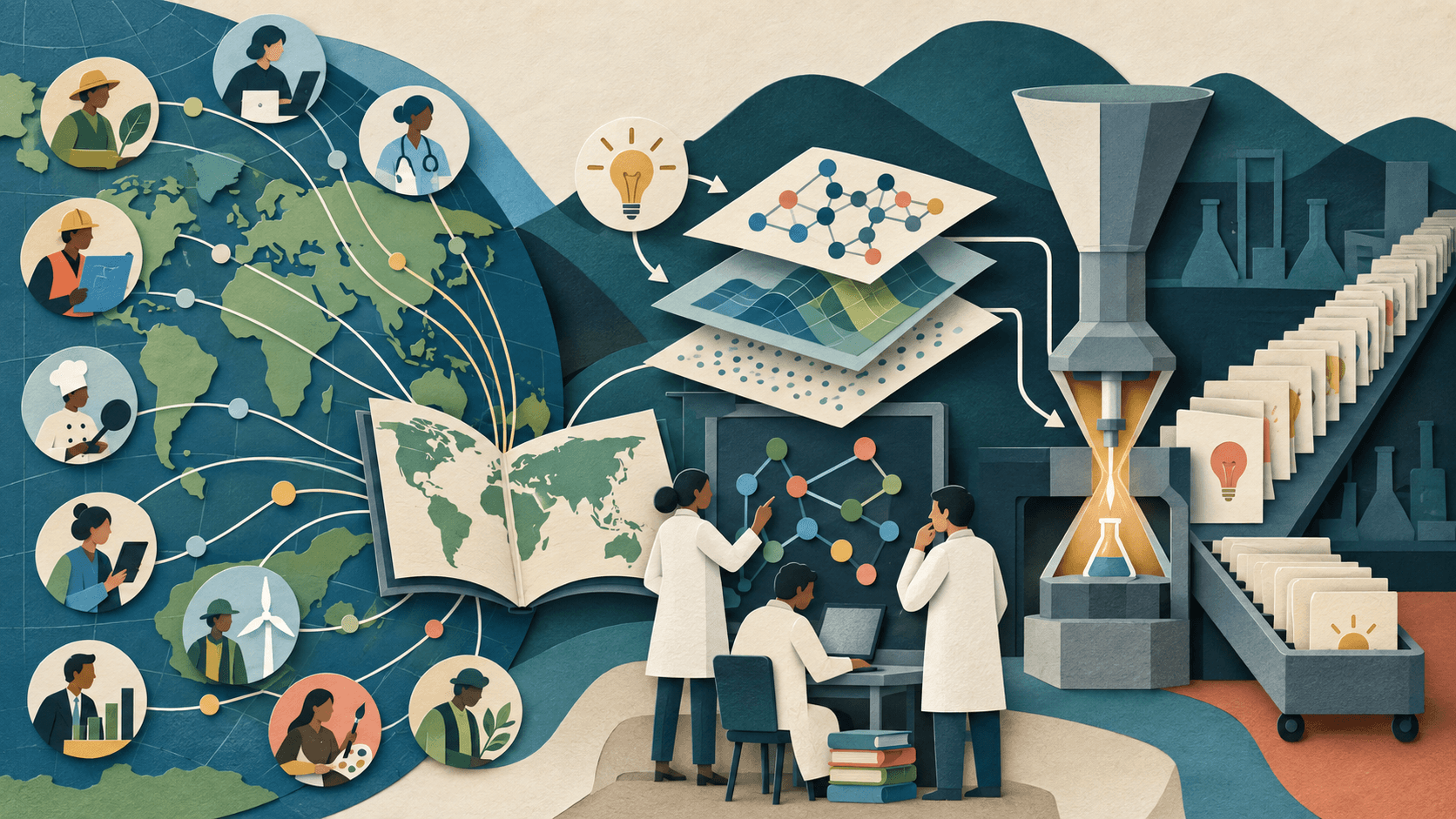
Bottom line
Google's updated AI & Economy ATLAS maps adoption across occupations and examines how scientists use language and specialized models. The productivity story is promising but incomplete.
Editorial accountability
Who checked this guide
- Evaluation type
- Research-based verification
- Last materially checked
- Evidence
- 4 listed sources
Hands-on testing is identified explicitly. Research-based coverage uses cited product documentation and other named sources; it does not imply every paid plan was used. Read the full methodology.
Editorial basis
What this guidance is based on
- Editorial basis
- Source-led analysis
- Primary references
- 4
- Products covered
- 1
- Last checked
- 2026-09-17
Important limits
- • Features, availability, and pricing can change after publication; confirm consequential details with the provider.
In this guide
*This research-based analysis covers Google's September 15, 2026 ATLAS update, its July methodology summary, and the linked science study. Findings are based partly on Google-product activity and self-reported survey responses; they do not measure every AI system, worker, country, or scientific output.*
The short answer
Google's updated AI & Economy ATLAS reports that nearly half of more than 600 surveyed U.S. and U.K. scientists use some form of AI daily and estimate saving just under seven hours per week. Yet the research also finds more time spent checking AI output, a growing backlog of hypotheses, and bottlenecks in physical experiments and clinical validation.
The broader open-access explorer maps millions of aggregated data points across occupations and countries. It suggests adoption differs substantially by region and job type. Because ATLAS is built from Google AI activity and a separate scientist survey, it is best read as a large observational window—not a census of global AI use or causal proof of productivity.
What is Google's AI & Economy ATLAS?
ATLAS stands for Activity, Task, Landscape, and Adoption Study. Its first release analyzed 15 million aggregated and de-identified interactions across the Gemini app, AI Mode, and Gemini API, spanning more than 150 countries, 140 languages, 800 occupations, and 4,000 tasks. Google says it removes personal and sensitive information, breaks links to underlying logs, summarizes text, and aggregates groups of users.
The new interactive explorer makes occupation, country, and non-work patterns easier to inspect. Google's earlier release found AI use across 68% of occupations representing 90% of U.S. employment, but only about 21% of tasks within a typical job. That distinction matters: broad occupational exposure is not the same as whole-job automation.
What did the update find about global adoption?
Google reports that computer and mathematical work accounts for 30% of work-related AI activity in the United States—twice the share outside the country. Arts, design, and media account for 19% of work-related use in India, 1.6 times the global average. In OECD countries, technical and business roles lead; in non-OECD countries, office support, creative, and education roles rank higher.
Adoption generally rises with GDP per person, though Brazil and the United Arab Emirates appear above that trend. Manual-task support also varies: real-time equipment diagnosis and troubleshooting represent 7% of work-related use in Brazil and Germany, versus 4% in Japan.
These shares describe the composition of observed Google AI activity, not the percentage of every worker using AI. Product availability, internet access, occupation mix, language support, and Google's market position can all shape the sample.
How are scientists using AI?
The linked study combines a taxonomy of scientific work, an analysis of 2,600 specialized AI models, and a survey of more than 600 scientists. It finds language models spread across fields and task types, while specialized models are relatively concentrated in health, life sciences, prediction, generation, and simulation.
Scientists report meaningful time savings, but saved time does not automatically become more validated discoveries. AI can accelerate literature work, coding, analysis, and hypothesis formation faster than labs can run physical experiments, recruit clinical participants, reproduce results, or complete peer review. Verification time also offsets part of the gross gain.
What should leaders do with these findings?
Measure the full workflow, not AI task speed alone. A research team that doubles hypothesis output without adding experimental capacity may simply create a larger queue. Track time to validated result, failed or duplicated experiments, verification effort, compute and lab costs, data provenance, and whether AI-assisted conclusions reproduce.
For workforce planning, use occupation-level data to locate tasks worth testing rather than predict job removal. Run bounded pilots with representative users and compare accepted output, cycle time, error correction, and downstream workload. Regional adoption gaps may also reflect access and product coverage rather than appetite or ability.
The verdict
ATLAS is valuable because it moves the AI-work debate closer to observed activity and task structure. Its science update makes the most important productivity point explicit: faster cognitive work can expose slower physical and institutional constraints.
The numbers should remain attributed to Google's dataset and survey. The practical takeaway is stronger than a headline hours-saved figure: organizations need to redesign validation, experimentation, and handoffs if they want AI assistance to improve completed outcomes rather than expand the backlog.
Sources and verification
Product details and claims were checked against the following primary sources.
Frequently asked questions
What is the Google AI & Economy ATLAS?
ATLAS is Google's ongoing study of how people use its AI products across work and daily life, using aggregated and de-identified interactions plus related research and surveys.
How much time do scientists report saving with AI?
In the linked survey of more than 600 U.S. and U.K. scientists, respondents reported saving just under seven hours per week on average. This is self-reported, not a causal productivity measurement.
Why has faster AI not automatically produced more discoveries?
The research identifies validation work, physical experiments, clinical testing, and a growing backlog of hypotheses as downstream constraints that do not accelerate at the same rate as digital knowledge tasks.
Does ATLAS represent all global AI use?
No. Its core activity data comes from Google products, while the science findings also use a U.S. and U.K. survey. The results are large and useful but shaped by product, geography, access, and sampling boundaries.
Found this useful?
Get the next one in your inbox.
One five-minute briefing a week: a meaningful change, a practical workflow, and a clearer tool decision—already filtered for lean teams.
Free · one email a week · unsubscribe any time
Tools mentioned in this article
Google Gemini
Google's deeply integrated AI assistant with unmatched access to Google's ecosystem
Gemini combines powerful AI with Google's vast data ecosystem — Search, Gmail, Docs, YouTube, and more — for a uniquely integrated experience.
Read next
Recommended for you

TypeSafe AI Review 2026: Is Jev Ready for Production?
Jev offers a genuinely different API for fast typed decisions, but early-access maturity and vendor-run evaluations make workload-specific validation essential.
A research-based TypeSafe AI review of Jev's typed decisions, confidence, pricing, evaluations, privacy, limitations, alternatives, and production-readiness test.
Read guide
AI Implementation for Small Business: Launch Your First Workflow in 30 Days
TypingMind Review 2026: Multi-Model Chat, Pricing, and Privacy
Dia Browser Review 2026: Is the AI Browser Worth Switching To?