In this guide
What happened
Google announced Gemini 4 Neon on November 18, 2026, positioning it for coding, analysis and extended tool-using work. This analysis was written on November 21. It is based on the announcement and model documentation, not our own performance tests.
The launch post describes a one-million-token context window and rollout through the Gemini API, business offering, paid Antigravity access and Pro/Ultra app plans. It quotes API rates of $3 per million input tokens and $15 per million output tokens, with cached inputs priced separately. An app subscription and API consumption are different purchasing decisions.
Free workflow pilot checklist
Test the workflow before you buy the tool.
Use our buyer checklist to plan a task, assign a reviewer and track time saved. You’ll also receive the weekly AI briefing.
Why the announcement matters
Our interpretation is that teams now have another candidate for work that moves through several steps rather than ending with a single answer. A longer context window may accommodate more material, but does not prove that the final conclusion correctly uses it. The model card explicitly retains hallucinations among its limitations.
For a small team, the useful question is whether a model completes a particular task with less total checking. A high benchmark placement cannot tell you whether it preserves the exceptions in your policy, follows your writing brief or handles your software project's conventions.
A useful first pilot
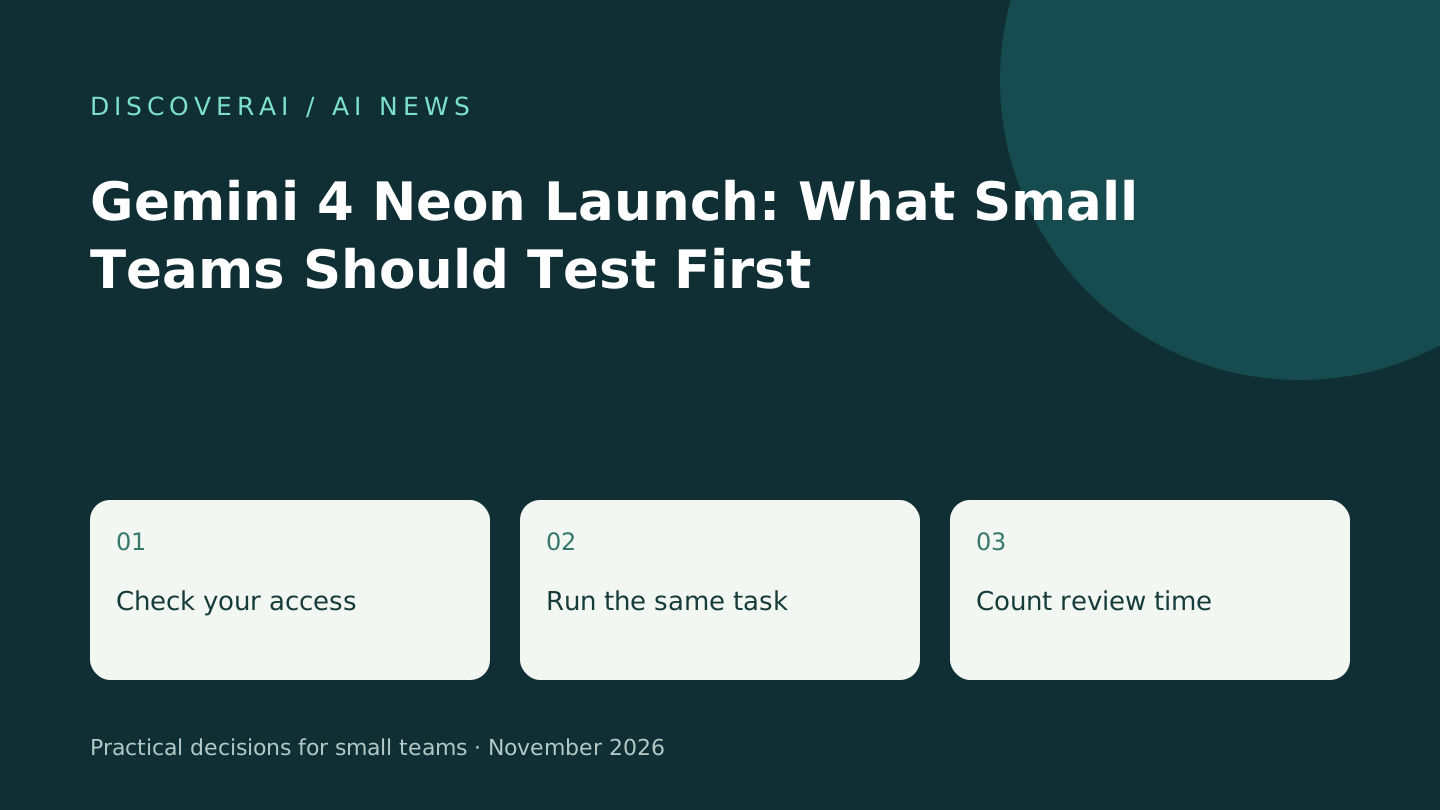
Choose an existing, non-sensitive work packet: a short project brief, an issue list and acceptance criteria. Ask the candidate model and your current tool to produce the same deliverable. Freeze the source files and instructions so that the comparison is meaningful. This is a proposed evaluation, not a completed experiment.
Score factual accuracy, missing requirements, correction time and cost separately. Include one conflicting detail that the model should flag rather than silently resolve. Ask a reviewer to identify every unsupported claim before being told which model produced the document.
For code, use an isolated branch and require the existing checks to pass. Review the patch itself, not just a confident summary of the changes. A successful demonstration on a disposable task is a reason for another bounded trial, not blanket access to production.
Count the whole task cost
Keep separate records for model usage, failed attempts and the person's review time. An inexpensive first response can become costly after repeated revisions. Conversely, a higher initial charge may be acceptable if it reduces correction work on a task that recurs often. Those outcomes must come from your measurements.
Do not treat the published context capacity as a target to fill. Supply the material needed for the decision, identify the authoritative sources and request explicit uncertainty where evidence is absent. Clear inputs remain useful regardless of which model is selected.
What to do next
Check availability in your own account and run a small task comparison using the trial scorecard. Keep your current workflow available during the pilot. Read our Gemini tool overview for the broader product context, and use the release-note drafting checklist if you plan to apply the model to customer communications.
The announcement establishes a new option. It does not establish a reason for every small business to change subscriptions this week.
Transparency
How this guide was checked
About this article
How this article was prepared
- Evaluation type
- Source-based research
- Last reviewed
- Evidence
- 2 listed sources
We label hands-on testing separately. Research-based articles draw on product documentation and other cited sources, rather than direct use of every plan. Read the full methodology.
Editorial basis
Sources and testing
- Editorial basis
- Source-based research
- Primary references
- 2
- Products covered
- 1
- Last checked
- 2026-11-21
Important limits
- • Features, availability and prices can change. Check the provider’s current terms before buying.
Sources and references
References cited by this article. Check the original source for scope, dates and current terms.
Tools mentioned in this article
Google Gemini
Google's deeply integrated AI assistant with unmatched access to Google's ecosystem
Gemini combines powerful AI with Google's vast data ecosystem — Search, Gmail, Docs, YouTube, and more — for a uniquely integrated experience.
Read next