Stop Comparing AI by Token Price—Track Cost per Accepted Outcome
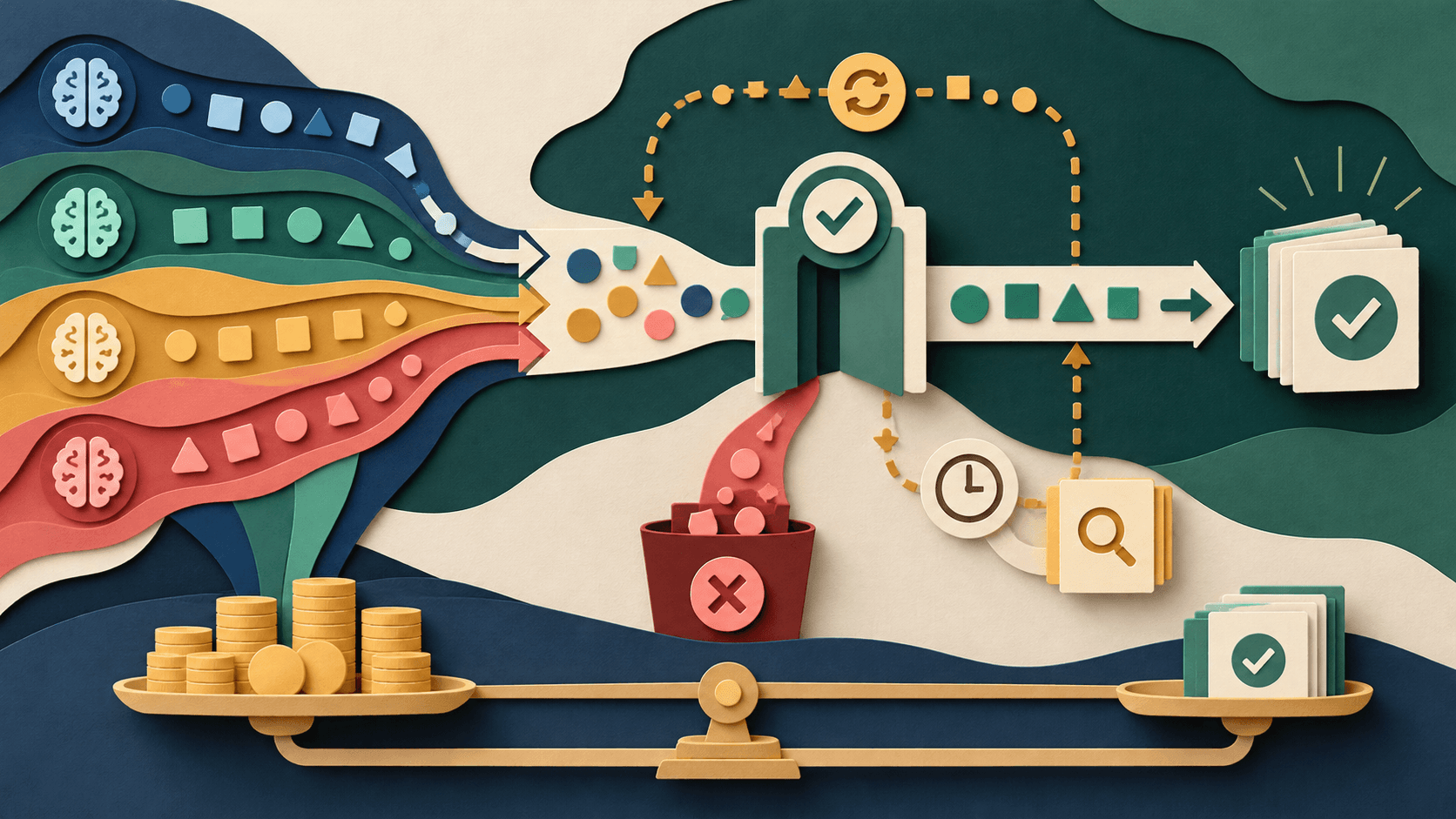
The cheapest model call can be the most expensive workflow once retries, corrections, failures, and rejected output enter the ledger.
Bottom line
Compare AI tools and models by the cost of approved work, not tokens or seats alone. This guide gives teams a repeatable outcome-level method.
Editorial accountability
Who checked this guide
- Evaluation type
- Research-based verification
- Last materially checked
- Evidence
- 4 listed sources
Hands-on testing is identified explicitly. Research-based coverage uses cited product documentation and other named sources; it does not imply every paid plan was used. Read the full methodology.
Editorial basis
What this guidance is based on
- Editorial basis
- Source-led analysis
- Primary references
- 4
- Products covered
- 3
- Last checked
- 2026-09-30
Important limits
- • Labor allocation and acceptance standards require organization-specific judgment.
- • Short pilots may not capture production drift, rare harms, or scale discounts.
In this guide
The metric
Cost per accepted outcome equals all workflow cost divided by the number of outputs that pass the real acceptance standard. Include model and platform charges, tool calls, retries, human review and correction, failures, infrastructure, and allocated implementation or maintenance.
Cost per accepted outcome = (AI + tools + labor + failures + operations) / accepted outcomes
Define the outcome first
Use a unit a customer or operator actually values: an approved support resolution, merged code change, qualified record, compliant document, published asset, or reconciled invoice. “Response generated” is usually an activity, not an outcome.
Build an acceptance rubric
Write pass/fail checks before testing. Include factual correctness, completeness, policy compliance, brand or technical standards, required citations, accessibility, and maximum correction time. Use independent review for consequential work.
Run a representative sample
Test each candidate on the same 30 to 100 real, safely handled tasks. Preserve difficult and ordinary cases. Pin model and settings. Record input/output tokens, cache, tools, latency, retries, failures, review minutes, correction minutes, and final disposition.
Calculate the hidden denominator
If a cheap model produces 100 drafts but only 55 pass, divide total cost by 55—not 100. If a premium model produces 80 accepted outcomes with less review, it may be cheaper despite a higher token price. Report uncertainty when labor estimates or volumes vary.
Decide and keep measuring
Choose the workflow that meets quality and risk thresholds at the best sustainable cost. Monitor acceptance rate, severe errors, drift, latency, and cost after launch. Re-run the comparison when prompts, models, tools, prices, or source data change.
Sources and verification
Product details and claims were checked against the following primary sources.
Frequently asked questions
What is cost per accepted outcome?
It is the total cost of producing work divided by the outputs that pass a predefined real-world acceptance standard.
Should human review time be included?
Yes. Review and correction can dominate workflow economics and must be valued consistently across candidates.
How many tasks should a comparison use?
Use enough representative tasks to include common and difficult cases—often 30 to 100 for an initial bounded decision—then report uncertainty.
Why not compare token prices alone?
Token prices omit retries, tool calls, correction, rejection, latency, failure handling, and the number of tokens required to finish equivalent work.
Tools mentioned in this article
ChatGPT
The general-purpose AI assistant that started it all
OpenAI's flagship conversational AI model, powering everything from casual chat to complex reasoning, coding, and creative work.
Claude
Anthropic's thoughtful, safety-focused AI with exceptional long-form reasoning
Claude excels at deep analysis, long-form writing, and nuanced reasoning. Built by Anthropic with a focus on safety and helpfulness.
Google Gemini
Google's deeply integrated AI assistant with unmatched access to Google's ecosystem
Gemini combines powerful AI with Google's vast data ecosystem — Search, Gmail, Docs, YouTube, and more — for a uniquely integrated experience.
Read next