AI Agents vs. Traditional Automation: Which Work Needs Which?
Use deterministic automation for stable rules and agents only where interpretation creates measurable value.

Bottom line
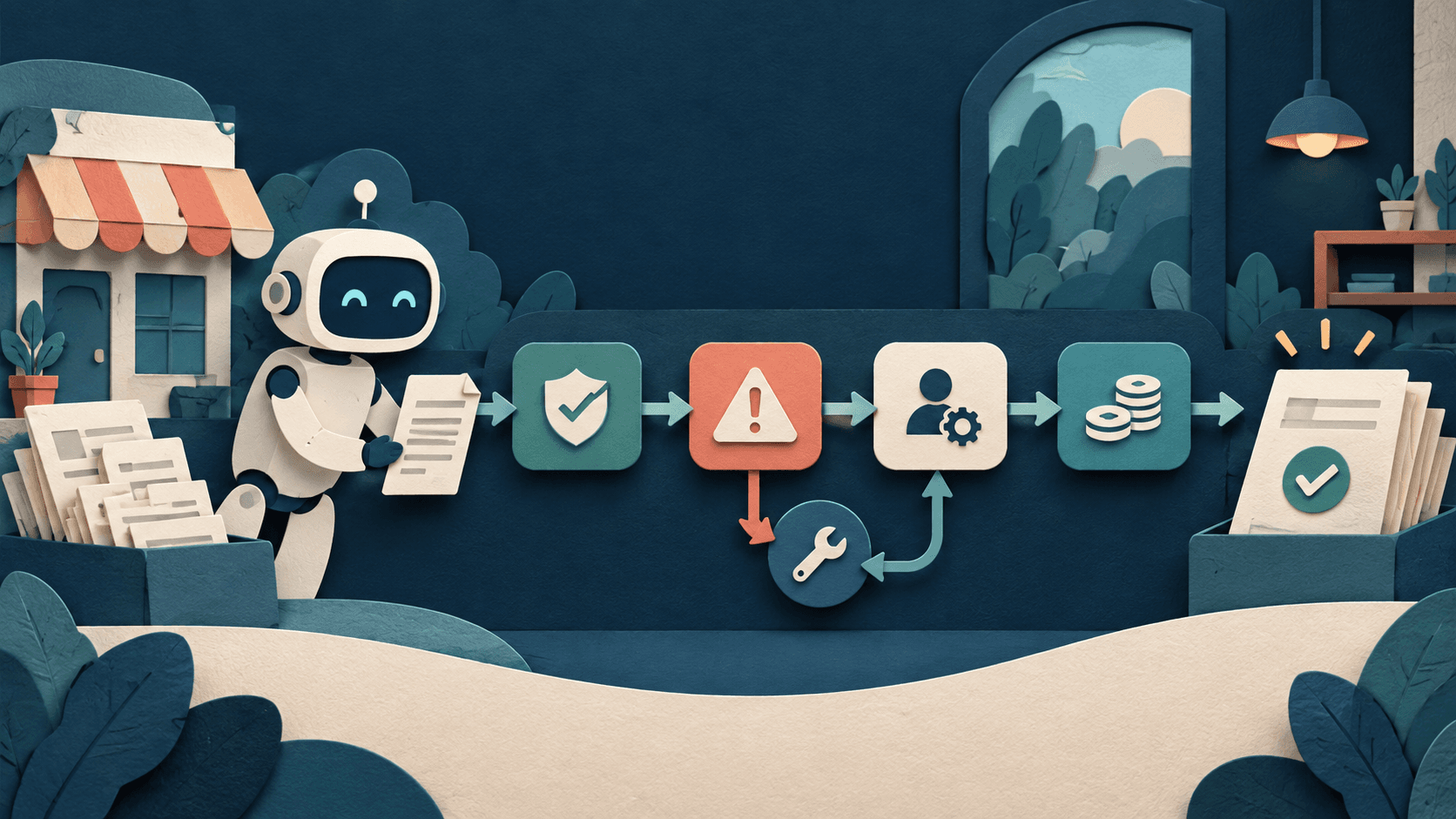
Use traditional automation when inputs, rules, and outputs are stable. Use an AI agent when the work genuinely requires interpretation, planning, or language under bounded permissions. Most reliable systems are hybrid: deterministic orchestration surrounds a narrow model step, validates its output, and routes uncertainty to a person.
Editorial accountability
Who checked this guide
- Evaluation type
- Research-based verification
- Last materially checked
- Evidence
- 4 listed sources
Hands-on testing is identified explicitly. Research-based coverage uses cited product documentation and other named sources; it does not imply every paid plan was used. Read the full methodology.
Editorial basis
What this guidance is based on
- Editorial basis
- Source-led analysis
- Primary references
- 4
- Products covered
- 3
- Last checked
- 2026-09-26
Important limits
- • Products, pricing, limits, and packaging can change after the verification date.
- • Vendor documentation and case studies do not independently prove results in another organization.
Short answer
Use traditional automation when inputs, rules, and outputs are stable. Use an AI agent when the work genuinely requires interpretation, planning, or language under bounded permissions. Most reliable systems are hybrid: deterministic orchestration surrounds a narrow model step, validates its output, and routes uncertainty to a person.
Free workflow pilot checklist
Test the workflow before you buy the tool.
Get the buyer checklist, including task, owner, approval, fallback, and time-saved fields—plus one useful briefing a week.
Decision rule
Ask whether a rules engine can describe the job. If yes, prefer deterministic automation. Add a model only where unstructured input or variable reasoning materially improves completion. Never use autonomy merely because it looks simpler in a demo.
Risk boundary
Map data sensitivity, recipients, money, records, commitments, deletion, and reversibility. High-consequence actions need validation and approval. Limit credentials by resource and action; do not give a reasoning component a broad shared token.
Hybrid pattern
Use deterministic triggers, schemas, allowlists, deduplication, limits, approvals, writes, and rollback. Place the model between controlled inputs and validated outputs. Log the prompt, context, tool calls, decision, result, and reviewer action.
Fair comparison
Run the same historical cases through rules-only, agent-only, and hybrid variants. Score accepted completions, false actions, abstentions, exceptions, correction time, latency, and full cost. Report severe failures separately from averages.
Adoption
Begin with read-only classification or drafting. Graduate to reversible internal writes, then approved external actions. Promotion requires a declared sample, quality threshold, no unresolved severe events, an owner, and a kill switch.
Sources and verification
Product details and claims were checked against the following primary sources.
Frequently asked questions
What should I measure for agent automation?
Measure accepted outcomes, severe errors, escalation quality, correction time, operating cost, and customer or operator impact.
Should AI act without approval?
Begin in shadow mode and keep consequential, ambiguous, financial, legal, or external actions behind explicit approval.
How long should a pilot run?
Use enough representative cases to include normal work, edge cases, failures, and recovery; four weeks is a practical starting window.
How should pricing be compared?
Normalize plan, usage, retries, integrations, implementation, review, and support to cost per accepted outcome.
Recommended tool
Use n8n if this workflow fits your team
It offers more control, code access, and deployment choice than many no-code automators.
Tools mentioned in this article
n8n
A flexible workflow-automation platform for AI agents, APIs, data, code, and human approvals
n8n offers unusually deep automation and deployment control, but workflow ownership, execution economics, credentials, failures, and self-hosting operations determine its real value.
Gumloop
A visual platform for AI workflows, agents, triggers, scraping, and connected business automation
Gumloop offers inspectable AI automation and agent workflows, but credit economics, loops, credentials, and failure handling demand disciplined testing.
Lindy
An AI assistant for inbox, calendar, meetings, follow-up, and delegated computer tasks
Lindy can consolidate communication-heavy administrative work, but its broad permissions and $49.99 starting price require a controlled, measurable trial.
Read next