How to Validate an AI-Generated Research Synthesis
A polished narrative is not a finding until its claims survive source checks, counterevidence, scope limits, and accountable review.
Bottom line
A repeatable acceptance test for AI-generated themes, summaries, and research findings.
Editorial accountability
Who checked this guide
- Evaluation type
- Research-based verification
- Last materially checked
- Evidence
- 4 listed sources
Hands-on testing is identified explicitly. Research-based coverage uses cited product documentation and other named sources; it does not imply every paid plan was used. Read the full methodology.
Editorial basis
What this guidance is based on
- Editorial basis
- Source-led analysis
- Primary references
- 4
- Products covered
- 3
- Last checked
- 2026-10-03
Important limits
- • No single acceptance threshold fits every study or decision risk.
- • Human reviewers can share biases and need calibration and adjudication too.
Short answer
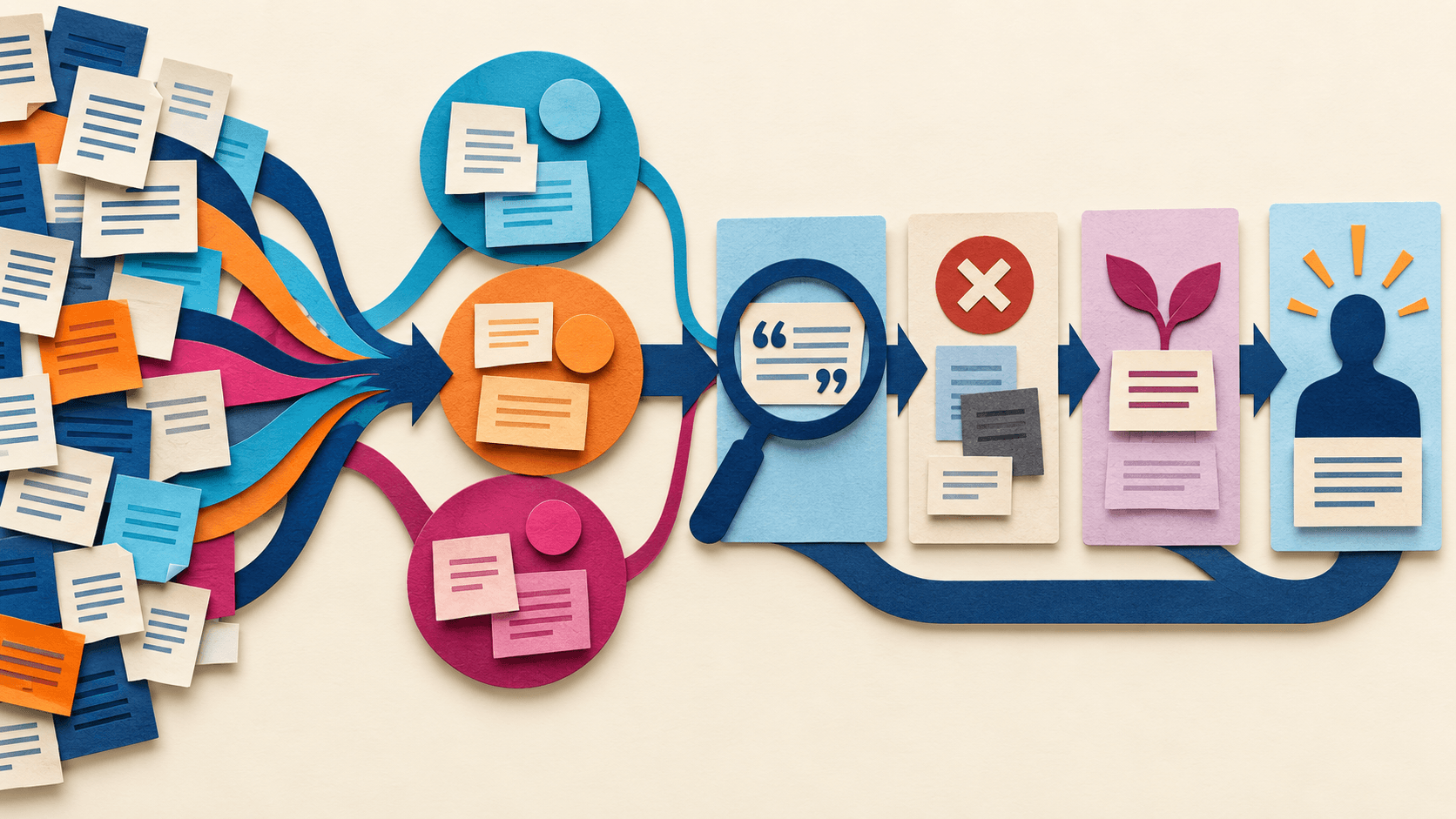
Validate an AI synthesis at the claim level. Sample every material conclusion, open the exact source, confirm quotation and context, search for negative cases, check whether minority views disappeared, review the sample boundary, compare a rerun, and record corrections before approval.
The acceptance test
Create a claim ledger with source IDs, supporting and conflicting excerpts, participant coverage, interpretation, confidence, and owner. Review all high-impact claims plus a random sample of the rest. Reject invented quotations, unsupported prevalence language, collapsed segments, missing contradictions, inaccessible sources, or claims that exceed the study.
Measure correction cost
Track false support, wrong attribution, omitted evidence, theme instability, reviewer minutes, and time to an approved deliverable. A faster draft is not a productivity win if verification and repair cost more than the manual baseline. Preserve the accepted output, corrections, prompt, model, source manifest, and approval record.
Sources and verification
Product details and claims were checked against the following primary sources.
Frequently asked questions
Can AI replace human judgment in AI research synthesis?
No. AI can accelerate retrieval, organization, and first-pass analysis, but an accountable person must verify evidence, context, permissions, and the final decision.
What should a team measure?
Measure source accuracy, correction time, missed counterevidence, permission behavior, export quality, and cost per accepted deliverable—not output volume.
What data is safe to use?
Only data covered by the participant notice, contract, organizational policy, and vendor terms. Remove unnecessary identifiers and keep the original evidence outside the model workflow.
What is the minimum audit trail?
Keep the source manifest, prompt and model record, output, reviewer corrections, approval decision, and deletion or retention record.
Tools mentioned in this article
Condens
Structured qualitative analysis and a governed research repository
Condens organizes sessions, highlights, tags, findings, repository search, and AI-assisted analysis for research teams that need reusable evidence.
Looppanel
AI-assisted interview analysis and research repository for source-linked insights
Looppanel combines recording, transcription, notes, tagging, synthesis, clips, repository search, and controlled AI access for interview-heavy research teams.
NotebookLM
A source-grounded Google research workspace for asking questions and generating overviews from a controlled source set
NotebookLM is a strong research companion when you already have a defined source library, but citations, source completeness, privacy, and plan limits still require human review.
Read next