Salesforce Launches AIforce for Governed CRM in Any AI Interface
The headless interface layer promises to carry Salesforce context, permissions, and actions into external AI surfaces—but identity propagation and action testing remain customer responsibilities.
Bottom line
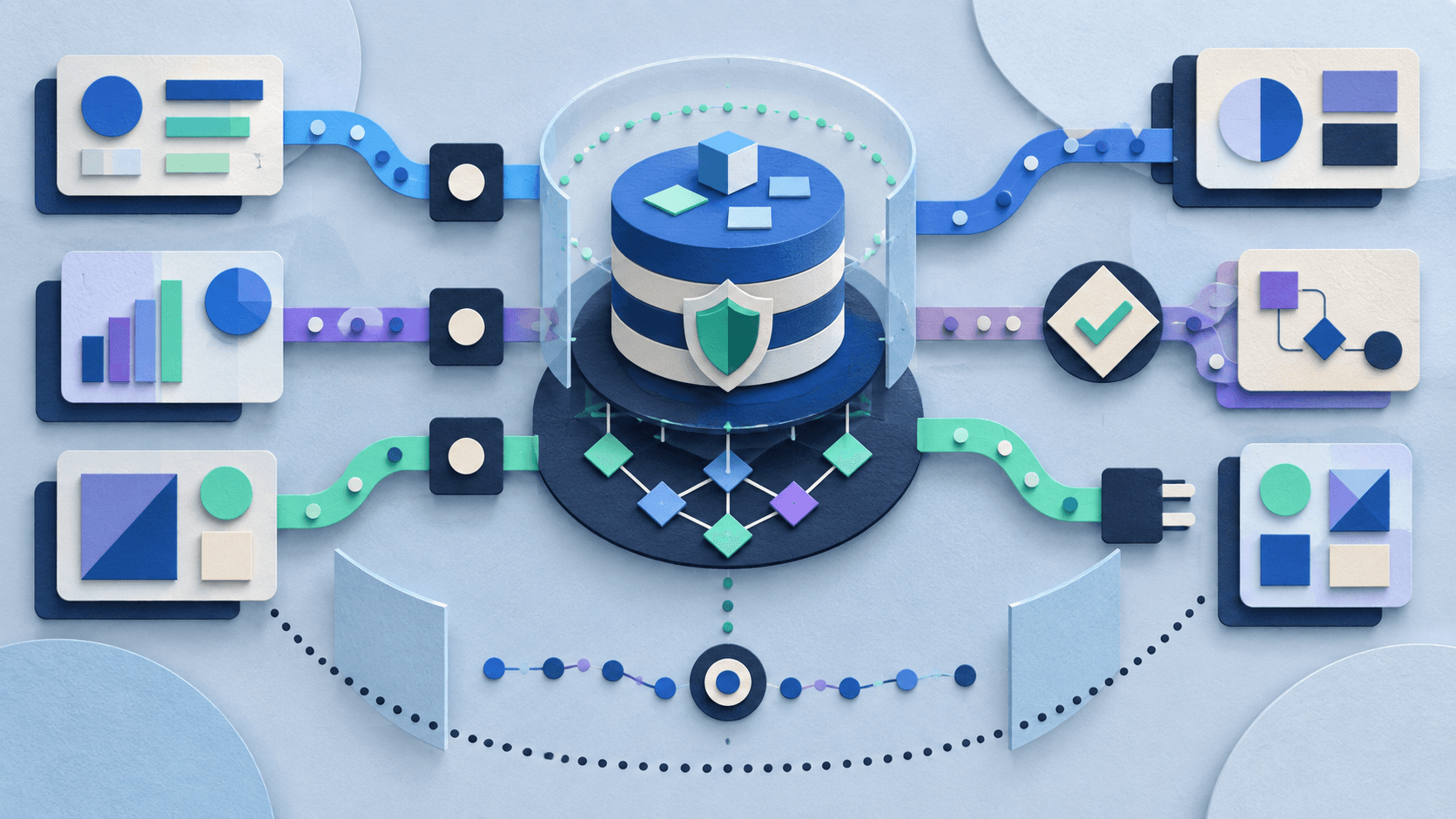
AIforce lets approved AI interfaces reason over and act on Salesforce data and workflows without requiring users to open the CRM. Here is what the architecture changes and what teams must govern.
Editorial accountability
Who checked this guide
- Evaluation type
- Research-based verification
- Last materially checked
- Evidence
- 4 listed sources
Hands-on testing is identified explicitly. Research-based coverage uses cited product documentation and other named sources; it does not imply every paid plan was used. Read the full methodology.
Editorial basis
What this guidance is based on
- Editorial basis
- Source-led analysis
- Primary references
- 4
- Products covered
- 1
- Last checked
- 2026-09-16
Important limits
- • Features, availability, and pricing can change after publication; confirm consequential details with the provider.
In this guide
*This research-based analysis covers Salesforce's September 16, 2026 AIforce announcement and first-party architecture, training, and security documentation. DiscoverAI has not independently tested AIforce. Availability and performance descriptions attributed to Salesforce are provider claims.*
The short answer
Salesforce AIforce is a headless interface layer designed to make Salesforce data, semantics, permissions, business logic, and actions available inside AI work surfaces such as Claude, Slack, and Agentforce Coworker. Its Headless Toolkit exposes MCP connections, APIs, plug-ins, skills, CLIs, and developer tools so builders can create custom interfaces without making every user navigate the standard Salesforce UI.
Salesforce says requests retain existing permissions and business rules, actions route through Salesforce, and model providers receive zero-data-retention handling. That is a strong architectural promise, not automatic proof that every connected agent is correctly scoped. The practical risk moves into identity propagation, permission design, tool definitions, prompt injection, auditability, and consequential-action approval.
What does AIforce change?
Traditional CRM access begins with a Salesforce screen. AIforce separates governed platform capabilities from that interface. An authorized user or agent can ask a question, combine information across records, update data, or trigger a workflow in another approved surface.
The launch starts with Claudeforce, Slackforce, and Agentforce Coworker, and Salesforce says more interfaces will follow. Custom builders can use the Headless Toolkit, while AgentExchange is positioned as the ecosystem for distributing compatible interfaces, agents, integrations, workflows, and actions.
How are permissions and data controls supposed to work?
Salesforce says every request uses existing platform permissions and business rules, so the external interface should see only what the requesting person can see. Agentforce documentation similarly says agents respect licenses, permissions, field-level security, and sharing rules through the Trust Layer.
The architecture still follows shared responsibility. Salesforce secures the platform, while customers remain responsible for configuration, access controls, custom code, data governance, and third-party integrations. For headless clients, Salesforce's architecture guidance recommends propagating per-user identity instead of pooled tokens, scoping and rotating OAuth credentials, and monitoring connected components as supply-chain boundaries.
Is AIforce available, and how much does it cost?
Salesforce announced AIforce at Dreamforce and describes it as launching with three initial surfaces, but the public release does not provide a simple standalone price table or universal entitlement list. It warns that pricing, packaging, and regional availability can vary and that purchasing decisions should rely on currently available contracted services.
Buyers should ask which Salesforce editions, Data 360 capacity, Agentforce licenses, partner products, API calls, model usage, implementation services, and support tiers are required. A headless interface can reduce navigation time while increasing consumption or integration costs elsewhere.
What should teams test before enabling actions?
Begin read-only with a dedicated permission set and representative test users. Build evaluations for record-level and field-level access, indirect prompt injection in CRM text, cross-account leakage, stale data, ambiguous identities, incorrect updates, duplicate actions, revoked access, and failed handoffs. Confirm that logs connect the outside request to the Salesforce identity, records read, tools called, changes made, and approvals received.
Only then enable narrow reversible writes. Require confirmation for high-impact actions, enforce idempotency, cap bulk operations, and keep rollback paths. Zero data retention at the model provider does not eliminate exposure in logs, connected apps, transcripts, caches, or downstream systems.
The verdict
AIforce is a consequential step toward making CRM a governed capability layer rather than a destination screen. It could make Salesforce knowledge and workflows substantially more accessible across the AI tools employees already use.
Its value depends on whether governance survives the interface boundary. Teams should verify entitlements and cost, preserve per-user identity, start read-only, test hostile and ambiguous inputs, and require evidence-rich audit trails before allowing an external agent to change customer or revenue records.
Sources and verification
Product details and claims were checked against the following primary sources.
Frequently asked questions
What is Salesforce AIforce?
AIforce is a headless interface layer that exposes governed Salesforce data, business logic, permissions, workflows, and actions to approved AI interfaces through tools such as MCP, APIs, plug-ins, and skills.
Where can people use AIforce?
Salesforce says AIforce is launching with Claudeforce, Slackforce, and Agentforce Coworker, with additional interfaces and partner integrations expected through its Headless Toolkit and AgentExchange ecosystem.
Does AIforce preserve Salesforce permissions?
Salesforce says requests run under existing permissions and business rules. Customers still need to configure access correctly, propagate individual identities, secure credentials, and test every connected interface.
How much does Salesforce AIforce cost?
Salesforce has not published a universal standalone price in the launch announcement. Required editions, Agentforce and Data 360 capacity, partner products, API usage, models, and services should be confirmed contractually.
Found this useful?
Get the next one in your inbox.
One five-minute briefing a week: a meaningful change, a practical workflow, and a clearer tool decision—already filtered for lean teams.
Free · one email a week · unsubscribe any time
Tools mentioned in this article
Claude
Anthropic's thoughtful, safety-focused AI with exceptional long-form reasoning
Claude excels at deep analysis, long-form writing, and nuanced reasoning. Built by Anthropic with a focus on safety and helpfulness.
Read next
Recommended for you

Best AI for Business Writing in 2026: Emails, Proposals, Reports, and Policies
Claude is our first choice for substantial documents, while ChatGPT is the stronger all-purpose assistant and Grammarly is the easiest editing layer.
Choose the best business-writing AI by deliverable, collaboration needs, privacy, and the amount of human editing it actually removes.
Read guide
DocsBot AI Review 2026: Pricing, Accuracy, Privacy, and Fit
AI Social Media Tools in 2026: Best Stack for Content, Scheduling, and Analytics
AI Tools for Nonprofits in 2026: Build a Practical Mission-First Stack