Run AI Agents in Shadow Mode Before You Grant Write Access
Let the agent observe and propose before it can send, change, delete, purchase, or trigger anything.
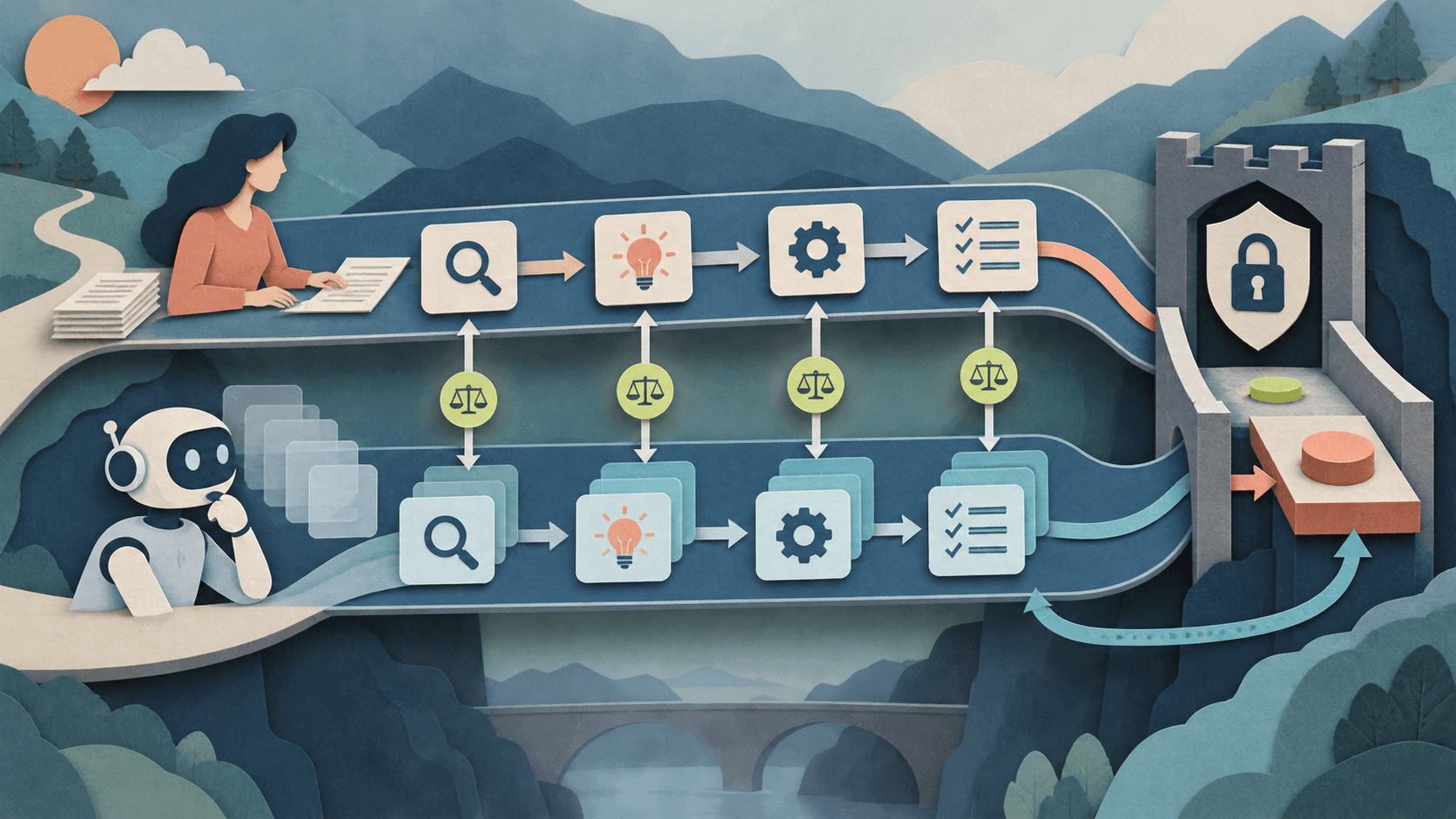
Bottom line
Shadow mode lets an AI agent receive the same inputs as a live workflow and produce proposed decisions or actions without executing them. Compare those proposals with what authorized humans actually did, score disagreements and missed cases, and grant narrowly scoped write access only after the agent meets predefined quality and safety thresholds across representative traffic.
Editorial accountability
Who checked this guide
- Evaluation type
- Research-based verification
- Last materially checked
- Evidence
- 4 listed sources
Hands-on testing is identified explicitly. Research-based coverage uses cited product documentation and other named sources; it does not imply every paid plan was used. Read the full methodology.
Editorial basis
What this guidance is based on
- Editorial basis
- Source-led analysis
- Primary references
- 4
- Products covered
- 3
- Last checked
- 2026-09-24
Important limits
- • Vendor claims and demonstrations are not independent proof of outcomes.
- • Availability, pricing, policies, and behavior can change.
In this guide
Short answer
Shadow mode lets an AI agent receive the same inputs as a live workflow and produce proposed decisions or actions without executing them. Compare those proposals with what authorized humans actually did, score disagreements and missed cases, and grant narrowly scoped write access only after the agent meets predefined quality and safety thresholds across representative traffic.
Free workflow pilot checklist
Test the workflow before you buy the tool.
Get the buyer checklist, including task, owner, approval, fallback, and time-saved fields—plus one useful briefing a week.
Define the production decision first
Name the exact unit of work, allowed evidence, output schema, deadline, prohibited actions, escalation conditions, and authoritative system. Shadow mode is not useful when success is a vague impression such as “seems helpful.”
Mirror inputs without mirroring consequences
Give the agent only the read access needed to evaluate real cases. Replace external sends and writes with a proposal ledger containing the intended action, target, payload, evidence, confidence, and reason. Prevent tools from reaching production endpoints.
Compare against outcomes, not imitation
Human decisions can also be wrong. Review a sample with an independent rubric and, where possible, later outcome data. Track agreement, accepted proposals, false positives, false negatives, prohibited actions, missing evidence, latency, escalation, and reviewer time by risk segment.
Test the failure paths
Include prompt injection, stale and conflicting records, inaccessible data, duplicate events, tool timeouts, revoked users, adversarial requests, and cases outside policy. Verify that the agent abstains or escalates instead of inventing access or silently proceeding.
Graduate in stages
Move from shadow mode to suggestions, then human-approved writes, then a small set of reversible automatic actions. Use canaries, rate limits, transaction caps, monitoring, a kill switch, and automatic fallback. Any permission or workflow change returns the affected path to shadow mode.
Practical template
For each action record: case ID, timestamp, inputs available, proposed action, evidence, confidence, human action, final outcome, reviewer label, severity, cost, latency, and notes. Publish the acceptance and stop thresholds before reviewing results.
Sources and verification
Product details and claims were checked against the following primary sources.
Frequently asked questions
What is AI agent shadow mode?
It is a test where an agent sees realistic inputs and proposes actions, but cannot execute those actions in production.
How long should shadow mode run?
Run until the sample covers normal volume, important segments, rare failures, peak conditions, and every high-consequence path—not for an arbitrary number of days.
What should teams measure?
Measure accepted proposals, severe errors, abstention, escalation, evidence quality, latency, reviewer effort, cost, and outcomes by risk segment.
When can an agent receive write access?
Only after predefined thresholds hold, failure paths are tested, permissions are narrow, actions are reversible, and monitoring, fallback, and revocation work.
Recommended tool
Use ChatGPT if this workflow fits your team
It has one of the clearest workflow fits in its category and is easier to recommend than tools that only look impressive in demos.
Tools mentioned in this article
ChatGPT
The general-purpose AI assistant that started it all
OpenAI's flagship conversational AI model, powering everything from casual chat to complex reasoning, coding, and creative work.
Claude
Anthropic's thoughtful, safety-focused AI with exceptional long-form reasoning
Claude excels at deep analysis, long-form writing, and nuanced reasoning. Built by Anthropic with a focus on safety and helpfulness.
n8n
A flexible workflow-automation platform for AI agents, APIs, data, code, and human approvals
n8n offers unusually deep automation and deployment control, but workflow ownership, execution economics, credentials, failures, and self-hosting operations determine its real value.
Read next