Researchers Are Using Codex and ChatGPT to Search for New Antimicrobials: What AI Actually Does
The workflow shows how general-purpose assistants can bridge coding and biology around specialist prediction models, while experiments—not fluent answers—remain the source of truth.
Bottom line
A University of Pennsylvania lab uses Codex and ChatGPT to support antimicrobial research. The assistants accelerate code, data, and hypothesis work; they do not turn predictions into medicines.
Editorial accountability
Who checked this guide
- Evaluation type
- Research-based verification
- Last materially checked
- Evidence
- 4 listed sources
Hands-on testing is identified explicitly. Research-based coverage uses cited product documentation and other named sources; it does not imply every paid plan was used. Read the full methodology.
Editorial basis
What this guidance is based on
- Editorial basis
- Source-led analysis
- Primary references
- 4
- Products covered
- 1
- Last checked
- 2026-09-13
Important limits
- • Features, availability, and pricing can change after publication; confirm consequential details with the provider.
In this guide
*This analysis covers OpenAI's September 10, 2026 profile of César de la Fuente's University of Pennsylvania lab and supporting scientific literature. OpenAI's article is a vendor-published case study, not a controlled evaluation of productivity or evidence that ChatGPT discovered an approved drug.*
The short answer
César de la Fuente's lab uses ChatGPT and Codex alongside specialist deep-learning systems to brainstorm hypotheses, write and refine code, prepare genome datasets, analyze results, and connect concepts across biology, chemistry, engineering, and computer science. The specialist models scan biological sequences and prioritize molecules that might have antimicrobial activity.
AI can shrink the initial computational search from years to hours, according to the lab and OpenAI. But a predicted molecule is only a candidate. Researchers must synthesize it, test whether it kills the target microbe, measure toxicity and resistance, study how it behaves in the body, establish manufacturability, and eventually complete regulatory review and clinical trials.
What role do ChatGPT and Codex play?
They are general-purpose collaborators around the scientific pipeline, not substitutes for the lab's antimicrobial prediction models. Team members use them to explain unfamiliar terminology, compare methods, organize ideas, write data-processing programs, and work across disciplinary and language boundaries.
That distinction is essential. A coding assistant can accelerate a pipeline or help a biologist express an analysis in code. It does not independently establish that the input data is representative, the method is biologically valid, the implementation is correct, or a candidate is safe.
How does AI search biology for antimicrobial candidates?
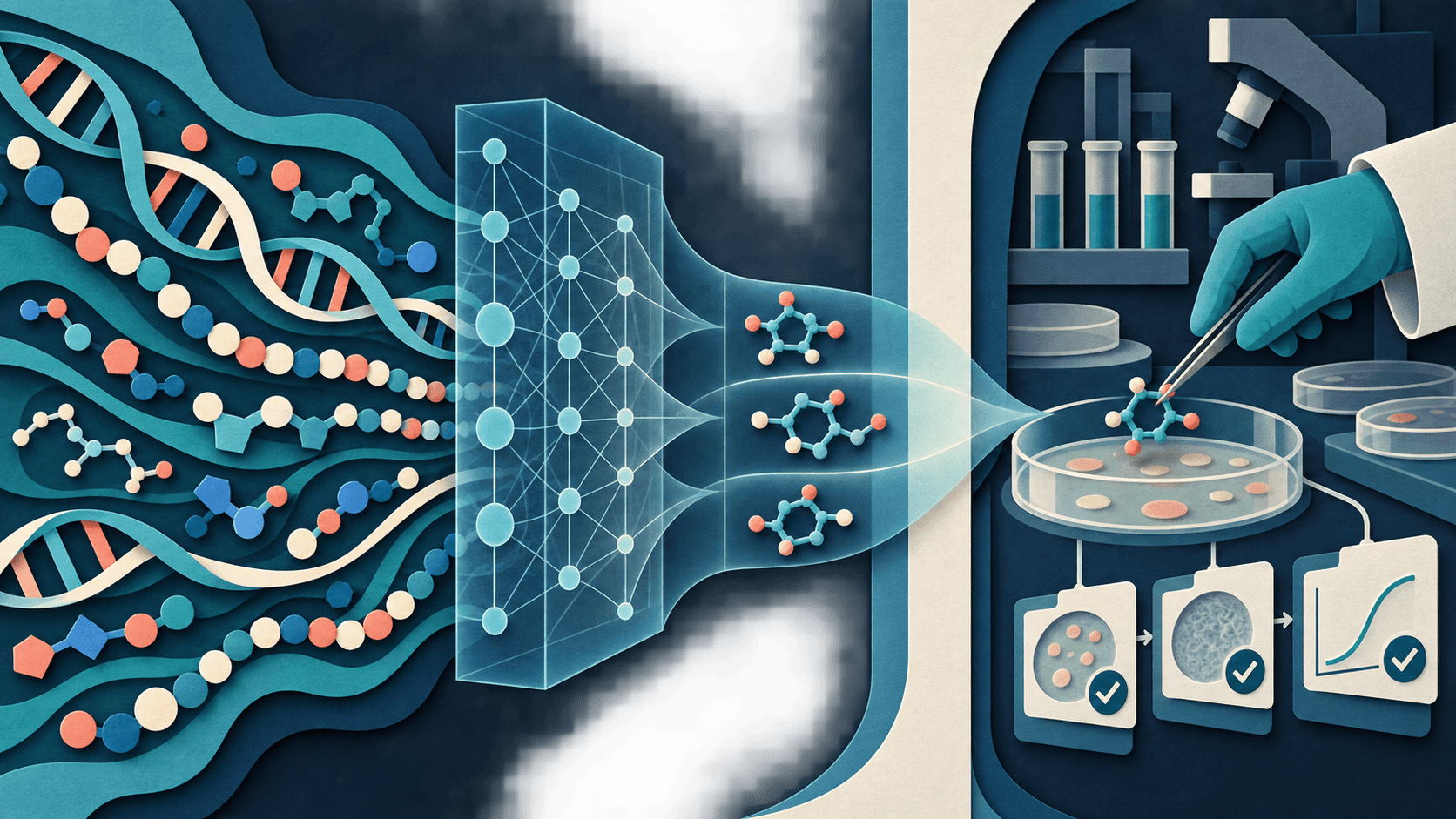
The lab treats genomes and proteomes as searchable information. Specialist models learn patterns associated with antimicrobial peptides, then screen very large collections of biological sequences from humans, microbes, living species, and extinct organisms. The output is a smaller candidate list that researchers can afford to investigate experimentally.
Published work from the group includes machine-learning searches across ancient proteins and generative methods for optimizing peptide antibiotics. These studies support the broader method, but they should not be read as independent validation of every claim in OpenAI's customer story or of the incremental contribution made by ChatGPT and Codex.
Has AI discovered a new antibiotic here?
Not in the sense most patients mean. OpenAI's new article describes how tools are used and points to a research program that has reported promising antimicrobial candidates. It does not announce an approved medicine, a completed clinical trial, or a controlled comparison showing how much Codex and ChatGPT improved scientific outcomes.
Discovery has many gates. A candidate must show activity at a practical concentration, avoid damaging human cells, remain stable, resist rapid microbial adaptation, reach the relevant tissue, be manufacturable, and outperform available options. Most early candidates do not become drugs.
What should research teams copy from this workflow?
Use general assistants for bounded work whose output can be checked: drafting scripts, documenting a pipeline, translating terminology, creating test cases, or generating hypotheses to rank. Preserve data provenance, pin software and model versions, review generated code, test against known controls, and record which claims came from a model.
Keep experimental ground truth outside the assistant. A credible workflow separates ideation, computational prediction, code verification, laboratory validation, and clinical evidence. It also prevents unpublished sequences, patient information, credentials, or partner data from entering a service without appropriate terms and approval.
The verdict
This case study is a strong illustration of AI's near-term scientific value: reducing search and coordination costs across a multidisciplinary team. It is not proof of autonomous drug discovery, and the vendor profile does not quantify ChatGPT's causal contribution.
The important trend is the combination of general-purpose assistants, specialist biological models, and physical experiments. AI can help scientists explore more candidates and write better tooling; laboratory results must still be allowed to say no.
Sources and verification
Product details and claims were checked against the following primary sources.
- How a researcher uses Codex and ChatGPT to search for new antimicrobial molecules — OpenAI
- A generative AI approach for peptide antibiotic optimization — Nature Machine Intelligence
- Deep-learning-enabled antibiotic discovery through molecular de-extinction — Nature Biomedical Engineering
- AI uncovers new antibiotics in ancient microbes — Penn Today
Frequently asked questions
Did ChatGPT discover a new antibiotic?
No approved antibiotic was announced. A Penn lab uses ChatGPT and Codex to support coding, data preparation, analysis, and hypothesis development around specialist models that identify antimicrobial candidates.
How does AI help find antimicrobial molecules?
Specialist models scan genome and protein datasets for sequence patterns associated with antimicrobial activity, reducing a huge search space to candidates that scientists can synthesize and test.
Why is laboratory validation still required?
A computational prediction does not establish microbial killing, safe dosage, toxicity, stability, resistance risk, behavior in the body, manufacturability, or clinical benefit. Those questions require experiments and regulated studies.
What can other research teams learn from this workflow?
Use assistants for bounded, reviewable tasks; preserve provenance; test generated code; compare against known controls; protect sensitive data; and keep prediction, laboratory validation, and clinical evidence as separate gates.
Found this useful?
Get the next one in your inbox.
One five-minute briefing a week: a meaningful change, a practical workflow, and a clearer tool decision—already filtered for lean teams.
Free · one email a week · unsubscribe any time
Tools mentioned in this article
ChatGPT
The general-purpose AI assistant that started it all
OpenAI's flagship conversational AI model, powering everything from casual chat to complex reasoning, coding, and creative work.
Read next
Recommended for you

GPT-6 Astra vs Claude for Business: Which Should Your Team Choose?
Astra is the higher-control agent bet; Claude remains the more flexible model family for many cost-sensitive knowledge and coding workflows.
GPT-6 Astra is best tested for difficult end-to-end agent work, while Claude offers more model and price choices for everyday business workloads.
Read guide
Aomni Review 2026: AI Sales Research, Account Plans, and Pricing
DocsBot AI Review 2026: Pricing, Accuracy, Privacy, and Fit
Scira AI Review 2026: Pricing, Sources, Privacy, and Fit