How to Clone Your Voice with AI
A step-by-step process for creating a useful cloned voice without sacrificing trust or quality.
Bottom line
How to clone your voice with AI responsibly, what source audio to use, and why review standards matter as much as the tool.
Editorial accountability
Who checked this guide
- Evaluation type
- Editorial guidance
- Last materially checked
- Evidence
- No source list
Hands-on testing is identified explicitly. Research-based coverage uses cited product documentation and other named sources; it does not imply every paid plan was used. Read the full methodology.
Editorial basis
What this guidance is based on
- Editorial basis
- Editorial guidance
- Primary references
- Not listed
- Products covered
- 3
- Last checked
- 2026-07-04
Important limits
- • This page provides editorial guidance rather than a documented hands-on test.
- • Verify pricing, availability, and high-stakes claims with primary sources before acting.
In this guide
Voice cloning is most valuable when it preserves consistency, saves recording time, or helps scale content responsibly.
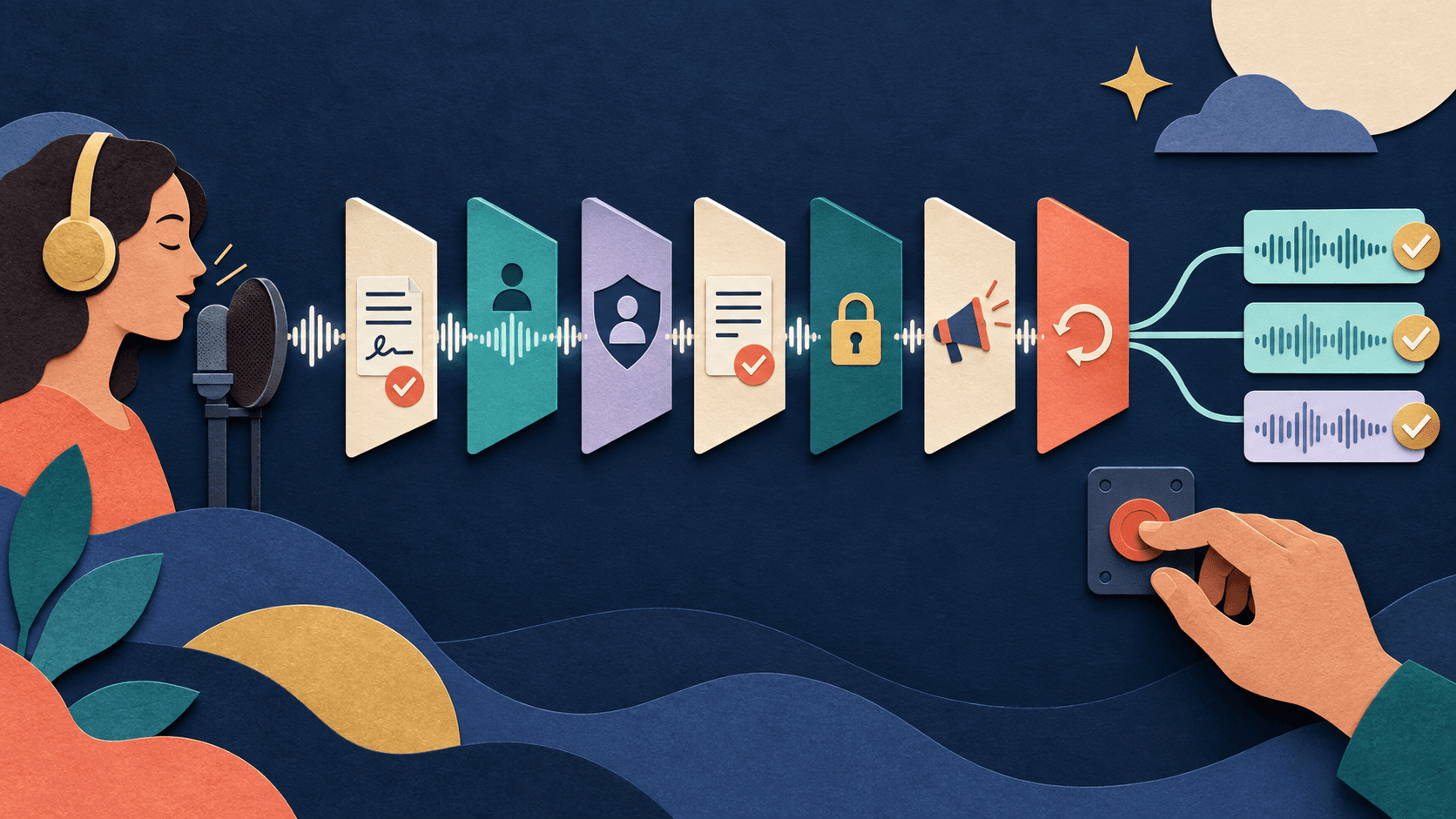
Start with consent and clarity
Only clone a voice you are fully authorized to use. This is a trust issue before it is a software issue.
Record a clean source sample
Use a quiet room, a decent microphone, and a natural reading pace. Better source audio usually matters more than tweaking settings later.
Train and test the clone
Run short scripts first. Listen for pacing, pronunciation, emotional flattening, and language-specific problems. ElevenLabs is a strong fit here because clone quality tends to hold up better under repeated production use than many lighter tools.
Build guardrails
Document where cloned audio is allowed, how it will be disclosed, and who approves final exports before publishing.
Frequently asked questions
Is voice cloning ethical?
It can be, when consent is explicit, usage is transparent, and the voice is not used to mislead people.
What is the best tool for voice cloning?
ElevenLabs is one of the strongest options when clone quality and long-term workflow flexibility both matter.
Recommended tool
Use ElevenLabs if this workflow fits your team
It stands out when you need the voice layer to feel premium, multilingual, and extensible rather than merely functional.
If you subscribe through this link, we may earn a commission. Recommendations stay editorial and only appear where ElevenLabs is a genuine fit.
Tools mentioned in this article
ElevenLabs
A leading AI voice platform for text to speech, voice cloning, speech to text, dubbing, and conversational agents
ElevenLabs combines premium text to speech, voice cloning, multilingual audio generation, speech to text, developer APIs, and voice agents in one AI audio platform.
PlayHT
A practical AI tool for audio workflows
PlayHT helps professionals improve audio workflows with AI-assisted drafting, automation, analysis, or production features.
Murf
A practical AI tool for audio workflows
Murf helps professionals improve audio workflows with AI-assisted drafting, automation, analysis, or production features.
Read next
Recommended for you
ElevenLabs Voice Cloning for Brands and Creators: 2026 Guide
A production voice clone needs more than a convincing demo: establish ownership, consent, approved uses, training quality, review, revocation, and misuse response.
A practical ElevenLabs voice-cloning guide for creators and brands choosing between instant and professional cloning while protecting consent and production quality.
Read guide
ElevenLabs Review 2026: Hands-On Voice Quality, Pricing, and Workflow Test
ElevenLabs vs PlayHT in 2026: Which AI Voice Platform Should You Choose?
ElevenLabs API Guide for Product Teams in 2026