In this guide
*This research-based analysis covers an OpenAI and MIT Engineering Quantum Systems Group case study published September 8, 2026. It is one laboratory workflow, not independent proof that AI can conduct quantum research autonomously.*
Free workflow pilot checklist
Test the workflow before you buy the tool.
Get the buyer checklist, including task, owner, approval, fallback, and time-saved fields—plus one useful briefing a week.
The short answer
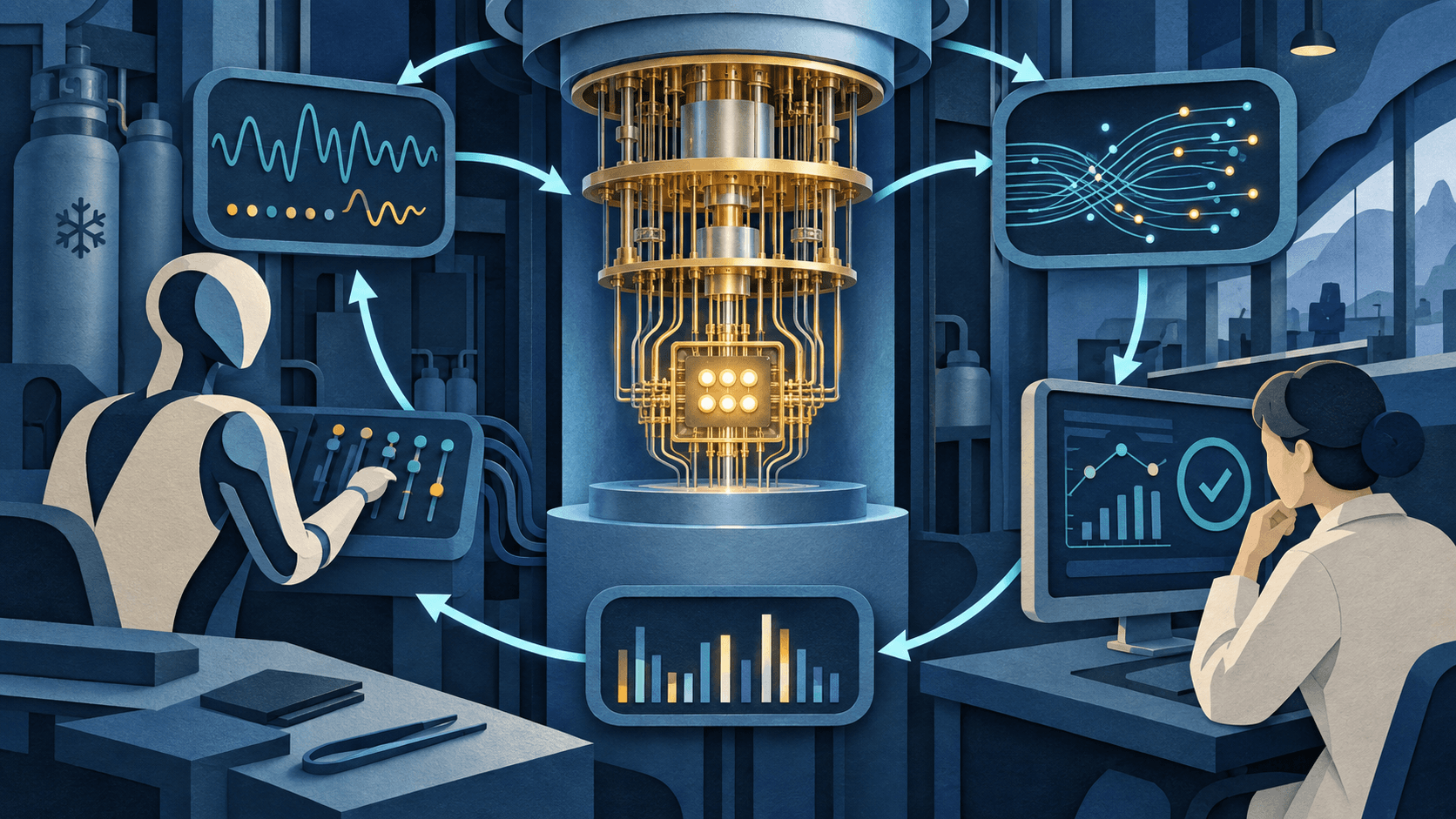
An MIT graduate researcher connected GPT-5.6 Sol, through Codex, to software controlling a superconducting quantum chip. Given measurement-specific skills and design targets, the agent selected parameters, operated laboratory hardware, analyzed results, refined measurements, and passed outputs into later calibration steps.
When signals were clear, OpenAI reports that the agent completed a standard measurement sequence with little intervention. When results were weak, noisy, or physically unexpected, it took longer and sometimes needed expert guidance. That boundary is the real story: current agents can execute well-defined experimental loops, but ambiguity still calls for a scientist who understands the instrument and the physics.
What did the agent actually do?
The experiment used a standard uncalibrated six-qubit chip produced by MIT’s Engineering Quantum Systems Group. Superconducting qubits must be characterized through interdependent measurements: identify transition frequencies, calibrate control and readout pulses, and measure how long quantum information persists.
The researcher supplied task-specific skills explaining how to run and assess each measurement. Codex then interacted with the laboratory software, chose parameters from the chip’s targets and observed data, executed measurements, analyzed the returned signals, and either refined the run or saved a result for the next stage.
This is not a chatbot describing an experiment. It is a software agent acting through a controlled interface on physical equipment. But it is also not an agent inventing the research program. A human built the integration, encoded procedures, chose the chip and goals, monitored work, and intervened when judgment was required.
Why quantum calibration is a revealing agent test
Quantum experiments are software-addressable but physically messy. A measurement can drift, a signal can weaken, and an apparently reasonable fit can be wrong. The workflow combines repeatable procedures with continuous decisions about whether a result is good enough to trust.
That makes it a stronger test than generating analysis from a static dataset. The agent must close a loop between code, instrument, data, and next action. At the same time, the experiment remains bounded: the allowed tools, target device, procedures, and output checks can be defined in advance.
Many real-world agent opportunities share this shape. Manufacturing calibration, materials characterization, robotics testing, network diagnostics, and environmental monitoring all contain routine loops interrupted by ambiguous cases. The likely near-term design is not unrestricted autonomy; it is automated normal operation with explicit escalation.
What the case does not prove
It does not show that GPT-5.6 Sol discovered new quantum physics, designed a novel chip independently, or outperformed an experienced researcher. OpenAI explicitly notes that experts may identify optimal calibration settings faster and that the agent struggled more with weak or noisy signals.
The case study does not provide a broad controlled comparison across laboratories, device architectures, agents, or safety configurations. It also does not establish reliability for unattended high-consequence operation. A successful sequence on one recurring chip type is valuable operational evidence, but it is not a general scientific-autonomy benchmark.
The safety pattern for agents attached to hardware
An agent that can operate equipment needs boundaries at several layers. Limit available commands and parameter ranges. Separate proposed action from execution for high-risk steps. Enforce physical and software interlocks outside the model. Log every command, observation, analysis, and override. Define stop conditions for anomalous signals, repeated failure, budget exhaustion, or disagreement with an independent check.
Credentials should be short-lived and specific to the instrument. The agent should not gain broader network or laboratory access simply because one control API is convenient. Human operators need a clear status view, a reliable stop mechanism, and enough recorded context to reconstruct why the system acted.
How another research team should evaluate lab agents
Start with a repeated, reversible, well-understood measurement whose acceptable outputs are easy to verify. Replay historical runs in simulation before allowing live control. Then use a shadow mode in which the agent recommends parameters while a researcher executes them.
Measure completion rate, time saved, invalid runs, unnecessary instrument use, intervention rate, recovery from drift, false confidence, and reproducibility. Seed known anomalies to test escalation. Expand autonomy only when the system reliably recognizes the edge of its competence.
The verdict
The quantum case matters because it moves the agent conversation from browser tabs into a real experimental loop. GPT-5.6 Sol appears useful at the structured, time-consuming measurement work surrounding scientific judgment.
Its weakness on noisy signals is not a footnote; it identifies the operating model. Let agents run bounded procedures and gather evidence. Keep scientists responsible for ambiguous physics, experimental design, and the decision to trust a result.
Transparency
How this guide was checked
Editorial accountability
Who checked this guide
- Evaluation type
- Research-based verification
- Last materially checked
- Evidence
- 4 listed sources
Hands-on testing is identified explicitly. Research-based coverage uses cited product documentation and other named sources; it does not imply every paid plan was used. Read the full methodology.
Editorial basis
What this guidance is based on
- Editorial basis
- Source-led analysis
- Primary references
- 4
- Products covered
- 1
- Last checked
- 2026-09-09
Important limits
- • Features, availability, and pricing can change after publication; confirm consequential details with the provider.
Sources and references
References cited by this article. Check the original source for scope, dates and current terms.
Frequently asked questions
Did GPT-5.6 Sol operate a quantum computer?
It operated laboratory software used to measure and calibrate an uncalibrated six-qubit chip, choosing parameters and adapting routine measurements through Codex.
Did the AI make a quantum computing discovery?
No such discovery was reported. The case focused on automating routine characterization so the researcher could spend more time on analysis and experiment design.
Where did the AI agent struggle?
OpenAI reports that weak or noisy experimental signals took longer to resolve and sometimes required guidance from an experienced researcher.
What should labs automate first?
Begin with reversible, well-understood measurements, simulation and shadow mode, external interlocks, bounded commands, full logs, clear escalation rules, and human review.
Tools mentioned in this article
ChatGPT
The general-purpose AI assistant that started it all
OpenAI's flagship conversational AI model, powering everything from casual chat to complex reasoning, coding, and creative work.
Read next