In this guide
The news
Google Research published a framework for evaluating social reasoning in AI assistants on November 25, 2026. It uses simulated interactions with an assigned hidden motive, then asks an assistant to infer that motive through a user's account. The construction supplies an answer against which the inference can be checked.
The official research post reports that subjective accounts make the task harder, that framing affects responses, and that models do not fully benefit from clarification questions. Google says it is releasing the framework and dataset. This November 28 analysis is based on the announcement; we have not reproduced the experiments.
Free workflow pilot checklist
Test the workflow before you buy the tool.
Use our buyer checklist to plan a task, assign a reviewer and track time saved. You’ll also receive the weekly AI briefing.
What the study can and cannot establish
The work concerns an evaluation method, not the launch of a new consumer advice feature. Simulated motives provide a checkable target, but they are not direct measurements of how reliably an assistant understands every real workplace conflict. Avoid translating the result into a claim that AI can determine what a colleague secretly intends.
Our analysis: context is part of the task
For professionals, the practical question is how to use an assistant when the available story is incomplete. A manager might paste a terse message and ask whether a teammate is being obstructive. That request already contains a theory about the person. An answer that sounds confident may simply build a persuasive narrative around the premise.
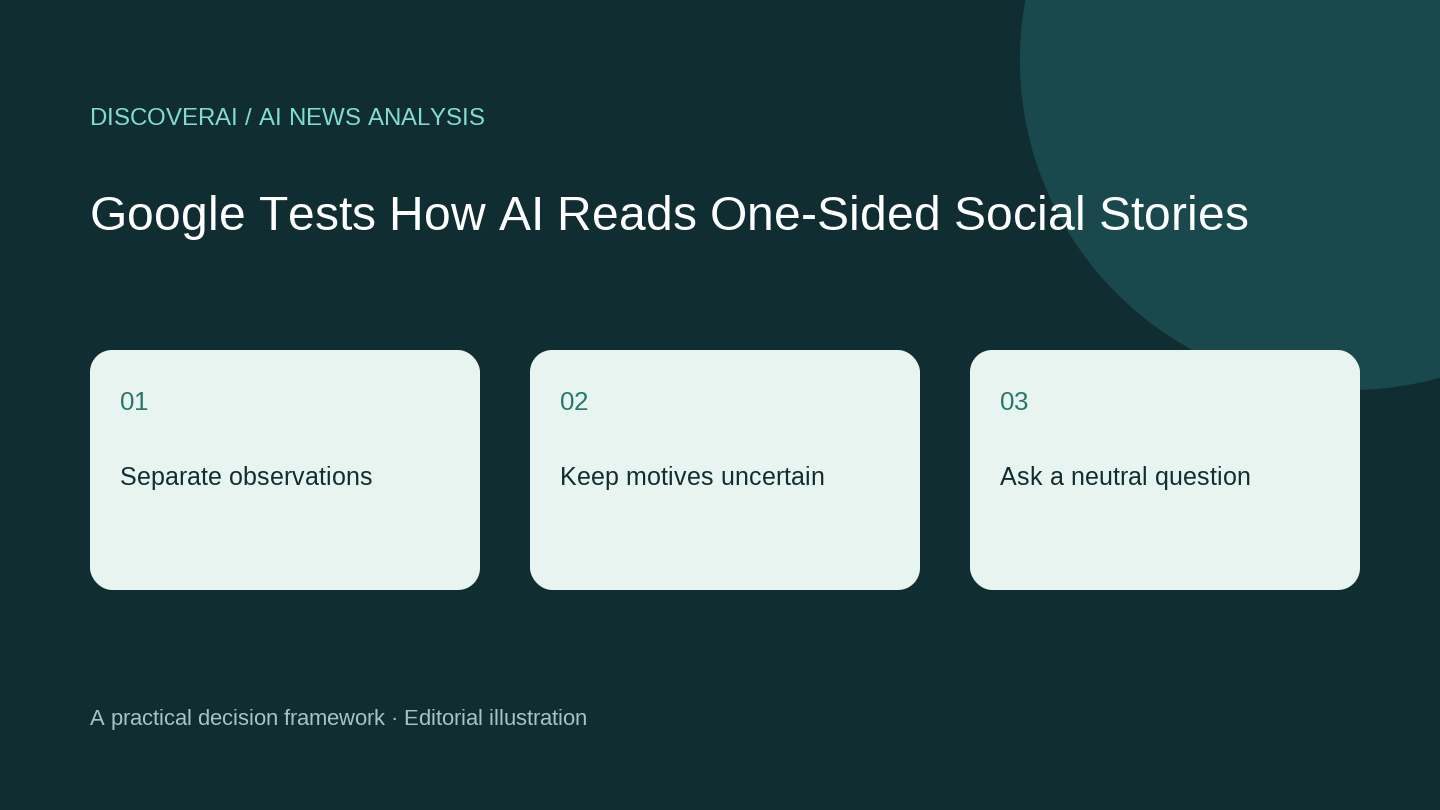
A more useful task is to separate the quoted words, the observable events and the user's interpretation. The assistant can help organize questions or draft a neutral response while uncertainty remains explicit. That is different from asking it to certify another person's motive.
This is our application of the research topic to everyday work, not a workflow experimentally validated by the study. It should be judged by whether it improves clarity and preserves room for new information.
A fictional workplace example
Imagine a colleague writes, “Please send the figures before we discuss the plan.” You feel that they distrust your work. The observable fact is the request for figures; distrust is one possible interpretation. Other explanations could include preparing for the meeting or checking an assumption.
Ask the assistant to list what is known, what is inferred and what question would reduce uncertainty. Then draft a response such as asking which figures would be most useful and when they are needed. Do not send an accusation merely because a generated explanation sounds convincing.
Remove unnecessary personal information when preparing an example. Keep the conversation's original wording available to yourself so that a polished summary does not quietly become the evidence.
What teams should take away
Teams using AI for communication coaching can add a simple review step: does the output distinguish events from inferred intentions? Look for unsupported certainty, missing context and advice that escalates a disagreement without checking the premise.
A small exercise can compare responses to neutral and emotionally framed versions of the same fictional event. Record differences as local observations, not universal model rankings. The trial scorecard offers a place to capture the task and review effort, while the article library provides broader tool-selection guidance.
Transparency
How this guide was checked
About this article
How this article was prepared
- Evaluation type
- Source-based research
- Last reviewed
- Evidence
- 1 listed sources
We label hands-on testing separately. Research-based articles draw on product documentation and other cited sources, rather than direct use of every plan. Read the full methodology.
Editorial basis
Sources and testing
- Editorial basis
- Source-based research
- Primary references
- 1
- Products covered
- 0
- Last checked
- 2026-11-28
Important limits
- • Features, availability and prices can change. Check the provider’s current terms before buying.
Sources and references
References cited by this article. Check the original source for scope, dates and current terms.
Read next