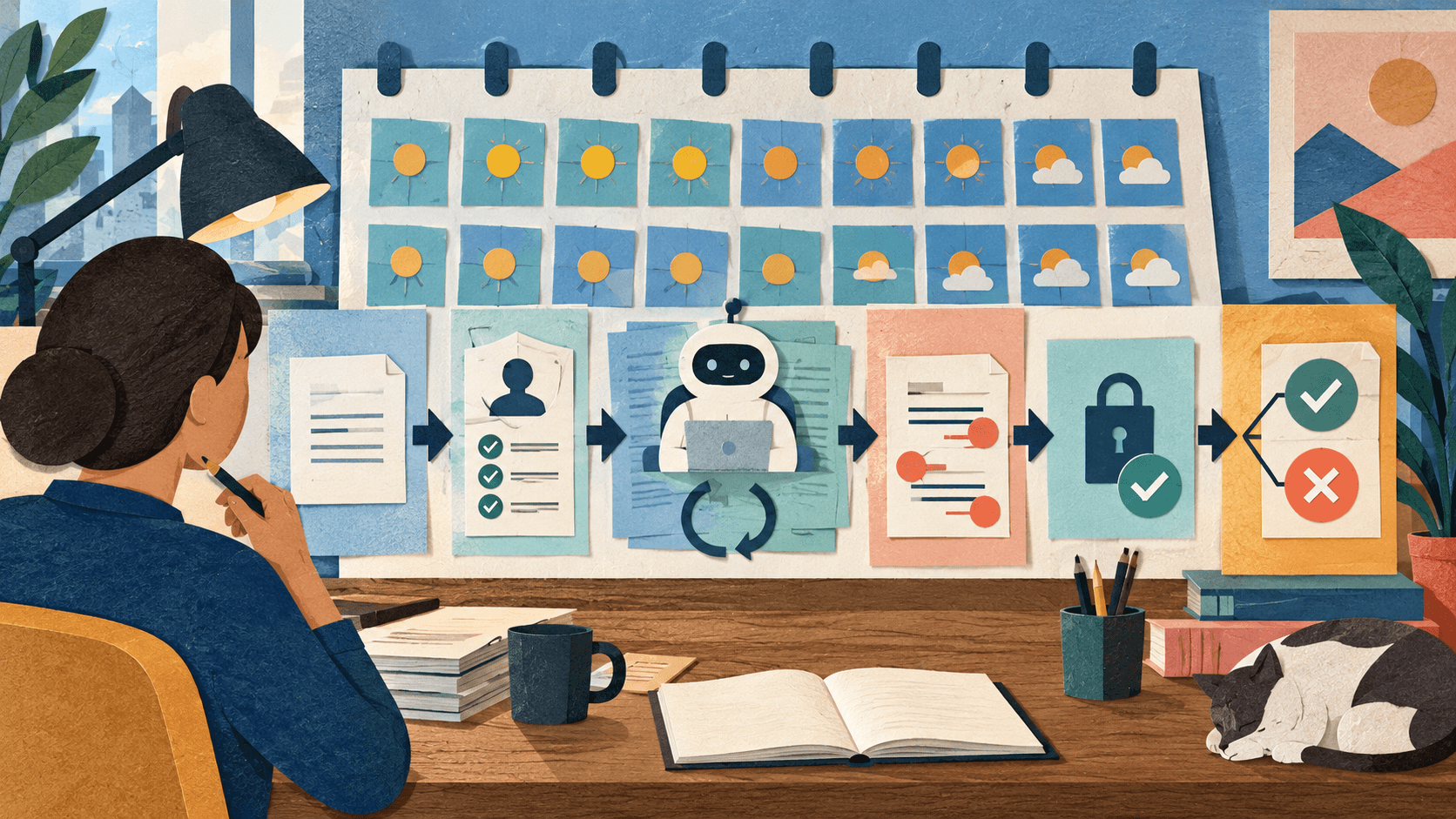
Google AI Study: Better Output Does Not Guarantee Learning
Google’s October 7 patent-law study separates AI-assisted output from independent judgment. Here is what managers can learn and what the study cannot prove.

Bottom line
Google’s October 7 patent-law study separates AI-assisted output from independent judgment. Here is what managers can learn and what the study cannot prove.
In this guide
Short answer
Measure work quality and independent skill separately when introducing AI. Google’s October 7 research report offers a concrete reason: assisted performance can improve without the same improvement appearing when the tool is removed. That distinction matters for onboarding, coaching and promotion decisions.
What the study reports
The research report describes randomized access to an AI patent-writing assistant among 133 lawyers at eleven firms over three months. Drafting tasks permitted AI; a later redlining exercise did not. Third-party professionals scored submissions.
The authors report improved assisted drafting and stronger unassisted judgment among senior participants. Junior participants showed no average gain in the independent task, with results spreading in both directions. This does not mean every junior worker lost skill.
The sample was specialized, the firms worked with Google, and follow-up lasted only three months. The authors identify these limits and changing models as reasons for further research. DiscoverAI has not independently reproduced the study or reviewed the linked working paper in full.
Why managers should care
Our editorial interpretation is that an output dashboard can miss a training problem. A polished draft says something about the combined worker-and-tool system. It says less about whether the worker recognizes a mistake tomorrow when the assistant is unavailable.
Consider a customer-support team. Faster replies may be useful, yet staff also need to identify missing information, distinguish policy exceptions and escalate appropriately. A manager who evaluates only speed could reward a workflow that leaves these skills underdeveloped. This is an illustrative scenario, not a finding from the patent study.
A proposed two-part scorecard
Track accepted work, correction time and substantive errors while AI is available. Separately, use occasional short practice exercises without AI to inspect reasoning and error recognition. Explain the purpose beforehand and use the results for coaching rather than surprise surveillance.
For both exercises, define the same relevant quality criteria. Ask reviewers to distinguish clear reasoning from attractive formatting. Keep tasks appropriate to experience: a beginner’s ability to explain a basic choice should not be judged as though they were an established specialist.
Do not use a single score to infer aptitude or decide a career outcome. Compare patterns over time and invite the person to explain what support would help. AI access, task familiarity and reviewer expectations can all affect the picture.
Make the learning step explicit
Before using an assistant, ask the learner to state their initial approach and the point they find uncertain. Afterward, have them identify one correction they accepted, one they rejected and the evidence behind each decision. Later, give a fresh scenario that requires applying the same principle.
These are proposed management practices, not interventions validated by this study. Pilot them with a small group and adjust the burden. The purpose is useful feedback, not turning every task into a lengthy examination.
What to do this week
Choose one recurring task where independent judgment matters. Write down what good assisted output looks like and what the person should be able to explain unaided. Review both after a short pilot. For individual study, our [checked AI flashcard workflow](/articles/create-ai-flashcards-you-can-trust) provides another way to keep generation and learning distinct.
Transparency
How this guide was checked
Editorial accountability
Who checked this guide
- Evaluation type
- Research-based verification
- Last materially checked
- Evidence
- 1 listed sources
Hands-on testing is identified explicitly. Research-based coverage uses cited product documentation and other named sources; it does not imply every paid plan was used. Read the full methodology.
Editorial basis
What this guidance is based on
- Editorial basis
- Source-led analysis
- Primary references
- 1
- Products covered
- 1
- Last checked
- 2026-10-08
Important limits
- • DiscoverAI has not independently reproduced research findings or performed the proposed product tests.
- • Availability, policies, billing and feature entitlements may change.
Sources and verification
Product details and claims were checked against the following primary sources.
Frequently asked questions
Was this a study of all professions?
No. It examined a limited sample of patent lawyers over three months.
Did all junior participants get worse?
No. The report describes no average independent-skill gain and a wider spread of junior outcomes.
What should managers measure?
Accepted assisted work and independent judgment, using appropriate coaching exercises.
Are the proposed coaching steps proven by this study?
No. They are editorial suggestions to pilot, not tested interventions.
Tools mentioned in this article
Google Gemini
Google's deeply integrated AI assistant with unmatched access to Google's ecosystem
Gemini combines powerful AI with Google's vast data ecosystem — Search, Gmail, Docs, YouTube, and more — for a uniquely integrated experience.
Read next