The decision
Should you choose GMaps Scraper AI?
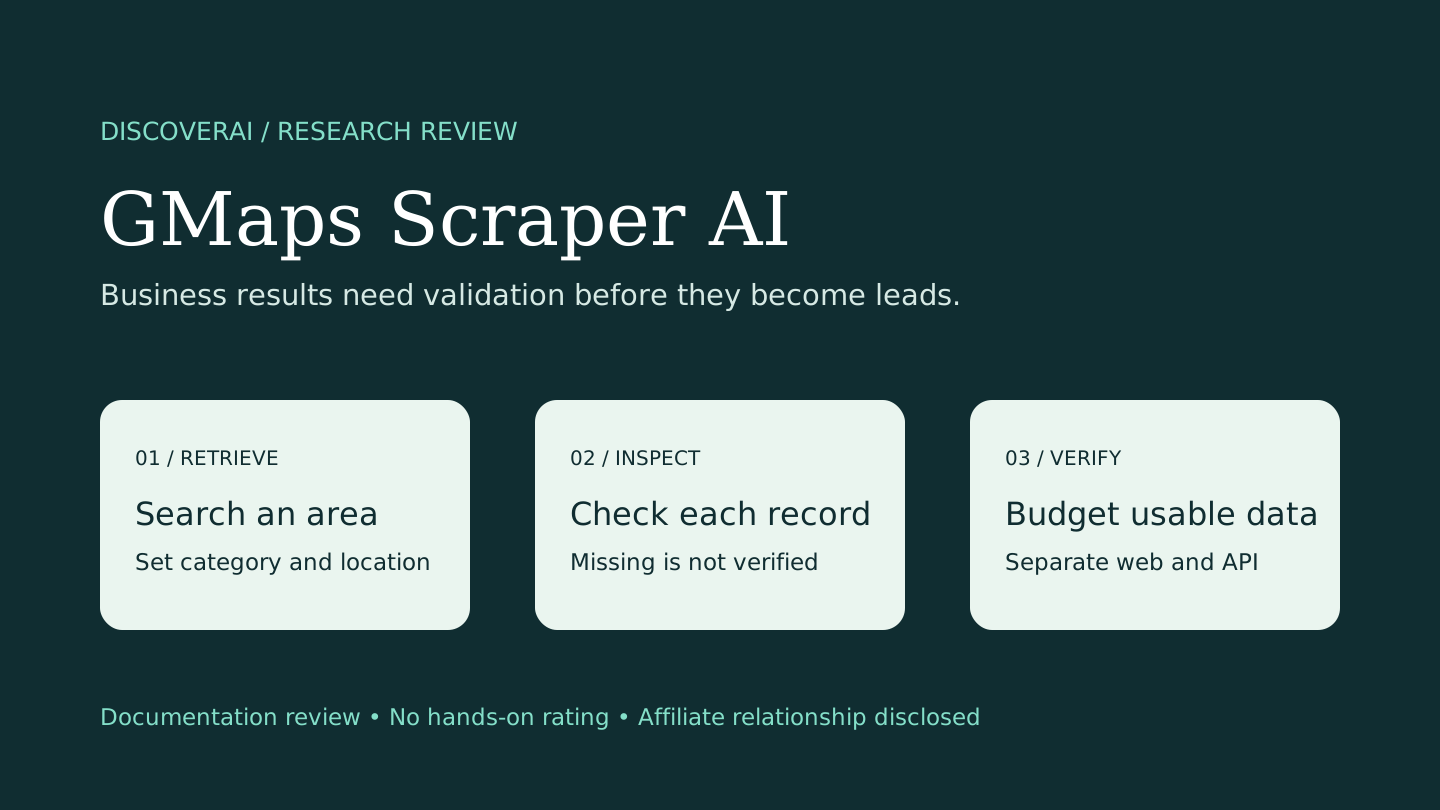
Run a small location-specific pilot, deduplicate results and measure usable records before subscribing.
Best for
Agencies researching local businesses; Analysts validating location-based datasets.
Choose something else if
Buyers expecting guaranteed verified email leads; Teams needing a guaranteed complete local business census
Evidence
Verified research · rating withheld
Pricing checked
From $29 · Nov 10, 2026
Free access is available, with limits.
Web: 1,000 credits monthly, two keywords per task and one concurrent task. API: 20 requests monthly, separately accounted.
DiscoverAI may earn a commission if you sign up or buy through our GMaps Scraper AI affiliate link, at no additional cost to you. This relationship does not determine our verdict.
In this guide
Short answer
GMaps Scraper AI is worth a small pilot for local business research when you can validate and clean the output. Its useful distinction is a web workflow for exported lists alongside a developer API for repeatable retrieval. The deciding question is how many records meet your actual requirements after checking location, relevance, duplicates and missing fields.
Affiliate disclosure: DiscoverAI may earn a commission if you sign up or buy through our GMaps Scraper AI affiliate link, at no additional cost to you. This relationship does not determine our verdict.
Free buyer comparison checklist
Compare this tool before committing.
Use the buyer checklist to compare two tools on the same tasks, including quality, review time and total cost. Get the weekly top 5 AI tools, one practical workflow and one way to reduce AI spending.
Evidence and review scope
This review is based on official documentation checked November 10, 2026. We did not open an account, extract listings, call the API, purchase a plan, contact support or test deletion. Ratings are withheld. Testimonials, speed claims and compliance statements belong to the provider; they are not our benchmark results. The buyer test below is a proposed evaluation.
What GMaps Scraper AI does
The official product page describes cloud extraction of public business listings using keywords, location and language settings. Available fields include business identity, contact details, websites, ratings and opening hours. Email addresses are conditional, so a returned business should not automatically be counted as an email lead. CSV and JSON exports support downstream analysis.
This could help an agency assemble a local competitor sample or a researcher organize businesses by area. It does not establish a complete census. Search wording and geographic boundaries can affect which records appear. Overlapping searches can also require deduplication before a list is useful. These are evaluation concerns, not failures observed in our testing.
Web pricing and credits
The web pricing page lists these monthly USD plans:
| Plan | Monthly price | Monthly credits | Keywords per task | Concurrent tasks |
|---|---|---|---|---|
| Free | $0 | 1,000 | 2 | 1 |
| Starter | $29 | 50,000 | 10 | 3 |
| Pro | $99 | 300,000 | 50 | 5 |
| Business | $199 | 1,000,000 | 100 | 5 |
Search accounting is by business result; reviews and photos use their respective result counts. Subscription credits reset without rollover. The displayed on-demand example is $15 for 15,000 credits without expiry. Annual billing is offered, but these are monthly rates; confirm checkout totals. Exhausting credits stops remaining work while collected results remain exportable.
A paid allowance is capacity, not a promise of usable prospects. Start by defining required fields, then count accepted records after cleanup. Divide the total subscription, enrichment and review cost by that count. For intermittent research, compare a small top-up with a recurring plan instead of buying against a theoretical maximum.
API access has a separate budget
The API pricing page explicitly separates requests from web credits. Monthly plans list Free with 20 requests, Starter at $15 for 1,000, Pro at $65 for 5,000 and Business at $115 for 10,000. Paid cards show extra-request rates of $0.014, $0.012 and $0.011 respectively. Ask how overages are authorized and capped before enabling unattended jobs.
Each request returns up to 20 places, with pagination consuming further requests. The listed rate limit is 300 requests per minute per key; monthly usage is shared across account keys. Those are published limits, not throughput we measured. Do not convert a request allowance into guaranteed records by multiplying by 20: sparse pages and repeated listings can reduce the accepted total.
The API documentation shows bearer-key authentication and search inputs for query, page, geographic position, language and country. Its example also exposes place identifiers useful for tracking records. Build a small integration first; preserve identifiers and retrieval times, protect keys and bound retries. Do not treat a successful HTTP response as proof that every field is current.
How much AI is involved?
The product uses AI positioning and advertises support for agent workflows. The public pages establish extraction interfaces, not independently measured reasoning or lead-scoring accuracy. We would evaluate it primarily as a business-data retrieval service. An assistant connected to a retrieval tool still needs source checks before making claims about a market.
If an AI system summarizes the exported list, require it to distinguish absent data from negative findings. A blank email field does not mean a business has no email, and a search sample does not support a definitive statement that no competitor exists. Keep source links available to the reviewer.
Privacy and data-use boundaries
The privacy policy describes cloud storage and collection of account, usage, technical and support information. Retention is expressed as needed for service and obligations, without a precise task-result deletion period. Ask about result retention, storage region and deletion procedures if those details matter to your project. We did not audit the provider's safeguards.
The terms require compliance with applicable rules and platform terms and disclaim complete accuracy or uninterrupted availability. The homepage's compliance language is a vendor claim, not a certification we verified. This review does not determine whether a particular collection or outreach campaign is permitted. Resolve that for the intended use before collecting or contacting people.
Cancellation and refund limits
The refund policy makes new subscription refunds conditional: request within seven days and use no more than 5% of credits. Used one-time credit purchases are non-refundable, with stated exceptions. Cancellation retains access through the current billing period. Check the current policy and checkout before paying; cancellation is not an unconditional refund.
Proposed buyer test
Write acceptance criteria before running searches. A small, inspectable sample is more useful than a large export whose accuracy nobody checks.
- Select one business category and a precisely defined area. Manually record a reference sample from current public listings.
- Run one narrow query and one overlapping query. Preserve task inputs, retrieval dates, returned counts and credits or requests consumed.
- Compare identity, location and required fields against the source. Count missing, stale and mismatched records separately.
- Deduplicate using stable identifiers where available. Review branches carefully so distinct locations are not merged into one business.
- Inspect CSV and JSON structure before importing. Check empty values, non-English characters and phone formats without overwriting good CRM data.
- For API work, check pagination, bounded retries and spend controls in a controlled pilot. Confirm the interface shows incomplete work clearly.
- Calculate cost and review time per accepted record. Upgrade only if the result meets your own coverage and budget requirements.
Repeat the sample later if freshness is essential. Save failure examples so future changes can be evaluated against the same requirements. These checks have not been executed by DiscoverAI.
Alternatives and verdict
For a small occasional sample, compare manual research with the cost of setup and cleanup. For a production application, evaluate a source platform's official API against your access, licensing and field requirements. A broader extraction platform may suit multiple source types. These are workflow alternatives, not comparative rankings based on performance tests.
Our recommendation is to start with the free allowance for the interface you actually need. Validate useful records, then buy capacity against measured work. Consult our AI tool buyer checklist, the GMaps Scraper AI profile and our ScrapeAtlas review for a different public-data API use case. Explore GMaps Scraper AI through our affiliate link.
Transparency
How this guide was checked
Editorial accountability
Who checked this guide
- Evaluation type
- Hands-on evaluation
- Last materially checked
- Evidence
- 7 listed sources
Hands-on testing is identified explicitly. Research-based coverage uses cited product documentation and other named sources; it does not imply every paid plan was used. Read the full methodology.
Editorial freshness
Pricing and material product claims were checked November 10, 2026.
Review evidence
What this guidance is based on
- Evaluation type
- Official documentation review; no hands-on benchmark
- Research date
- November 10, 2026
- Commercial relationship
- Supplied affiliate link; disclosed
Important limits
- • No account, extraction, API, purchase, support or deletion tests performed.
- • Completeness, email availability, speed and reliability not independently verified.
- • Web and API quotas are separate; confirm overage controls and retention requirements.
Standardized benchmark coverage
How this review maps to the research benchmark
Citation accuracy
Not applicableThe reviewed workflow does not produce source-grounded research answers, so a citation score would be misleading.
Read protocol v2026.10-v1 →Thematic analysis
Not applicableThe reviewed workflow is not qualitative evidence analysis, so a thematic-analysis score would be misleading.
Read protocol v2026.10-v1 →Eligibility is not a product score. DiscoverAI publishes results only after output collection, blinded adjudication, reproducibility checks, and severe-error review.
Open the optional evaluation worksheet
Reusable trial worksheet
Test GMaps Scraper AI before you commit
Turn this review’s buyer test into evidence. Your entries autosave only in this browser and are never added to shared shortlist links.
Confirm the tool meets every must-have workflow and stakeholder requirement.
Review starting point: Agencies researching local businesses; Analysts validating location-based datasets
Run the same representative work you would use in production; do not score a polished demo.
Review starting point: Run a bounded set of representative tasks with known acceptable outcomes, then compare the result with your current workflow.
Calculate the effective cost per accepted result, including usage, review, corrections, and required add-ons.
Review starting point: Checked November 10, 2026: monthly web plans Free $0/1,000 credits; Starter $29/50,000; Pro $99/300,000; Business $199/1,000,000. Web on-demand example: $15/15,000 credits, no expiry. Subscription credits do not roll over. API plans are separate: Free 20 requests/month; Starter $15/1,000; Pro $65/5,000; Business $115/10,000. Verify checkout and overage…
Define an acceptance threshold, test known answers and edge cases, and record every correction.
Review starting point: Editorial quality signals: features 0.0/5. Validate these signals in your own work.
Verify what data enters the product, who can access it, how long it is retained, and whether it trains models.
Review starting point: Use approved low-risk data first. Check roles, consent, deletion, subprocessors, model-training settings, and the contract—not only the marketing page.
Test the real handoffs, permissions, failure states, and export path your team depends on.
Review starting point: GMaps Scraper AI integration requirements are not fully structured in this review; list every required system and test each connection.
Record training, governance, reliability, accessibility, ownership, and change-management risks before rollout.
Review starting point: Email availability is not guaranteed; Web and API budgets are separate; Data quality and completeness require checking
Loading saved worksheet… · private to this device or your optional account
Community evidence
How verified users put GMaps Scraper AI to work
Structured, editor-moderated experience—not star ratings. This complements our independent review and never changes its score.
No approved community evidence yet. Be the first verified user to contribute.
Community choice
Recommend GMaps Scraper AI
Loading weekly votes…
One vote per verified account per tool, counted for seven days. Return after your vote expires to support again. Community votes influence homepage trends, never editorial ratings. Voting does not subscribe you to emails.
Sources and references
References cited by this article. Check the original source for scope, dates and current terms.
Frequently asked questions
What is GMaps Scraper AI?
GMapsScraper.AI is a cloud tool for extracting public business listings, reviews and photos from Google Maps. The web interface exports CSV or JSON; developers can use a separately billed API.
Is GMaps Scraper AI free?
The web app lists 1,000 monthly credits, two keywords per task and one concurrent task. The API has a different free allowance of 20 monthly requests. Free capacity is not a guarantee of complete data.
How much does it cost?
Checked November 10, 2026: monthly web plans start at $29. API subscriptions start at $15 per month and are billed separately. Confirm the selected billing interval and total at checkout.
Are email addresses guaranteed?
No. The provider says email addresses are available when present. A business result is not necessarily a unique, deliverable email contact.
Do credits expire?
Web subscription credits reset each billing cycle without rollover. The pricing page says on-demand web credits do not expire. API requests use separate accounting.
Did DiscoverAI test GMaps Scraper AI?
No. This is official-documentation research checked November 10, 2026. No account, extraction, API, purchase, support or deletion tests were performed; ratings are withheld.
Does DiscoverAI earn a commission?
DiscoverAI may earn a commission if you sign up or buy through our GMaps Scraper AI affiliate link, at no additional cost to you. This relationship does not determine our verdict.
Recommended tool
Use GMaps Scraper AI if this workflow fits your team
Run a small location-specific pilot, deduplicate results and measure usable records before subscribing.
DiscoverAI may earn a commission if you sign up or buy through our GMaps Scraper AI affiliate link, at no additional cost to you. This relationship does not determine our verdict.
Tools mentioned in this article
GMaps Scraper AI
Extract local business listings with separate web and API budgets
GMapsScraper.AI extracts public Google Maps business data in the cloud, with CSV/JSON exports and separately billed API access.