ElevenLabs Scribe Review 2026: Speech-to-Text Accuracy and Cost
Scribe has a compelling feature set for multilingual transcription, but accuracy must be measured on your speakers, terminology, noise, and downstream workflow.
Bottom line
An evidence-bounded review of ElevenLabs Scribe v2 for batch and realtime transcription, including features, pricing, privacy, and a controlled benchmark.
Editorial accountability
Who checked this guide
- Evaluation type
- Hands-on evaluation
- Last materially checked
- Evidence
- 4 listed sources
Hands-on testing is identified explicitly. Research-based coverage uses cited product documentation and other named sources; it does not imply every paid plan was used. Read the full methodology.
Editorial freshness
Pricing and material product claims were checked September 21, 2026.
Review evidence
What this guidance is based on
- Growth basis
- Adjacent product intent around the site's highest-performing affiliate relationship
- Review type
- Research-based product assessment with a 20-hour benchmark design
- Material review date
- September 21, 2026
- Evidence
- First-party capability, pricing, API, and retention documentation
Important limits
- • DiscoverAI did not independently run the proposed 20-hour multi-provider benchmark.
- • Accuracy, latency, rates, surcharges, retention options, and compliance eligibility vary by audio, plan, region, and configuration.
In this guide
*Affiliate disclosure: DiscoverAI may earn a commission if you subscribe to ElevenLabs through links on this page. That does not change the price you pay or our evaluation criteria.*
Short answer
ElevenLabs Scribe v2 is worth shortlisting when a team needs multilingual batch and realtime transcription alongside diarization, word timestamps, keyterm prompting, entity detection, and an existing ElevenLabs voice stack. It is not “the most accurate” for every recording because transcription quality changes with language, accent, microphone, overlap, noise, terminology, and whether the output must be verbatim.
The sensible decision is a controlled benchmark against the current provider using real audio and a human-corrected reference transcript. Measure weighted error, speaker assignment, terminology, latency, correction time, privacy configuration, and complete cost.
What Scribe v2 does
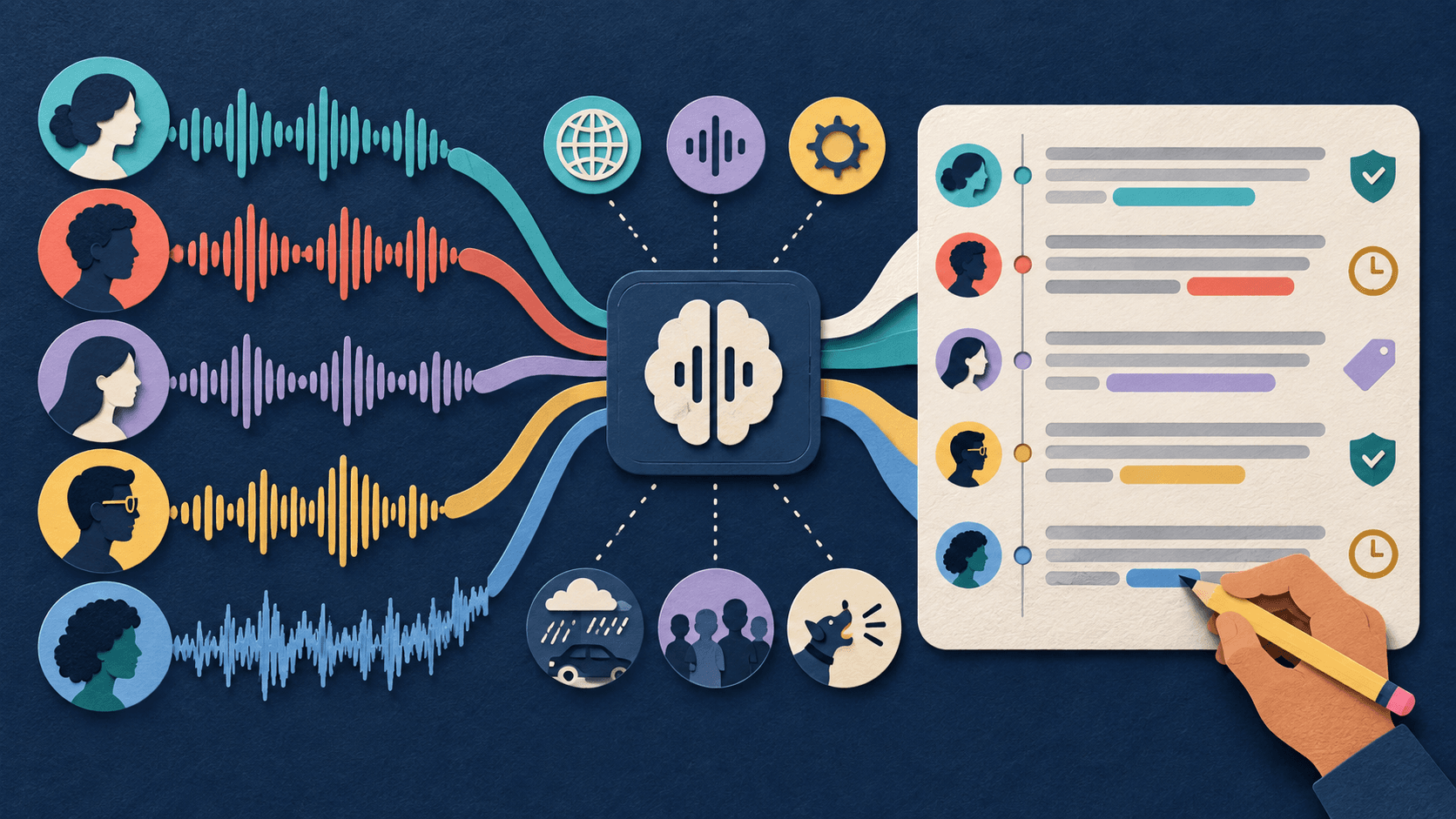
ElevenLabs documents batch Scribe v2, Scribe v2 Realtime, and a medical model. The current capability page lists support for more than 90 languages, precise word-level timestamps, speaker diarization for up to 32 speakers, audio-event tagging, language detection, keyterm prompting, and entity detection. The realtime model is positioned for low-latency streaming.
The API accepts common audio and video formats. Standard uploads can be much larger and longer than a typical meeting recording, and asynchronous results can be delivered through webhooks. These are useful platform specifications; they do not tell you how the model performs on your hardest calls or recordings.
Where Scribe is strongest
Scribe is especially interesting for multilingual media, interviews, contact-center analysis, subtitles, searchable archives, and voice products that already use ElevenLabs. Keyterm prompting can help with product names, people, technical vocabulary, and domain phrases. Diarization and timestamps reduce downstream assembly work when they are accurate.
The optional no-verbatim mode removes fillers and false starts for readability. Do not use it where exact wording matters. Legal, research, compliance, and evidentiary workflows usually need the untouched recording plus a verbatim-oriented transcript and a documented correction process.
Accuracy claims need a local benchmark
Vendor accuracy claims and benchmark tables are useful for candidate selection, not procurement. Create a stratified audio set covering languages, accents, microphones, background noise, overlapping speakers, telephone audio, music, numbers, proper nouns, acronyms, and code-switching.
Have qualified reviewers create reference transcripts. Measure word error rate, character error rate where appropriate, keyterm recall, speaker-attribution error, timestamp drift, entity precision and recall, punctuation usefulness, reviewer minutes, and downstream task success. Report results by segment; an average can hide failure for a minority language or difficult channel.
Pricing and surcharges
ElevenLabs prices speech-to-text by audio duration, with rates varying by plan and model. The current product page lists included UI transcription by subscription tier and a published extra-hour API rate for the displayed plans. Advanced API options can add cost: the API reference documents surcharges for features such as keyterms, role-based diarization, and entity redaction.
Estimate cost from submitted duration, concurrency, advanced features, failed retries, storage, transfer, human correction, and downstream processing. A slightly more expensive transcript can be cheaper overall if it removes significant editing; a low per-hour rate can be poor value if names and speakers need constant repair.
Privacy and sensitive audio
Audio can contain biometric, health, payment, employment, customer, and confidential business information. Document lawful collection, participant notice, region, retention, training use, human access, subprocessors, deletion, encryption, access logs, and incident response.
ElevenLabs documents enterprise Zero Retention Mode for eligible API use, with important product and interface boundaries. Its speech-to-text documentation says organizations requiring HIPAA support must contact sales and execute the applicable BAA before covered deployment. Those controls do not make a workflow compliant automatically; the buyer remains responsible for purpose, configuration, access, and downstream storage.
A 20-hour benchmark
Use at least 20 hours drawn from the intended environment: ten clean, five noisy, three overlapping-speaker, and two edge-case hours. Compare Scribe with the incumbent using identical files and reviewer rules. Track accuracy by cohort, correction minutes per audio hour, diarization errors, keyterm misses, latency, webhook reliability, redaction failures, and total accepted-transcript cost.
Run a separate realtime test for partial-result stability, endpointing, interruption behavior, and time to usable text. Batch accuracy does not establish realtime quality.
Verdict
Scribe is a credible transcription candidate, particularly for multilingual teams and products already using ElevenLabs. The breadth is attractive, but the purchase case should come from lower correction effort and reliable downstream results on representative audio—not a generalized accuracy superlative.
See the [ElevenLabs review](/articles/elevenlabs-review-2026) for the broader voice platform and the [ElevenLabs API guide](/articles/elevenlabs-api-developer-guide-2026) for integration planning.
Reusable trial worksheet
Test ElevenLabs before you commit
Turn this review’s buyer test into evidence. Your entries autosave only in this browser and are never added to shared shortlist links.
Confirm the tool meets every must-have workflow and stakeholder requirement.
Review starting point: AI voice generation; Voice cloning; YouTube narration
Run the same representative work you would use in production; do not score a polished demo.
Review starting point: Run a bounded set of representative tasks with known acceptable outcomes, then compare the result with your current workflow.
Calculate the effective cost per accepted result, including usage, review, corrections, and required add-ons.
Review starting point: Free plan available. Starter $6/month, Creator $22/month, Pro $99/month, Scale $299/month, Business $990/month, and Enterprise pricing on request.
Define an acceptance threshold, test known answers and edge cases, and record every correction.
Review starting point: Editorial quality signals: features 4.7/5; AI quality 4.9/5. Validate these signals in your own work.
Verify what data enters the product, who can access it, how long it is retained, and whether it trains models.
Review starting point: Use approved low-risk data first. Check roles, consent, deletion, subprocessors, model-training settings, and the contract—not only the marketing page.
Test the real handoffs, permissions, failure states, and export path your team depends on.
Review starting point: REST API, SDKs, Zapier for voice agents, Calendly for voice agents, Stripe for voice agents, Salesforce for voice agents, MCP tools for agents
Record training, governance, reliability, accessibility, ownership, and change-management risks before rollout.
Review starting point: Credit-based pricing needs active usage management as teams scale; Some teams only need lightweight narration and will not use the broader platform; Workflow depth can feel like overkill for occasional one-off voiceovers
Loading saved worksheet… · private to this device or your optional account
Community evidence
How verified users put ElevenLabs to work
Structured, editor-moderated experience—not star ratings. This complements our independent review and never changes its score.
No approved community evidence yet. Be the first verified user to contribute.
Sources and verification
Product details and claims were checked against the following primary sources.
Frequently asked questions
What is ElevenLabs Scribe?
Scribe is ElevenLabs' speech-to-text family for batch and realtime transcription, with multilingual recognition, timestamps, diarization, keyterms, and entity features.
How many languages does ElevenLabs Scribe support?
ElevenLabs currently documents more than 90 languages for Scribe v2. Buyers should still benchmark every production language and accent.
How much does ElevenLabs speech to text cost?
Pricing is duration-based and varies by plan and model. Included UI minutes, API rates, pay-as-you-go terms, and advanced-feature surcharges should be verified before purchase.
Is Scribe suitable for sensitive or medical audio?
Potentially, but only with the required contract, eligible configuration, lawful collection, access controls, retention design, and downstream safeguards. Contact ElevenLabs about a BAA for HIPAA-covered use.
Found this useful?
Get the next one in your inbox.
One five-minute briefing a week: a meaningful change, a practical workflow, and a clearer tool decision—already filtered for lean teams.
Free · one email a week · unsubscribe any time
Recommended tool
Use ElevenLabs if this workflow fits your team
It stands out when you need the voice layer to feel premium, multilingual, and extensible rather than merely functional.
If you subscribe through this link, we may earn a commission. Recommendations stay editorial and only appear where ElevenLabs is a genuine fit.
Tools mentioned in this article
ElevenLabs
A leading AI voice platform for text to speech, voice cloning, speech to text, dubbing, and conversational agents
ElevenLabs combines premium text to speech, voice cloning, multilingual audio generation, speech to text, developer APIs, and voice agents in one AI audio platform.
Read next