Claudex Loop Guide: Claude Code and Codex Cross-Review
A bounded cross-provider workflow can expose plan and implementation gaps, but two models agreeing is evidence of review—not proof that the code is correct.

Bottom line
How Claudex Loop uses reconnaissance, requirements, adversarial plan review, authorized building, proof checks, and independent inspection across Claude Code and Codex.
Editorial accountability
Who checked this guide
- Evaluation type
- Research-based verification
- Last materially checked
- Evidence
- 4 listed sources
Hands-on testing is identified explicitly. Research-based coverage uses cited product documentation and other named sources; it does not imply every paid plan was used. Read the full methodology.
Editorial basis
What this guidance is based on
- Editorial basis
- Source-led analysis
- Primary references
- 4
- Products covered
- 2
- Last checked
- 2026-09-17
Important limits
- • Features, availability, and pricing can change after publication; confirm consequential details with the provider.
In this guide
*This research-based guide covers the open-source chaseai-yt/claudex-loop project as documented on September 17, 2026. The project is community software, not an Anthropic or OpenAI product, and DiscoverAI did not independently benchmark defect detection or token cost. The official project name is styled “Claudex Loop”; some searches render it as “ClaudeX Loop.”*
The short answer
Claudex Loop is a community-built orchestration skill that connects Claude Code and OpenAI Codex across four stages: reconnaissance, requirements, adversarial plan review, and an authorized build followed by independent inspection. The model that builds should not grade its own work, while the host arbitrates findings and keeps the cycle within configured round limits.
Choose it when a software change is important enough to justify structured planning and a second provider's review. Skip it for tiny, reversible edits where setup, duplicated context, and review cost exceed the likely benefit.
What does Claudex Loop actually do?
The current repository describes a host-neutral workflow rather than a single hard-coded Claude-builds/Codex-reviews sequence. The current host scouts the code and context, resolves material requirements, writes a plan with observable acceptance checks, and asks the other provider to challenge it. After authorization, a selected builder implements the plan, proof checks run, and the other provider inspects the final code in a fresh session.
The plan and an append-only review log preserve findings, dispositions, model choices, proof, and remaining uncertainty. The documented defaults bound plan review, fix, and inspection rounds rather than promising an endless autonomous cycle.
The four phases
1. Reconnaissance
Inspect the repository, relevant documentation, dependencies, and greenfield assumptions. Surface an assumptions ledger rather than quietly filling material gaps.
2. Requirements and acceptance checks
Resolve questions that would change the outcome. The plan should name files or systems in scope, user-visible behavior, constraints, proof commands, and decisions that still need human authority.
3. Adversarial plan review
The opposite provider examines the plan and relevant evidence. The host accepts, rejects, or incorporates findings instead of treating every model comment as truth. Review ends at an explicit verdict or the configured round cap.
4. Build, proof, and inspection
An authorized builder implements the locked plan. Deterministic checks run independently, and the non-building provider inspects the final changes. Remaining findings are reported rather than hidden behind a consensus label.
What do you need to run it?
The repository says the full workflow requires authenticated Claude Code and Codex CLIs plus Python 3.10 or newer. It supports Claude Code plugin installation and manual skill installation for both hosts. Model access, rate limits, platform subscriptions, and supported command behavior can change, so verify the repository's current runtime documentation before installation.
Treat third-party skills and installers as executable code. Inspect the repository and release you intend to install, understand which commands it can invoke, avoid secrets in the working tree, and start in a disposable branch or repository.
Where does Claudex Loop help most?
Its strongest use case is plan risk. A second model may notice missing migrations, unsafe data assumptions, rollback gaps, authorization errors, or acceptance checks that cannot prove the promised outcome. The persistent review log also makes the reasoning easier for a human to audit than a long, unstructured chat.
Cross-provider diversity is useful but not magical. Claude and Codex can share blind spots, misunderstand the same requirement, or agree on code that fails in production. Tests, types, linting, security tooling, real data constraints, observability, and human review remain the evidence layer.
Costs and failure modes
Each handoff repeats repository context and consumes tokens. Large plans or broad codebases can make multiple review rounds expensive and slow. Reviews may also produce contradictory preferences, churn a correct plan, or prioritize theoretical concerns over the user's actual deadline.
Set a task-specific round budget, narrow the files and evidence each reviewer needs, and rank findings by user impact. Never let model consensus grant new authority: publishing, committing, deleting data, changing infrastructure, sending messages, or spending money should still follow the user's explicit instructions.
The verdict
Claudex Loop is a disciplined option for consequential coding work where plan quality matters and both CLIs are already available. Its advantage over a casual “ask another model” workflow is the explicit lifecycle, evidence log, bounded rounds, and independent final inspection. The payoff must be measured in defects caught and rework avoided—not in how many agents participated.
Sources and verification
Product details and claims were checked against the following primary sources.
Frequently asked questions
What is Claudex Loop?
Claudex Loop is a community orchestration skill that uses Claude Code and Codex for structured reconnaissance, requirements, adversarial plan review, authorized implementation, proof checks, and independent inspection.
Is Claudex Loop an official Anthropic or OpenAI product?
No. It is an open-source community project that invokes the companies' official CLI tools; neither the workflow nor its claims should be treated as vendor guarantees.
What is required to use Claudex Loop?
The current repository documents authenticated Claude Code and Codex CLIs plus Python 3.10 or newer for the full workflow. Users should verify current runtime requirements before installing.
Does approval from both models prove the code is correct?
No. Cross-model agreement documents that two systems reviewed the work. Correctness still depends on executable tests, security and data checks, production evidence, and accountable human review.
Found this useful?
Get the next one in your inbox.
One five-minute briefing a week: a meaningful change, a practical workflow, and a clearer tool decision—already filtered for lean teams.
Free · one email a week · unsubscribe any time
Tools mentioned in this article
Claude
Anthropic's thoughtful, safety-focused AI with exceptional long-form reasoning
Claude excels at deep analysis, long-form writing, and nuanced reasoning. Built by Anthropic with a focus on safety and helpfulness.
ChatGPT
The general-purpose AI assistant that started it all
OpenAI's flagship conversational AI model, powering everything from casual chat to complex reasoning, coding, and creative work.
Read next
Recommended for you
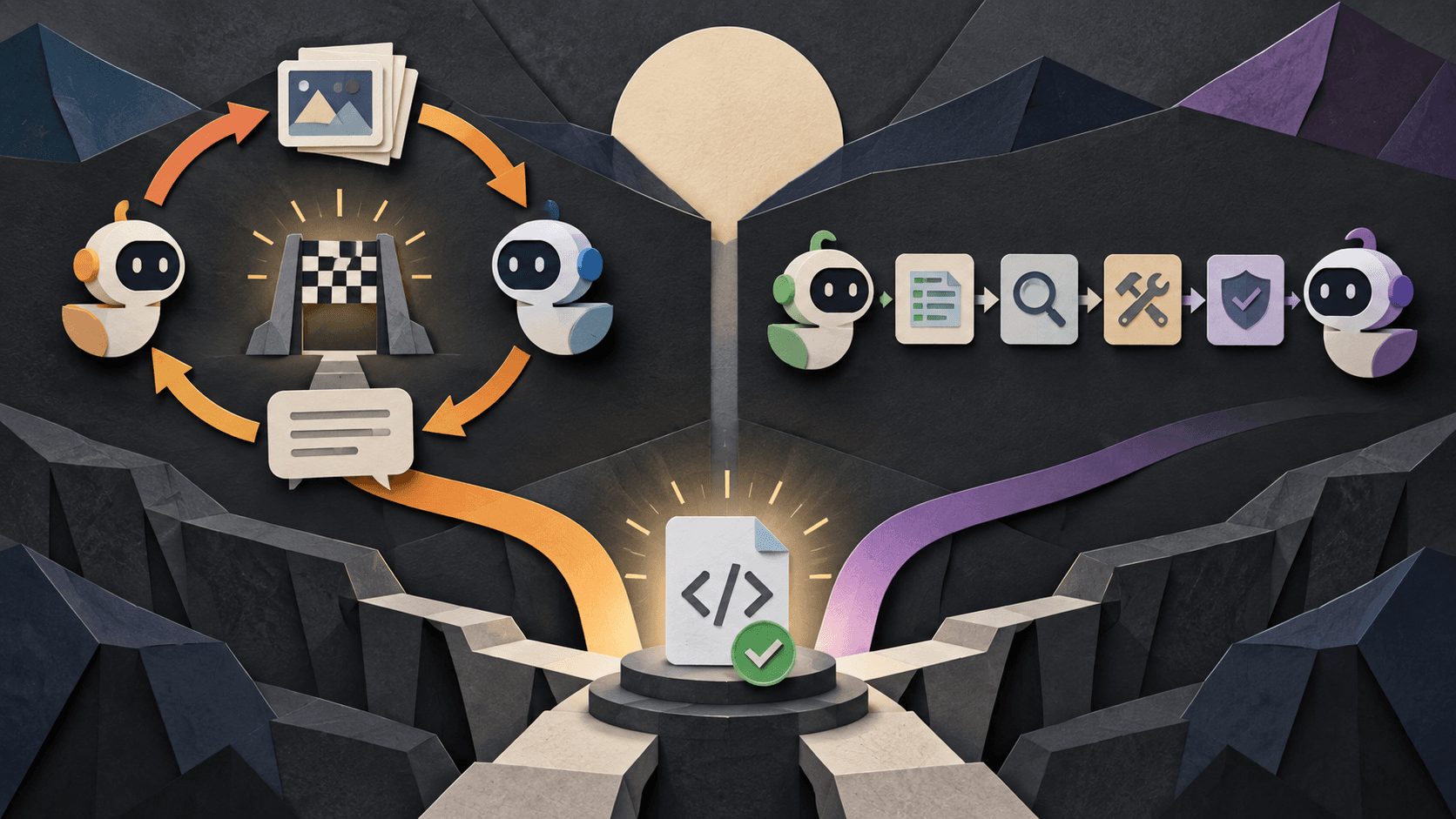
Gauntlet Loop vs Claudex Loop: Which Workflow Fits?
Choose Gauntlet for reference-driven artifact refinement; choose Claudex for bounded software planning, cross-provider review, implementation, and inspection.
A practical comparison of Gauntlet Loop and Claudex Loop across goals, evaluators, workflow structure, setup, cost, stopping rules, and safety controls.
Read guide
AI Implementation for Small Business: Launch Your First Workflow in 30 Days
How to Automate Business Tasks With Zapier and AI in 2026
Claude vs. ChatGPT for Small Business in 2026: Which Should You Pay For?