In this guide
What was announced?
Anthropic’s October 22 call invites principal investigators and groups at academic institutions, nonprofits and government labs to propose life-science projects. Selected investigators would collaborate with Anthropic researchers for 8–12 weeks; Anthropic would run its models and harnesses without charge. The announcement describes jointly published outputs and open-source accompanying data and code, with investigators retaining rights to their data.
Applications are described as open for approximately 14 days, not an exact deadline. The announcement asks for public information only in application materials. Check the linked application for current dates and terms.
Why the time window matters
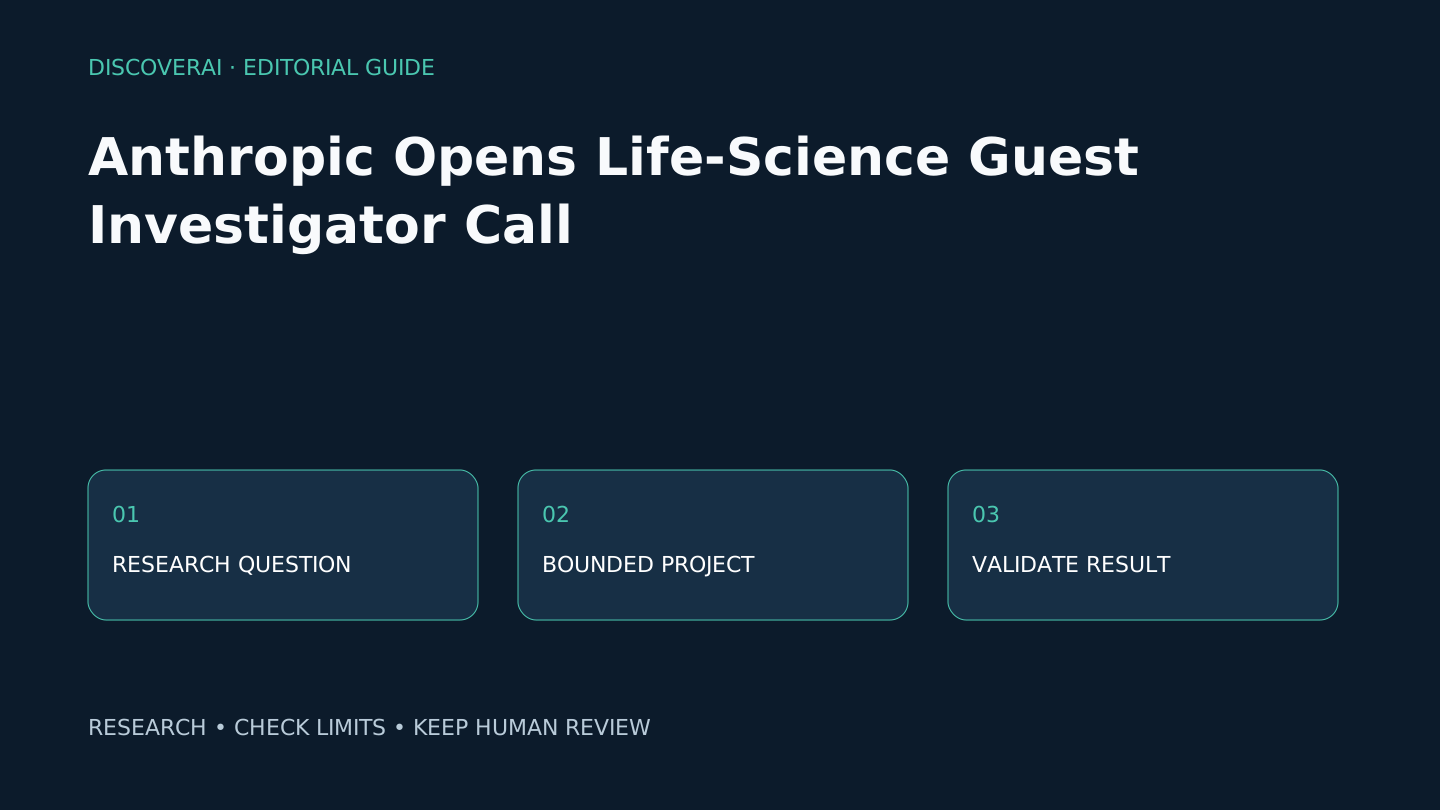
Our editorial assessment is that a short collaboration needs a bounded research artifact. “Accelerate drug discovery” is too broad to evaluate. A reproducible analysis, an openly usable dataset or a tool with a documented failure set gives collaborators a clearer target.
Before applying, a team could write a one-page project plan with its question, permitted inputs, baseline method and specific output. Name who will review the result and what evidence would count against the hypothesis. The plan should distinguish an interesting candidate from a validated finding.
Questions applicants should resolve
Ask how compute access, investigator time and publication review will work. Clarify dependencies, data permissions and the treatment of outputs that cannot be shared openly. Institutional approval should precede any transfer of restricted material. The public-only application request is a reason to describe the problem without attaching private datasets.
A practical milestone sequence might be: establish the baseline, reproduce it, compare the assisted workflow, then document limitations. This sequence is our suggested planning approach, not an announced program requirement.
Keep preliminary findings in context
An AI-produced analysis can be useful without proving a scientific claim. Independent replication and domain validation remain separate work. Readers should look for the eventual artifacts, evaluation methods and negative findings before drawing conclusions about scientific impact.
For a repeatable comparison process, see our enterprise search evaluation pack. Its domain differs, but the discipline of frozen inputs and explicit acceptance criteria transfers. This news article reports an application opportunity; it does not offer medical advice or claim a research outcome.
Transparency
How this guide was checked
Editorial accountability
Who checked this guide
- Evaluation type
- Research-based verification
- Last materially checked
- Evidence
- 1 listed sources
Hands-on testing is identified explicitly. Research-based coverage uses cited product documentation and other named sources; it does not imply every paid plan was used. Read the full methodology.
Editorial basis
What this guidance is based on
- Editorial basis
- Source-led analysis
- Primary references
- 1
- Products covered
- 0
- Last checked
- 2026-10-23
Important limits
- • Features, availability, and pricing can change after publication; confirm consequential details with the provider.
Sources and verification
Product details and claims were checked against the following primary sources.
Frequently asked questions
Is this an unrestricted free Claude plan?
No. The announcement describes a selected research collaboration, with Anthropic running models and harnesses.
Should applications include private datasets?
The announcement explicitly requests only publicly available information in application materials.
Read next